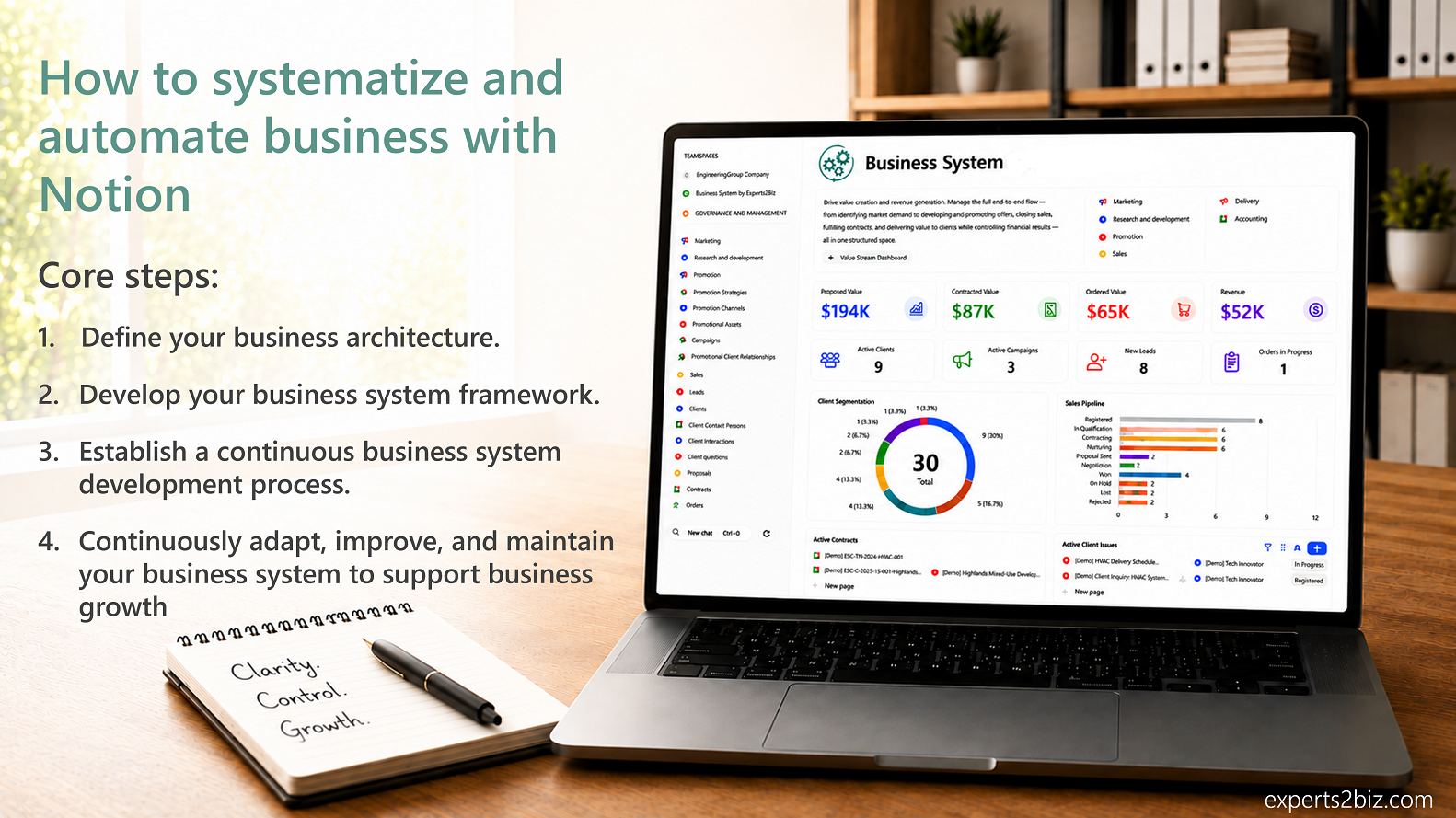
This article serves as an introduction to a step-by-step guide for systematizing and automating business using Notion. It focuses on creating a holistic approach to define, design, build, and manage an entire business system. This method addresses common challenges in business systematization, such as adapting to market changes and managing collaboration. It blends global standards with practical experience to help businesses systematize and automate effectively while maintaining flexibility. Whether for small startups or large companies, this guide offers actionable insights for building efficient, sustainable, scalable business systems.
Understanding the Challenge
The market currently offers a wide range of affordable No-Code/Low-Code platforms used to systematize and automate business. Among the most popular are Notion, Airtable, Coda, and ClickUp, and their number is growing, as is the number of businesses adopting them.
I believe that founders and business owners who seek to systematize and automate their business are experts in their field, aiming to make their operations more profitable, sustainable, and capitalized. However, they often lack deep experience with modern tools, which makes it natural for them to see potential risks and challenges in such projects.
In my opinion, the key issue with such projects is the lack of a proper approach from the start, including the chosen methodology, development strategy, and system architecture. These initial mistakes lead to ongoing problems, forced reworks, and disappointments throughout the entire development process and the system’s functionality. This, in turn, will reduce the potential benefits of using the system and increase costs, ultimately resulting in missed opportunities and lost profits. On the other hand, high expectations of No-Code/Low-Code products can also be problematic, as these tools cannot solve all automation challenges, such as creating rich and fully user-friendly interfaces, ensuring high performance and security, or providing sufficient data storage as the system scales, among others.
Years of designing such solutions have allowed me to develop a universal approach that enables project stakeholders to achieve quick results while building and evolving systems without stress or unnecessary complexity. This approach allows stakeholders to start using and benefiting from the system from the very first days of the project, all while continuing to develop it in parallel with their core business activities – the very reason the system is being created. Moreover, this approach helps avoid a wide range of risks that companies often face in such projects, including:
- Inability to quickly adapt the system to rapidly changing business conditions. These include market shifts, new competitors, regulatory changes, or growth opportunities such as expanding product lines, entering new markets, or geographical expansion. Quick and stress-free updates to existing processes and their supporting systems become essential, necessitating a built-in change management system from the start.
- Delays and extended project timelines. Critical questions take too long to discuss, and consensus on how to systematize is often reached only after several failures and reworks.
- Lack of employee experience in organizing collaborative work. For instance, an employee might think: “I’m a professional in my own work and have already systematized it (individually), but how can we organize the workflows of the entire company, considering different departments, roles, and a long-term growth strategy?” Additionally, does such a strategy even exist in a formal document, or is it just in the head of the company leader?
- Transferring offline chaos to online tools. Instead of creating a structured system, companies risk ending up with a jumble of IT services and scattered information, leading to low efficiency and poor usability and further aggravation of this chaos will only increasing costs.
That’s why I propose a simple, step-by-step, and effective method for systematization and automation. This approach enables to gain the correct perspective on business as a system, to gradually enhance and improve it without disrupting the company or incurring high costs. This method is based on the synthesis of global standards, such as ISO 9000 (Quality Management Systems), ISO 12500 (Project Management), PMI standards (Project Management Institute), IIBA standards (International Institute of Business Analysis), CMM/CMMI (Software Engineering Institute), and so on. At the same time, this method is as lightweight as possible, avoiding extensive, tedious analytical and diagnostic projects.
It’s also crucial to highlight that this method is suitable not only for building systems with No-Code/Low-Code platforms but also for traditional custom development or implementing other software solutions. Additionally, it works well for combining No-Code/Low-Code platforms with custom-built systems, particularly in cases where these platforms alone cannot fully solve your challenges but can still be valuable for tasks like preparation, requirements management, project oversight, or prototyping. In other words, the main idea is to leverage the maximum potential of No-Code/Low-Code platforms and then follow aligned with the business’s vision and long-term development strategy. If your strategic management processes are well-configured, it goes without saying that the strategy should also include a sub-strategy for building and evolving the business system.
I am confident that this approach can be applied to various types of activities and businesses of different sizes – from solopreneurs to portfolio companies managing multiple businesses, from startups aiming to properly organize their processes to increase their chances of success, to established companies seeking greater simplicity, sustainability, growth drivers, and cost reduction.
Business Case Example
Let’s assume we are dealing with a small company that provides design and installation services for engineering systems in various construction projects. Historically, the company was created and comfortably developed in a growing market with low competition, but recently it has faced increased competition in its location, forcing the company to improve its processes and expand its service portfolio. At the same time, the company’s founder sees potential and opportunities to expand the business geographically and would like to take advantage of this. Given the period of comfortable existence, the company lacks a holistic system of processes, and employees use various isolated software products for their needs. The founder understands that business activities need to be systematized and processes automated, as well as ensuring data integration from various systems or migrating data into one system where possible. According to the company’s founder, this will give the business competitive advantages, scalability, and provide sustainable long-term growth. But the founder doesn’t know where to start, has no idea who to work with, and lacks confidence that the solutions being proposed will deliver the desired results.
Goals
Therefore, the founder faces the following objectives:
- Unified System of Processes: To systematize the company’s business processes to create a comprehensive and holistic view of these processes, one that all employees can understand and accept.
- Collaborative Work: Enable users to operate within a unified collaborative system that lays the foundation for future automation.
- Engagement: Ensure employees are both engaged and motivated to improve processes and contribute to the development of the business system.
- Automation and Control: Automate collaborative processes to minimize routine tasks while maintaining control and access to process analytics.
- Systematization Strategy: Develop a clear understanding and vision for how to build and evolve the system in alignment with the business’s long-term goals and objectives.
Methodology
To reach this goals we have to start from four steps:
- Step 1: Define a high-level holistic and integrated model of processes for the entire business. This first step will include the initial systematization and task management automation based on a business process model using Notion. This is a very convenient approach that provides a significant boost right from the start, especially for those just beginning to systematize: now we view the business from the perspective of a lean and efficient process model, and we immediately start using elements of this model in our practical activities.
- Step 2: Design business system framework. Using Notion, develop a business system framework consisting of a goal structure, a list of indicators, a business process structure, a list of functions of IT systems and apps, and databases, all of which are logically connected. Creating this business system framework allows you to:
- Gain a comprehensive view of the business as a system and communicate it to stakeholders.
- Identify business bottlenecks and develop solutions to address them.
- Determine the metrics to measure processes and track the achievement of strategic goals.
- Assign responsibility for processes to specific roles or team members.
- Create a roadmap for strategy implementation and individual project roadmaps using the goal structure.
- Obtain baseline data for planning activities aimed at developing the business system: organizational changes, process optimization, and automation.
- Use the resulting framework as a foundation for building the business knowledge base.
- Step 3: Launch regular processes of ongoing business system development, maintenance, and improvement. At this step, we will focus on explaining the processes of developing and improving the business system. This is crucial because we cannot create a perfect system instantly. Initially, it might seem that achieving results requires implementing at least one or a series of projects. But the reality is much more complex…
- First, when you implement Step 2, you will be more likely to understand the scope of activities for building the business system because you will observe the current state of business systematization in relation to the desired outcome.
- Secondly, the external environment in which your business operates is constantly changing, which will continuously necessitate adjustments to the system to address external challenges. Therefore, you cannot simply stop and freeze the result once you think you’ve achieved the desired goals of building the business system.
- Thirdly, as your business system evolves, you and your team will discover new opportunities for business growth and generate fresh ideas for development, which will also trigger changes to the existing system
- Step 4: Continuous development, maintenance and improvement business system according to plans. In this step, I will demonstrate how to shift the focus from understanding the conditions necessary to launch regular activities for creating, developing, and improving a business system to actual practical activities, with examples of process systematization and automation.
Tools
The Notion platform will be used as the basic tool, while Make.com (formerly Integromat) will be used for advanced automation.
Why Notion?
Notion is a universal platform for organizing data, collaboration, managing tasks, calendars, projects, documents, and notes. It isn’t an ideal tool for the tasks described above. However, it is popular, affordable due to its low cost of ownership, and offers several useful features that we will utilize:
- The ability to structure Notion’s workspace to systematize information. In our case, we will create an information structure for the workspace based on the business process model.
- The ability to create database tables quickly, flexibly, and conveniently.
- The ability to create hierarchical data structures in database tables is a very powerful tool that we will actively use.
- The ability to link items between database tables using relationships.
- The ability to store data in database tables as documents with additional text and graphical information, such as diagrams and charts.
- The ability to create task lists to track the progress of projects, process operations, and individual assignments.
- The ability to use built-in automation functions to solve simple automation tasks.
- The ability to automate complex processes and integrate Notion’s workspace with other apps, systems, and databases using tools like Make (formerly Integromat), Zapier, and others.
It is also worth mentioning the disadvantages of Notion:
- As a No-Code platform, Notion provides a set of standard functions for working with content, which limits us in our quest to achieve the perfect solution for our case. For example, we cannot create process diagrams, complex business logic, advanced user interface, or sophisticated forms, which are often desired by demanding users.
- As a SaaS solution, Notion may conflict with the security policies of certain businesses.
- Notion databases fall under the NoSQL type, which imposes certain limitations in terms of functionality. Additionally, they have constraints on the number of records in database tables compared to databases built on industrial-grade DBMS platforms.
However, businesses with higher requirements can use the Notion platform:
- For systematization – to describe the system the company wants to build and implement.
- For prototyping – that is, creating prototypes of databases and applications to refine and thoroughly prepare requirements, which will later be implemented on more advanced and powerful platforms or through traditional software development methods.
That is why, in the following articles, we will try to get the most out of the Notion platform for our business case.
Leave a Reply