Tag: Business System

Deep dive into building and optimizing structured business systems that improve productivity and scalability

  • How to systemize and automate business with Notion. Step 4: Continuous development, maintenance and improvement business system according to plans

    How to systemize and automate business with Notion. Step 4: Continuous development, maintenance and improvement business system according to plans

    We have already completed the three main steps of systematization and achieved the following results:

    1. Built the process model of the entire business, which served as the foundation for structuring the Notion workspace. Based on this model, we organized the workspace accordingly and actively use process tags to systematize information in databases. In essence, the system architecture is based on the process model.
    2. Developed a set of services for creating the business system framework, which allows for a deeper understanding of the business as a holistic system and enables more accurate formulation of requirements for further systematization and automation.
    3. Examined in detail the life cycle process of systematization — including the processes of analyzing the current state of the business system and justifying the need for its development, developing the business system through projects, and supporting the current version of the business system.

    We now have a complete understanding and an initial set of tools, implemented directly in the Notion environment, that are necessary to plan and perform activities related to the development, support, and improvement of the business system. Planning should start at the strategic level, which must be represented by long-term business goals, and the systematization and automation goals should align with them.

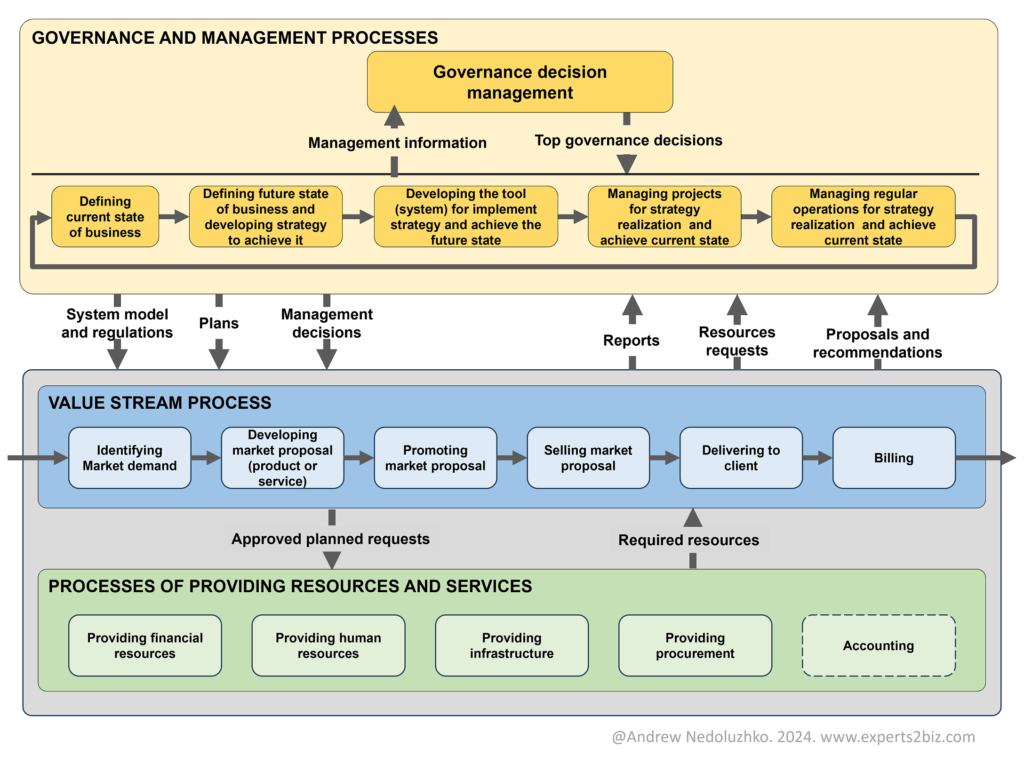
    But before moving on to defining goals, it is essential to clearly understand — and regularly monitor in the future — where the business currently stands. This is accomplished through the practice of business analysis, which is carried out in the process “Defining the Current State of the Business” in our holistic model (Figure 1)
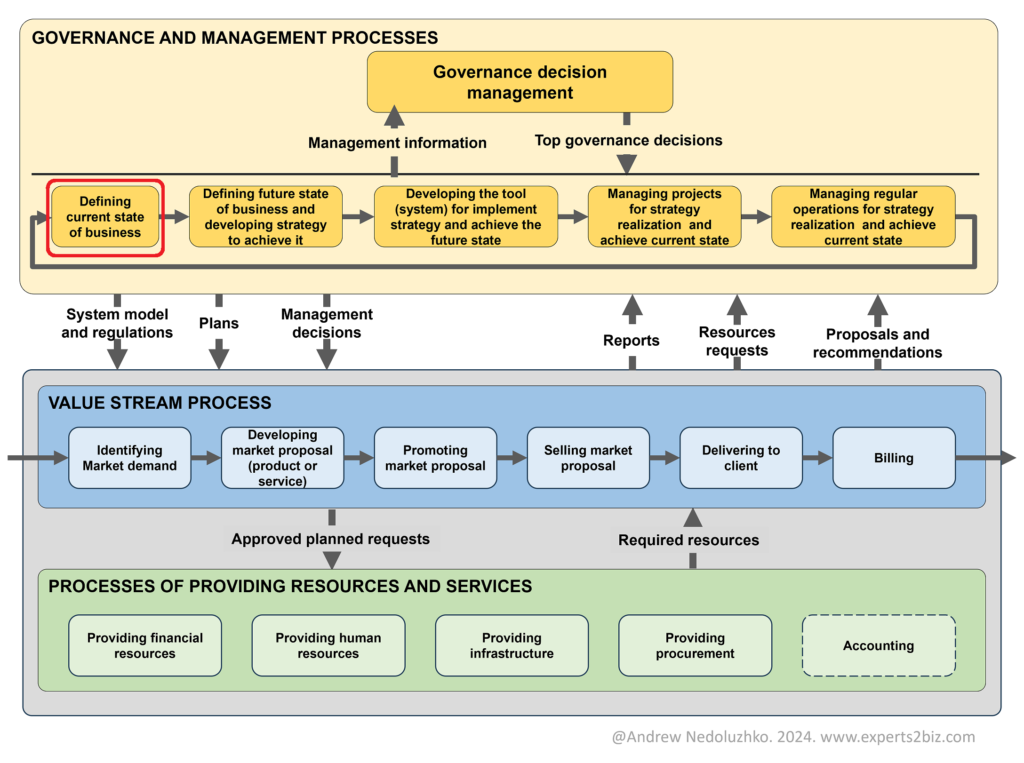
    It’s reasonable to ask why I didn’t start explaining the business systematization methodology with this process. The answer is simple: at the beginning of such projects, the business usually has only a vague understanding of the goals, tasks, value, and impact of business analysis. However, after completing the earlier stages, achieving practical results, and gaining a comprehensive view of the business, the importance of this process becomes clear. At this point, developing business analysis expertise within the company also becomes justified.

    The result of the business analysis process — which serves as an input for defining the future state of the business — is the “Current Business State Assessment” document. In general, it includes the following components:

    1. Internal and external environment analysis
    2. SWOT analysis
    3. Stakeholder analysis
    4. Gap analysis
    5. Business requirements definition

    The “Current Business State Assessment” document is the key input for initiating the definition of the Vision, Strategy, and Long-Term Strategic Goals in the process “Defining the future state of the business and developing the strategy to achieve it.”

    Typically, strategic business goals include objectives such as increasing market share, improving financial performance, and enhancing the company’s market value. Goals related to the development of the business system are an essential part of long-term business goals, as they create the necessary conditions for achieving them (Figure 2).
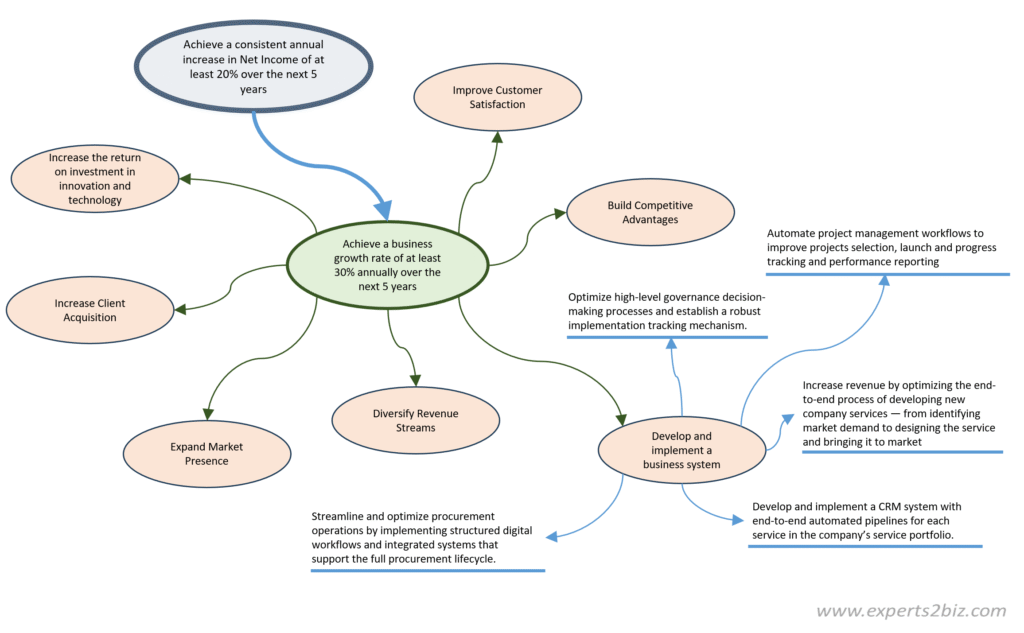
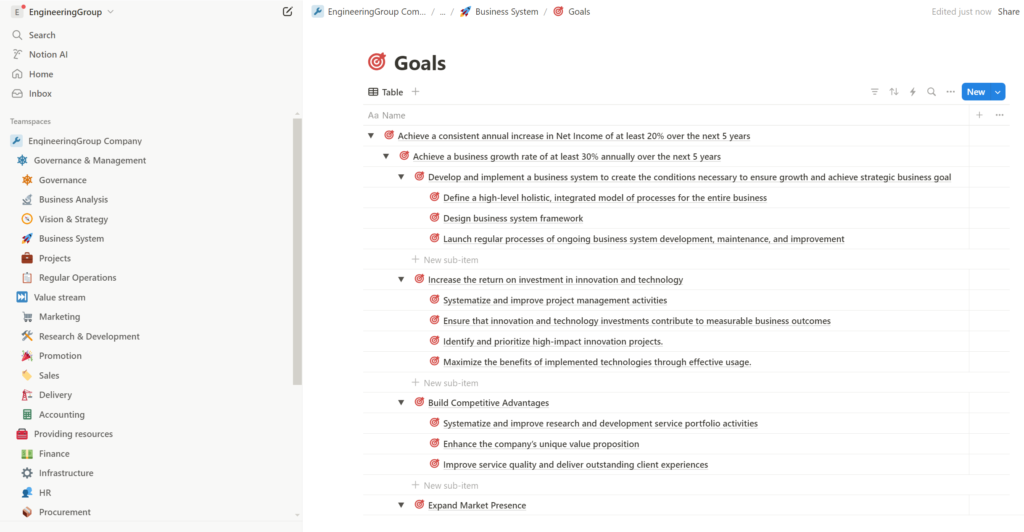
    During the previous work, an initial draft structure of strategic goals was defined in the Goals database table (Figure 3), along with the initial goal for the development of the business system: “Develop and implement a business system to create the conditions necessary to ensure growth and achieve strategic business goals”.
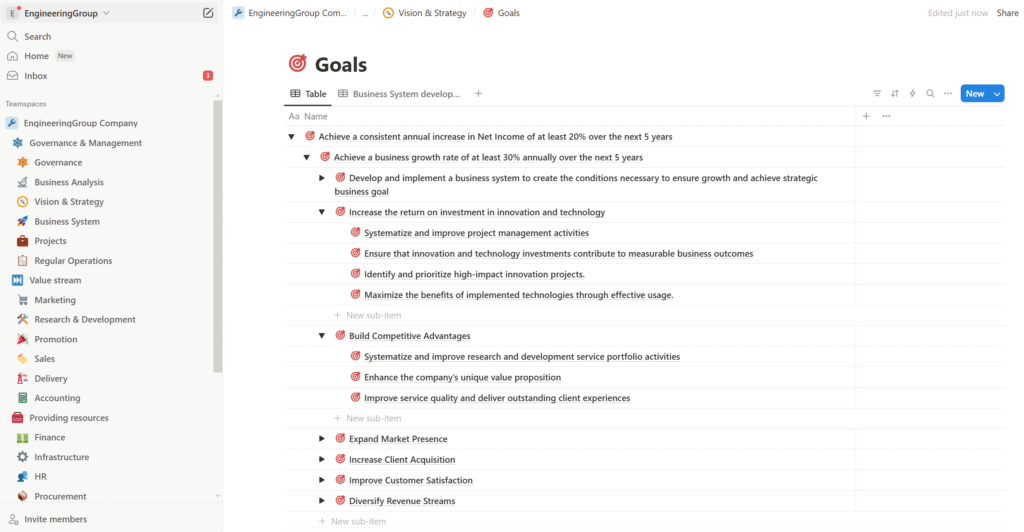
    This goal will be broken down into sub-goals, which we will present in the form of a strategic goal map. The elements of this strategic map will then be transformed into initial Innovative Proposals for developing the business system, triggering the business system life cycle processes described in the previous article. In this way, we move from understanding systematization processes to launching actual systematization and automation activities. Thanks to No-Code tools, systematization seamlessly and naturally flows into automation, and both can be carried out by the same team.
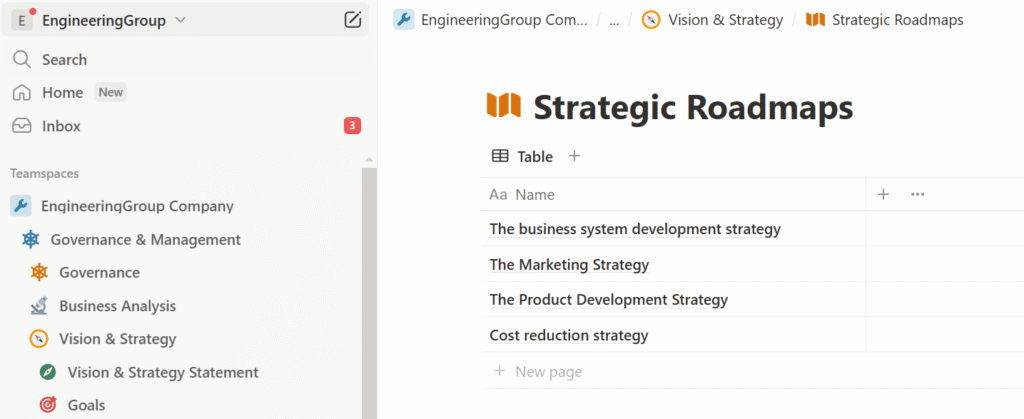
    To represent goals as strategic maps, create a “Roadmaps” database table in the Vision & Strategy section, where we have already set up linked views of the Goals and Indicators tables, as well as a section for drafting the overall vision, mission, and strategy statements. Then we can create a Relation property in the Goals table to link it with the “Roadmaps” table and create different views of roadmaps, as shown in the Figure 5
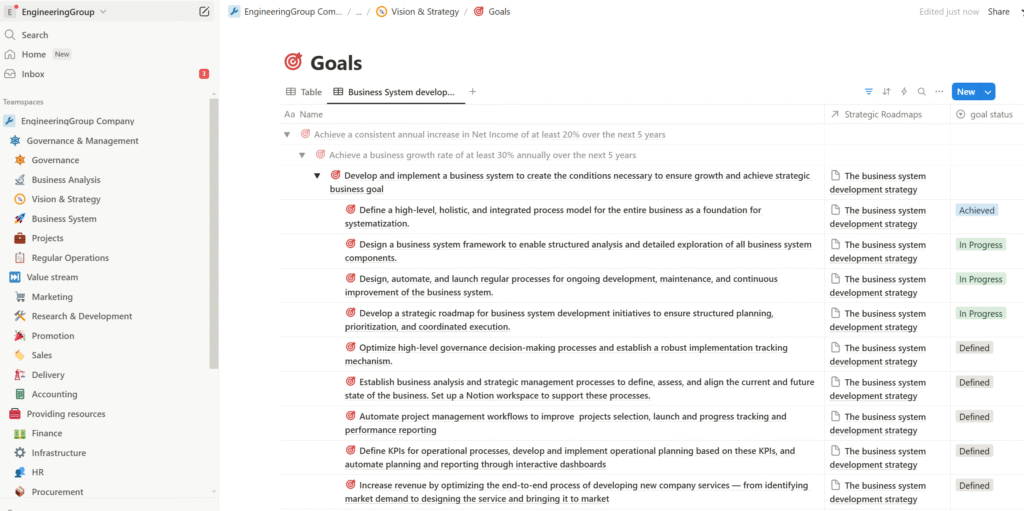
    Formalizing Business System Development Goals

    A great aid in setting the initial business system development goals is the use of the same business process model. We go through the top-level processes sequentially, identifying and formulating the most obvious and urgent goals for business system development — that is, for systematization and automation. Less obvious goals will become visible during further iterations of business system development. I usually recommend starting from the top of this diagram and moving downward — beginning with the ‘Governance and Management Processes’, followed by the ‘Value Stream Processes’, and finally the ‘Processes of Providing Resources and Services’. I will selectively provide examples of business system development goals and some of their characteristics:

    GOVERNANCE AND MANAGEMENT PROCESS CATEGORY

    Process: Governance Decision Management:

    • Goal: Optimize high-level governance decision-making processes and establish a robust implementation tracking mechanism.
      • Expected Result: Clear decision pipeline with tracking for implementation.
      • Time Frame: 3–5 weeks.
      • Metrics & Milestones:
        • Weekly decision review cycle in place.
        • Implementation status dashboard live.
      • Owner: CEO / Executive Assistant.

    Processes: Defining the current state of the business; Defining the future state of the business and developing the strategy to achieve it

    • Goal: Establish business analysis and strategic management processes to define, assess, and align the current and future state of the business. Set up a Notion workspace to support these processes and build supporting workflow automation.
      • Expected Result: Regular BA cycles (quarterly reviews), strategy updates, and Notion workspace setup.
      • Time Frame: 4–6 weeks.
      • Metrics & Milestones:
        • Strategic review page live in Notion.
        • SWOT and Current/Future state documented.
      • Owner: CEO / Strategic Planning Lead.

    VALUE STREAM PROCESS CATEGORY

    Processes: Identifying Market Demand, Developing Market Proposal for new or updated service, Promoting Market Proposal

    • Goal: Increase revenue by optimizing the end-to-end process of developing new company services — from identifying market demand to designing the service and bringing it to market
      • Expected Result: Clear innovation pipeline, tracked in Notion from idea to market.
      • Time Frame: 6–8 weeks.
      • Metrics & Milestones:
        • Time to market reduced by 25%.
        • Service development cycle documented.
      • Owner: CMO / CTO

    Processes: Selling Market Proposal

    • Goal: Develop and implement a CRM system with end-to-end automated pipelines for each service in the company’s service portfolio.
      • Expected Result: Notion-based CRM with workflows per service type.
      • Time Frame: 4–6 weeks.
      • Metrics & Milestones:
        • Pipelines running for 100% of services.
        • Conversion tracking enabled.
      • Owner: CMO

    Process: Delivering To Client

    • Goal: Optimize and automate the order fulfillment process to improve customer satisfaction, accelerate delivery cycles, and enhance cash flow.
      • Expected Results:
        • Faster, more accurate order processing and delivery.
        • Fewer fulfillment-related errors or delays.
        • Improved customer satisfaction (e.g., feedback, repeat purchases).
        • Accelerated conversion of orders into revenue (faster cash inflow).
      • Time Frame:
        • 4–6 weeks for workflow analysis, design, and first automation cycle.
      • Metrics & Milestones:
        • Average order fulfillment time reduced by 30%.
        • Error rate in order processing reduced to <2%.
        • Customer satisfaction scores increased by 15%.
        • Automated fulfillment tracking dashboard implemented.
      • Owner:
        • COO / Engineering Delivery Manager

    Process: Billing and Accounting

    • Goal: Integrate the accounting system with the Notion workspace to ensure automatic data exchange, timely financial settlements, and improved financial oversight.
    • Expected Results:
      • Seamless synchronization of key financial data (e.g., invoices, payments, expenses)
      • Reduced manual data entry and reconciliation errors
      • Faster and more accurate financial reporting
      • Timely client invoicing and payment tracking directly from Notion workflows
    • Time Frame:
      • 4–6 weeks for integration setup, testing, and rollout
    • Metrics & Milestones:
      • 100% of invoices automatically synced between Notion and accounting system
      • Manual input workload reduced by at least 70%
      • Financial settlements completed within standard terms >95% of the time
      • First automated monthly financial report generated from integrated data
    • Owner:
      • CFO / Accounting Manager

    PROVIDING RESOURCES AND SERVICES PROCESS CATEGORY

    Process: Providing Financial Resources

    • Goal: Implement financial supporting system (e.g., dashboards and automation tools) to enable seamless financial planning, monitoring, and reporting.
      • Expected Result: Budgeting, funding tracking, and financial dashboards in place.
      • Time Frame: 5–7 weeks.
      • Metrics & Milestones:
        • 100% projects tracked by budget vs. actual.
        • Monthly reporting cycle automated.
      • Owner: CFO / Financial Manager

    Process: Providing Human Resources

    • Goal: Optimize and automate the human resource management process to support hiring pipelines, onboarding programs, performance reviews, and full employee lifecycle management.
      • Expected Result: Automated hiring, onboarding, review, and offboarding flows in Notion.
      • Time Frame: 6–8 weeks.
      • Metrics & Milestones:
        • Time to hire reduced by 30%.
        • 100% employees tracked with review status.
      • Owner: COO / HR Manager

    Process: Providing Infrastructure

    • Goal: Reduce costs and increase utilization efficiency through the implementation of structured and streamlined workflows, along with supporting systems to manage infrastructure assessments, timely development cycles, incident handling, and usage monitoring.
      • Expected Result: Monitoring system for infrastructure with incident logs and optimization reports.
      • Time Frame: 4–6 weeks.
      • Metrics & Milestones:
        • Downtime < 1%.
        • Issue response time reduced by 50%.
      • Owner: CTO / Infrastructure Manager

    Process: Providing Procurement Resources and Services.

    • Goal: Streamline and optimize procurement operations by implementing structured digital workflows and integrated systems that support the full procurement lifecycle.
      • Expected Result: Procurement process database with workflows and automation.
      • Time Frame: 3–5 weeks.
      • Metrics & Milestones:
        • Requisition-to-approval cycle reduced.
        • Vendor data maintained with 100% accuracy.
      • Owner: COO / Procurement Manager

    Next, based on the goals, innovative proposals are formed and the processes described in the previous article are launched. As a result, we get the following end-to-end management workflow: Current Business State Assessment—> Vision and Strategy Statement —> Business Strategic Goals (Strategic Plans)—> Business System Development Roadmap —> Business System Development Innovative Proposals —>Business System Development Feasibility Reports —> Business System Development Projects (Project plans and Tasks) —>Current Version of the Business System Under Maintenance (Operational Plans based on KPI’s and Tasks)
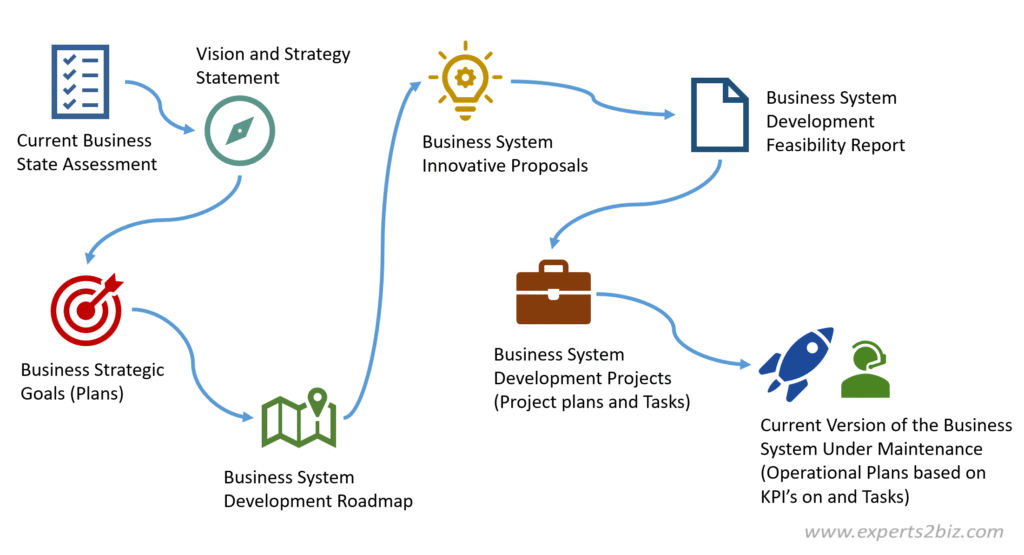
    The gradual launch and regular execution of this workflow ensures that the business reaches a new level and achieves sustainable development in line with the approved goals.

    Benefits of Work Done

    Strategic Alignment and Shared Vision

    A comprehensive view of management processes and their role in the development of the business system ensures maximum management efficiency, transparency, and traceability in decision-making and business system development. This approach to organizing management processes provides full control over the implementation of projects aimed at achieving strategic goals and maintaining long-term focus. As a result, we achieve significant time savings for the key people in the business — and their time is expensive!

    Standardization and Template-Based Implementation

    We can apply a similar approach and its implementation to marketing, product and service development, and resource provision processes — that is, an end-to-end process from current state analysis and goal setting, through projects, to regular operations. As a result, we achieve significant cost savings through standardization and template-based implementation.

    Automation

    Now we can gradually automate the processes — first as standalone procedures, and then, where possible, integrate them into end-to-end workflows. This leads to increased productivity, faster execution, and, consequently, improved business profitability

    Using AI

    The step-by-step creation of database tables in Notion that we carried out at each stage of systematization, along with the use of Relation columns to link the tables together, ensures proper structuring of information and data. This, in turn, enables the most efficient and accurate use of AI for automating even complex analytical tasks.

    Improving High-Level Planning and Prioritization

    Agility – we can proactively make changes to the roadmap by adjusting the sequence of goal achievement in case circumstances change or new opportunities arise.

    Having a roadmap allows for calm and unhurried planning of business transformation projects, enabling timely reservation of necessary resources, adjustment of timelines, and thus optimizing and making the most rational use of available resources.

    Stronger Management Control and Focus

    • Gives managers a structured reference point to track progress and maintain focus over time;
    • Prevents loss of direction during daily operations or when priorities shift;
    • Enables regular strategic reviews and informed adjustments.

    Overall Summary and Conclusions

    The comprehensive view

    We have completed all four steps to systematize business to gain fully understanding the approach of systematizing business, prepare and provide readiness for further automation. Having a comprehensive understanding of the methodology implemented as a set of management processes allows for confident, stress-free, and timely progress toward the development and implementation of the business system.

    Establishing Control

    My systematization approach starts by uncovering and structuring the core management processes—their sequence, logic, and interdependencies. These foundational processes must come first in building a business system. If they are not properly designed and functioning, the rest of the processes cannot be effectively launched or operated. Inefficient management processes inevitably lead to inefficiencies across the entire organization. By focusing initially on these key processes and activating their operational mechanisms, we establish real control and oversight over all other business functions. This creates a truly effective, integrated, and sustainable business system.

    Services that support management processes

    While studying the proposed approach, we created a set of Notion database tables to support effective work on defining the current state of the business, envisioning its future state, formulating long-term strategy, working with goals and roadmaps, analyzing, developing, and maintaining the business system, and managing projects and operations. Many of these services will be used not only for the business system lifecycle but also across all business processes, including marketing, R&D, promotion, sales and service delivery, accounting, and providing resources. These database tables will also support further automation and the application of AI to elevate business productivity to the next level.

    Readiness for Launch

    The results obtained make it possible to develop a roadmap for business system development, define and sequentially launch the necessary projects, and maintain full control over their execution, scope, and allocated resources — while flexibly making adjustments and changes in response to shifts in both the external and internal environment. And we are now ready to consider implementing some workflow automation.

    Progress Review: Achieving the Business Systematization Goals

    Let’s review which of the goals, outlined in the business case from the first article, have already been achieved:

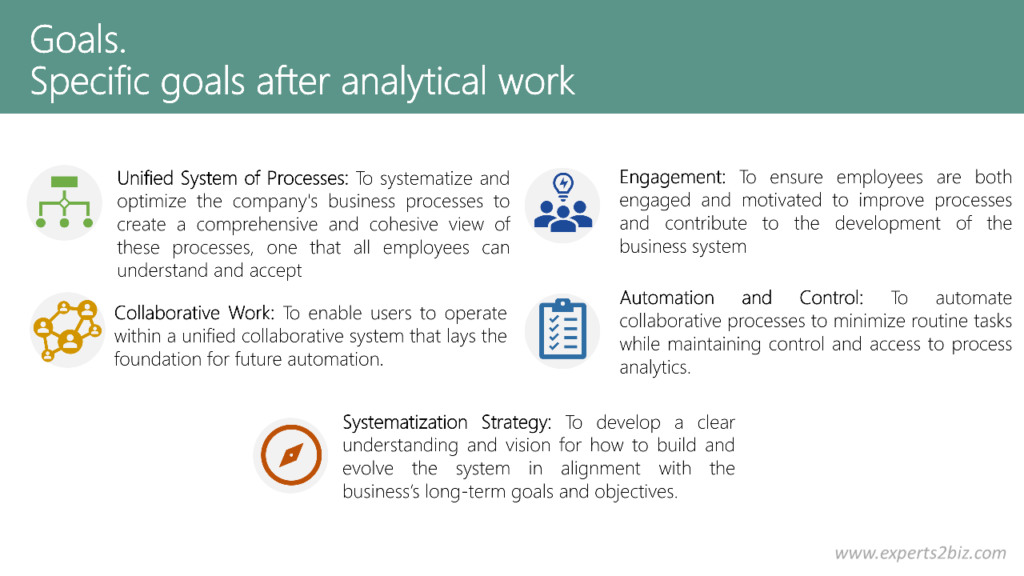
    1. Unified System of Processes: To systematize the company’s business processes to create a comprehensive and holistic view of these processes, one that all employees can understand and accept.
      Status – ✅ Achieved: We developed a holistic and integrated process model of the entire business and created the Notion database table ‘Processes’, filling it with the actual process structure
    2. Collaborative Work: Enable users to operate within a unified collaborative system that lays the foundation for future automation.
      Status – ✅ Achieved: We chose and started using the Notion platform for collaborative work and as a foundation for future automation.
    3. Engagement: Ensure employees are both engaged and motivated to improve processes and contribute to the development of the business system.
      Status – ✅ Achieved: We have already started engaging people in systematization on three levels:
      • First level: The company workspace structure reflects the process model of the entire business, helping to organize information properly and avoid chaos.
      • Second level: Process tags are used across various database tables to structure goals, projects, tasks, feasibility studies, resource procurement, and more.
      • Third level: The ‘Innovative Proposals’ database table provides an opportunity for employees to propose ideas for improving the business system and other aspects of the company.
    4. Automation and Control: Automate collaborative processes to minimize routine tasks while maintaining control and access to process analytics.
      Status – ⏳ In Progress: We have completed the preparatory work for process automation and are ready to begin the sequential automation of the most important and critical workflows. The most interesting automation cases will be explored in the upcoming articles
    5. Systematization Strategy: Develop a clear understanding and vision for how to build and evolve the system in alignment with the business’s long-term goals and objectives.
      Status – ✅ Achieved. We created the Goals and Roadmaps databases and defined key automation and systematization goals aligned with our long-term strategy to drive the business forward.

    We have successfully completed 4 out of the 5 goals defined in our business case. The remaining goal—automation and control—is actively in progress. Key steps and practical examples for achieving it will be explored in the next articles.

  • How to systematize and automate business with Notion. Step 3: Launch regular processes of ongoing business system development, maintenance and improvement

    How to systematize and automate business with Notion. Step 3: Launch regular processes of ongoing business system development, maintenance and improvement

    At this step, we will focus on explaining the mechanisms of the processes for building, developing, improving, and maintaining the business system.

    Implementing such a process mechanism addresses the core challenge of business systematization: before systematizing the business itself, it is necessary to first build and launch the systematization processes to reduce potential risks and achieve greater impact. It’s also impossible to create a perfect business system instantly. We can’t create it within a single project or even a series of projects. Because there are three main factors affected there:

    • The first factor is accepting reality — a realistic understanding of the current state of business systematization in relation to the desired outcome. That is, if you’ve attempted to complete Step 2, which is to develop a business system framework, you’ve probably already realized that even properly formalizing the structure of goals and processes is quite challenging. You’ll likely need to revisit, review, and adjust what has already been done from time to time. And sometimes, you may even need to pause the work to gather more information — for example, actual performance data to refine the goals, or feedback from process participants regarding how those processes are carried out.
    • The second factor is the external environment — everything happening around your business. Market changes, innovations, new methods, products and technologies, emerging markets, regulatory changes, and the appearance of new competitors will all require you to review and adjust your products, services, processes, goals, and strategies for achieving them. Accordingly, from time to time, it is necessary to make changes to the existing business system to ensure that the entire business aligns with market realities and remains profitable and competitive.
    • The third factor is the human factor. First, people within the business need to mature in order to embrace a systematic approach — and not everyone can do this quickly. It often takes several cycles or iterations before they begin to view the business as a system, think systematically, make decisions systematically, and act accordingly. Even more importantly, as new elements and functions of the business system are implemented, those involved in the business will begin to discover new opportunities for growth and generate fresh ideas for development. This will also lead to changes in the existing system, prompting further improvement and evolving of the business system.

    In other words, a recurring, cyclical (iterative) approach will be more effective than scattered, impulsive projects. Of course, there are businesses with extremely simple business models and technologies, or those operating in stable markets — and even there, such a cyclical approach can still be effective; the cycles of change and development in the business system will simply occur less frequently and at a smaller scale. However, for dynamic, growing businesses or those operating in highly competitive markets, one must be prepared for a large number of repeated business system development projects before reaching any level of stabilization.

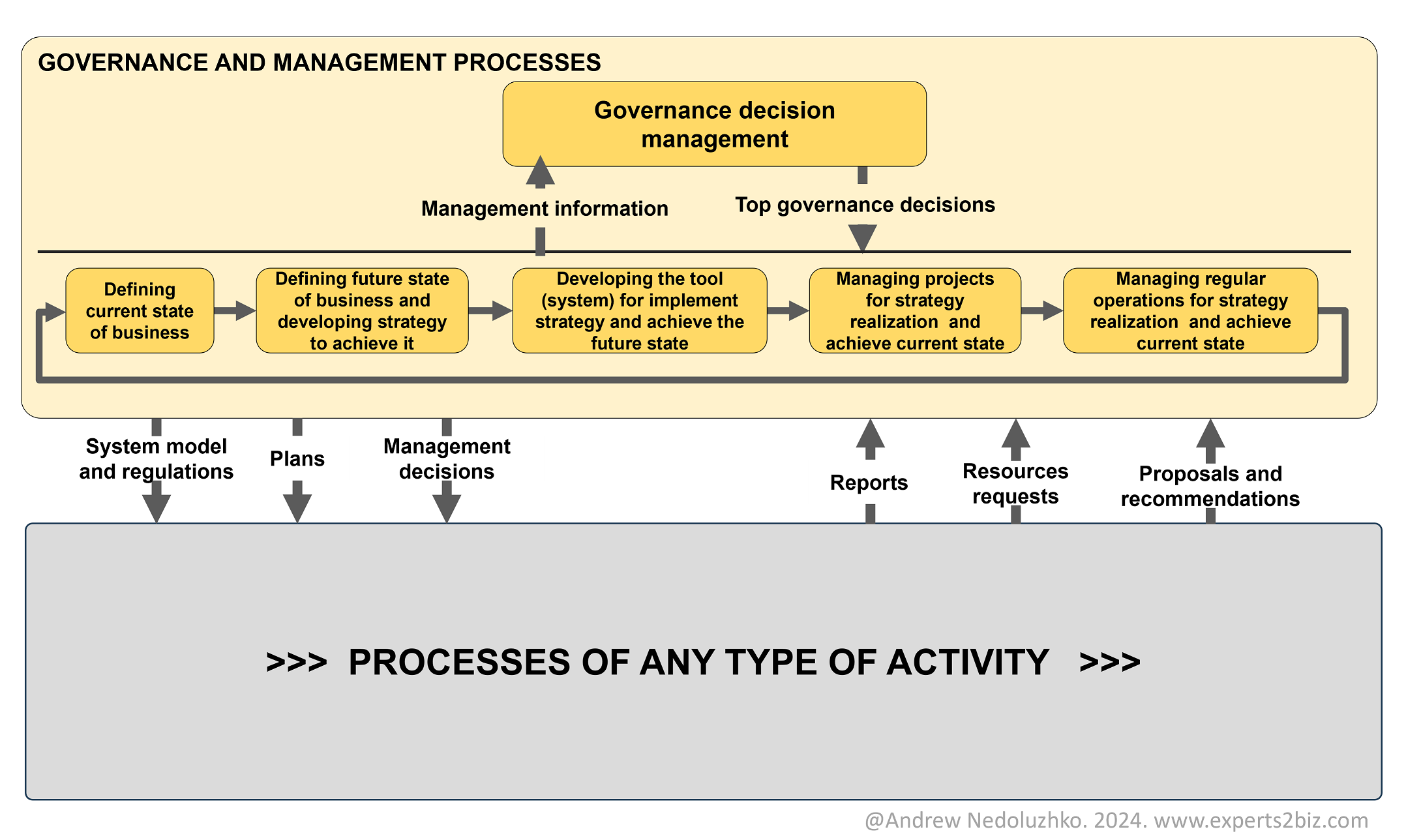
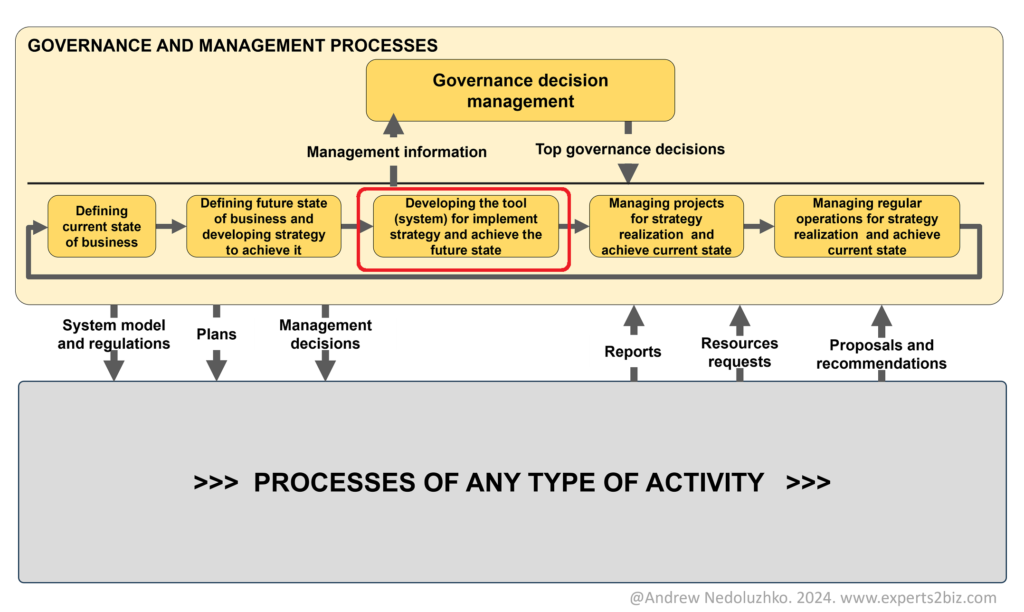
    Before we move on to designing this process and developing services in Notion to support and automate it, we need to pause and consider the context of the process — that is, to understand its inputs and outputs. In the article where I discussed the development of a high-level process model of the entire business, I presented the following conceptual diagram:

    In this diagram, the process “Developing the tool (business system) for implementing strategy and achieving the future state” represents the business system lifecycle process — or, for short, the Systematization Process.

    This diagram implies that the main input for the business systematization process is the outcome of the strategic management process: “Defining the current state of the business and developing the future state of the business.” These outcomes can be presented as innovative proposals for the development of the business system. In addition, such proposals can be created by managers or owners of various processes. Innovative proposals may also be formed within the systematization process itself, during the execution of operations supporting the current version of the business system. An innovative proposal is essentially an idea aimed at improving existing business processes. Small companies and solopreneurs may use the term ‘ideas’ for simplicity and convenience, while still understanding the purpose of these ideas.

    The output of the process is the business system framework in the form of Notion databases containing elements of the business system, the development of which was presented in the previous article, along with supporting documentation in the form of various regulations, procedures, or instructions. This documentation elaborates on the framework and can be stored directly in the corresponding database records. For example, we can store instructions in the description of a particular process, or a brief draft of a roadmap in the record of a specific goal, and so on. The structure and documentation of the business system are also used to ensure the correct execution and automation of all business and control processes—so we can make sure that all our processes are properly configured and functioning, and that any nonconformities identified are either resolved immediately or formalized as innovative proposals to be implemented in future iterations of business system development.

    The Business Systematization Life Cycle Process

    Now let’s examine the internal structure of the process “Developing the tool (business system) for implementing strategy and achieving the future state.” When we look at this process as the life cycle of a business system, we can distinguish four categories of activities or tasks that must be performed to achieve optimal results. This approach allows for a more structured and effective design of the business process. These categories include:

    • Analytical tasks. These are discrete tasks that need to be performed periodically to assess whether the current state of the business system meets present needs. If it does not, we must prepare and approve a rationale for initiating changes, which serves as the basis for launching a change project and reserving and allocating the necessary resources for its implementation.
    • Project tasks. Once a project is initiated, we must clarify the requirements, carry out the design of the changes, implement those changes, and finally integrate them into the business operations.
    • Regular operations. This involves maintaining the current state of the system, which includes identifying and resolving nonconformities and deviations, making minor updates to the framework and documentation of the business system, or preparing innovative proposals for further development.
    • Management tasks. We must manage each type of activity (analytical, project-based, operational), meaning we need to plan, monitor execution, measure, and analyze the outcomes.

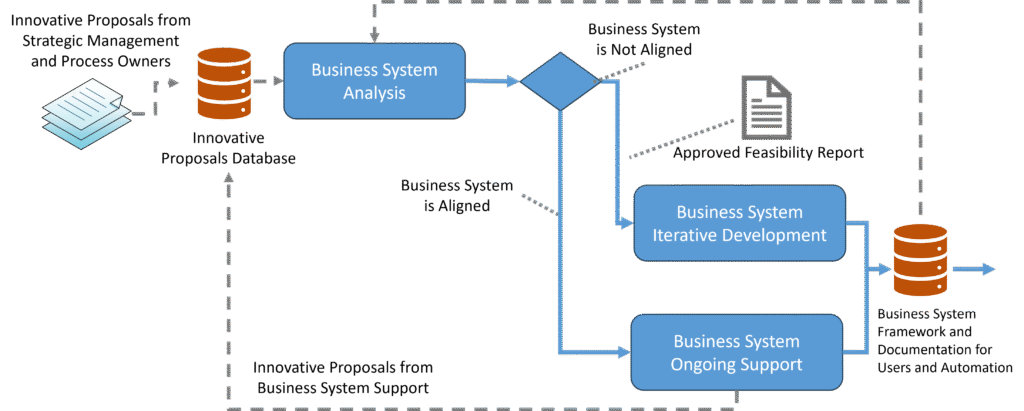
    Accordingly, we arrive at the following model of the business systematization lifecycle process.

    This process includes three sub processes: Analysis, Development, and Support of the Business System. The words ‘Iterative’ and ‘Ongoing’ are not necessary – I added them to emphasize this aspect. Now, let’s take a closer look at each of them.

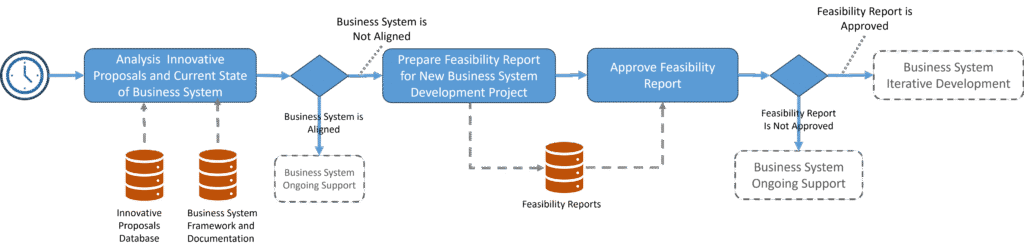
    The Business System Analysis Subprocess

    This process have the next logic:

    1. Innovative proposals are collected in a database table and, at a set interval—monthly, quarterly, or semi-annually—these proposals are reviewed. It is possible that there are no proposals at all, or too few and too minor to justify a system-development project. In that case, we simply continue supporting the current version of the business system.
    2. If, however, there are enough innovative proposals, the next step is to prepare a Feasibility Report to justify launching a new business-system development project. Once the report is drafted, it goes through an approval process:
      • If the Feasibility Report is approved, the business-system development project is initiated.
      • If the Feasibility Report is not approved, we continue to support the existing system until the next scheduled review of innovative proposals against the current state of the business system.

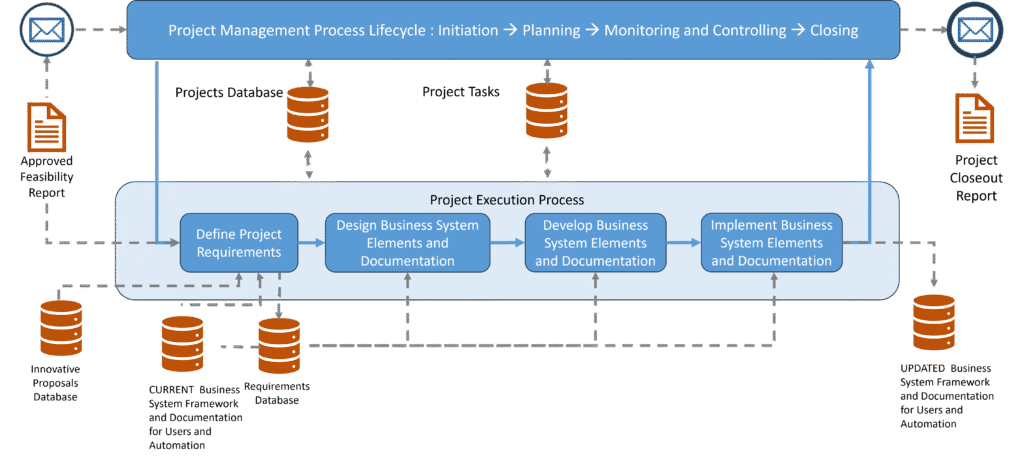
    The Business System Development Subprocess

    The logic of this process is as follows. It consists of two subprocesses:

    1. Project Management Process, which includes the classic project management processes: Initiation, Planning, Monitoring and Control, and Project Closure.
    2. Project Execution Process: which involves the sequential steps of Defining Requirements, Designing Business System Elements and the structure of necessary documents, Developing Business System Elements and documents, and Implementation.

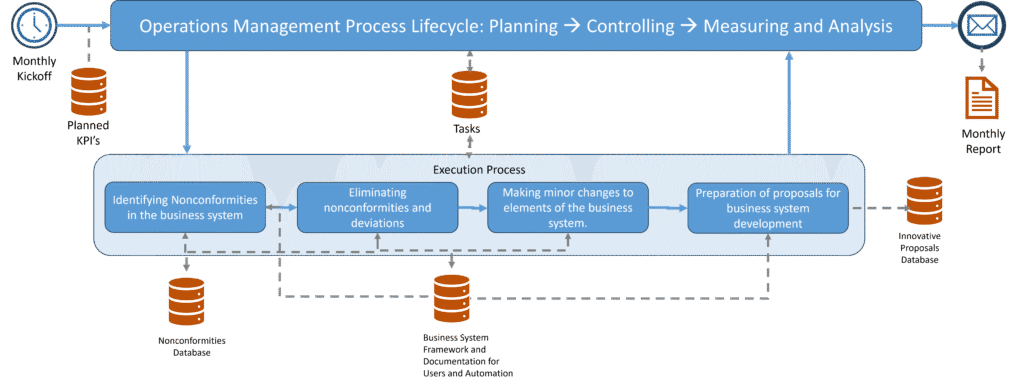
    The Business System Support Subprocess

    As in the previous case, the word ‘Ongoing’ is not necessary. I added it to emphasize this aspect as well.

    The Business System Support process also consists of two sub processes:

    1. Support Operations Management Process, which includes Planning, Control, Measurement, and Analysis.
    2. Support Operations Execution Process, which includes the following execution steps:
      1. Identifying Nonconformities and Deviations in the Business System,
      2. Eliminating Nonconformities and Deviations in the Business System,
      3. Making Minor Changes to Business System Elements and Documentation,
      4. Preparing Proposals for the Development of the Business System.

    It is important to understand that at the start of the systematization activities, innovative proposals will mainly be formed based on strategic goals, which will indicate which projects we need to implement in order to achieve the desired business system. The frequency of such projects will be high at first; then, a stabilization period will follow, during which the frequency of such projects will decrease, and innovative proposals will mainly be generated by process owners or managers, as well as by the business system support process.

    Realization in Notion.

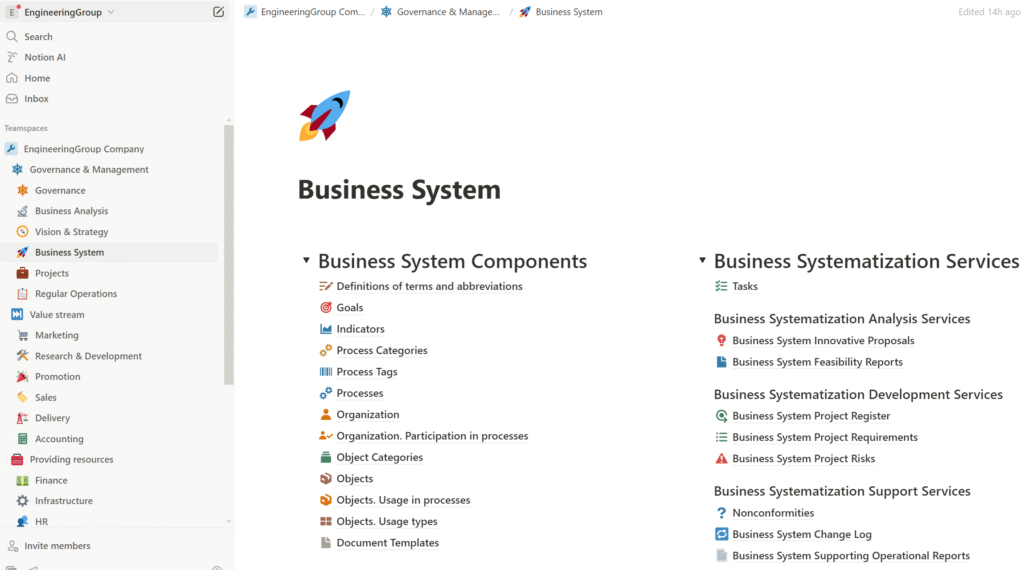
    The systematization life cycle diagrams clearly show which Notion database tables must be created next to launch the building, improvement, and support of the business system.

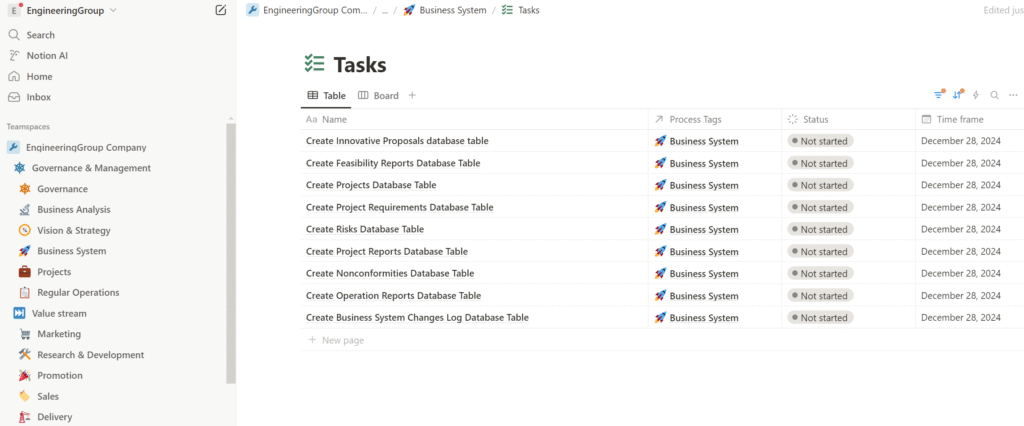
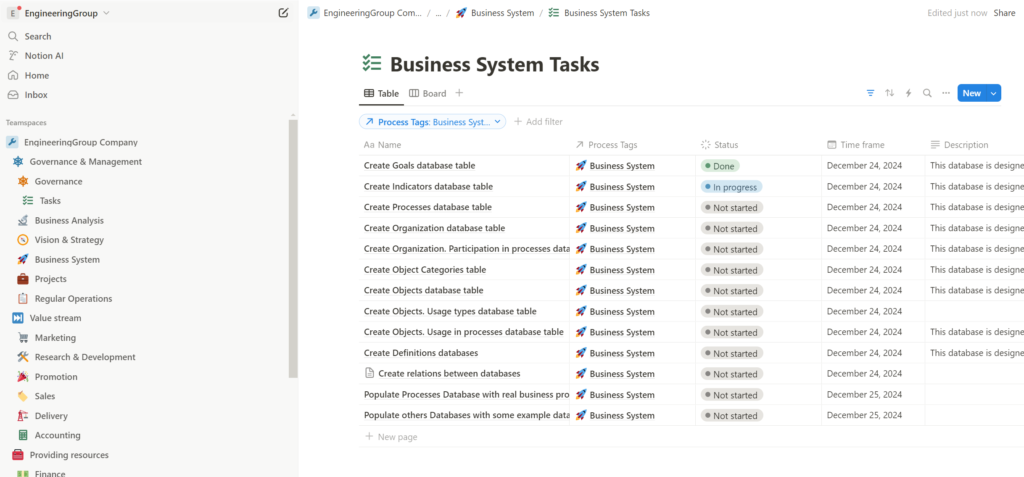
    So, we should add next portion of tasks in the Tasks database table with “Business System” tag and start executing them:

    1. Create Innovative Proposals database table;
    2. Create Feasibility Reports database table;
    3. Create Projects database table;
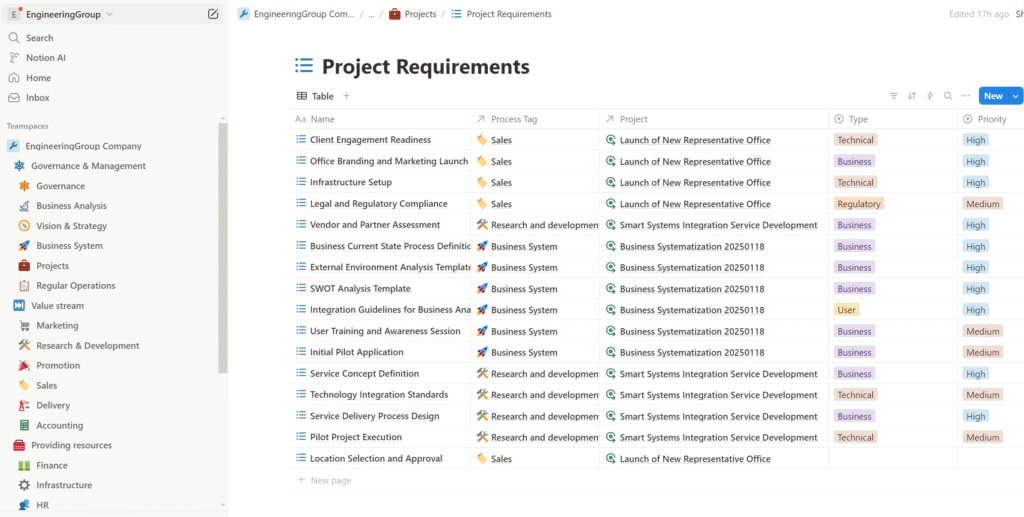
    4. Create Project Requirements database table
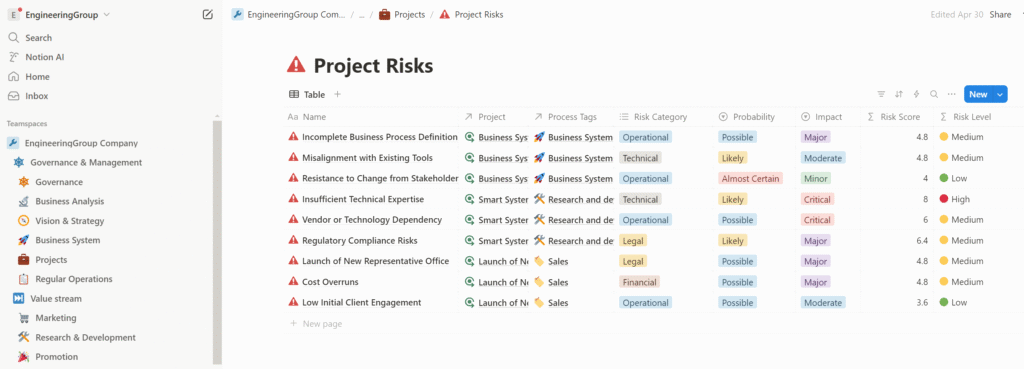
    5. Create Project Risks database table
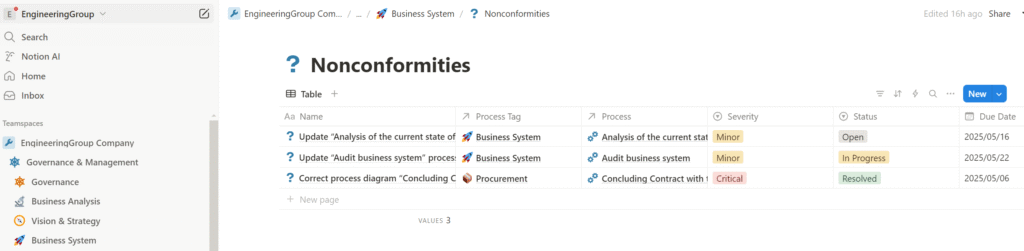
    6. Create Nonconformities database table
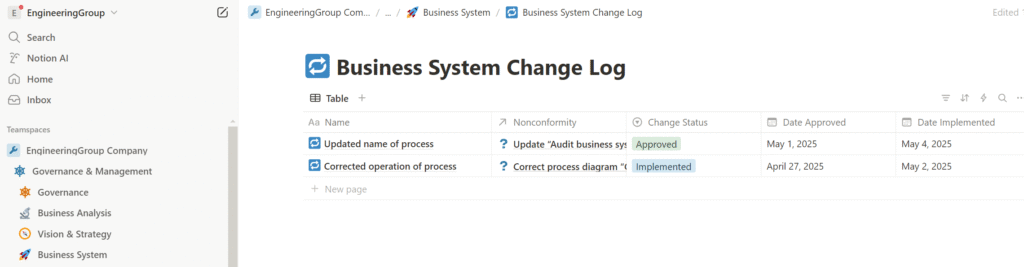
    7. Create Business System Changes Log database table
    8. Create Project Reports database table – optional table of project information to track project’s progress.
    9. Create Operation Reports database table – optional table to prepare and tracking operational reports.

    Benefits of Work Done

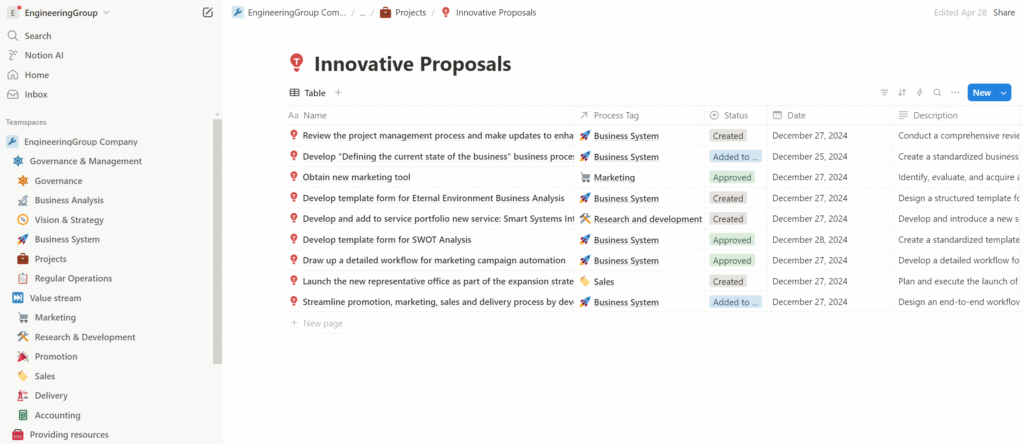
    Innovative Proposals Notion Database Table

    The ‘Innovative Proposals’ table is used to collect proposals on how to improve the existing business. Thanks to Process Tags, the ‘Innovative Proposals’ database becomes a universal tool that can be applied not only to systematization but to any aspect of the business — including new products, marketing tools, promotional campaigns, sales activities, and more.

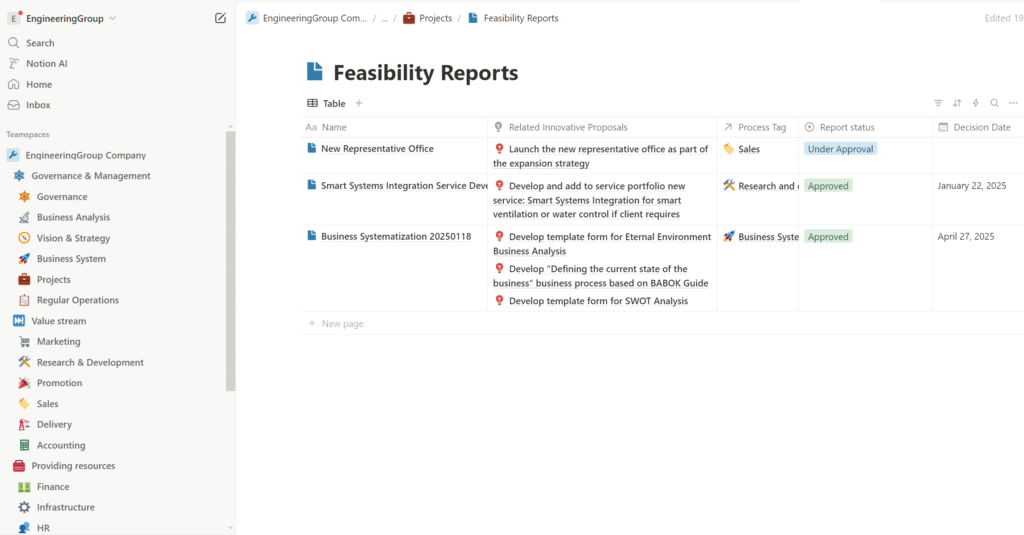
    Feasibility Report Notion Database Table

    The ‘Feasibility Reports’ table is used to group proposals and justify the feasibility of their implementation through development projects. It is linked to the ‘Process Tags’ table to identify the area of the future project, and to the ‘Goals’ table to clarify which previously established goals the project’s implementation is intended to support. Like the Innovative Proposals table, the Feasibility Reports table applies not only to the systematization of activities but also to the business as a whole.

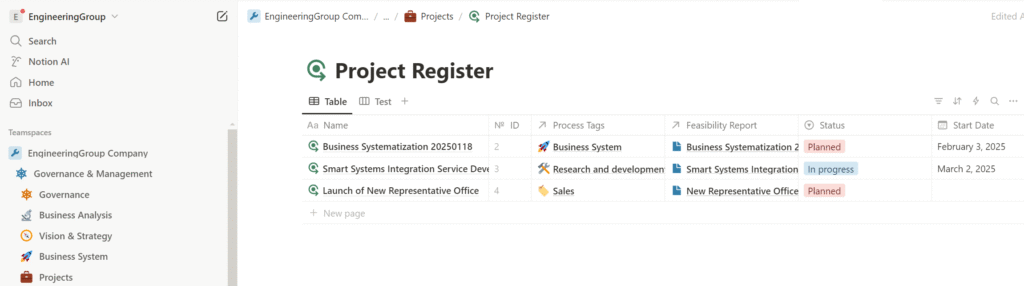
    Project Register Database Table

    The ‘Project Register’ table is used to manage all projects across the entire business and the data related to them. It links with Process Tags, Feasibility Reports, Goals, Project Requirements, Project Risks, and Project Reports to provide a comprehensive view of each project’s context, rationale, objectives, constraints, and outcomes.

    Project Requirements Database Table

    The ‘Project Requirements’ table is used to define, collect, refine, prioritize, and manage project requirements throughout the project lifecycle, ensuring alignment with stakeholder expectations and project objectives.

    Project Risks Database Table

    The ‘Project Risks’ table is used to manage all identified and documented risks by tracking their likelihood, impact, mitigation strategies, and status throughout the project lifecycle

    Nonconformities Database Table

    The Nonconformities Database Table is used to register, handle, and resolve identified nonconformities of the business system by documenting their nature, root causes, corrective actions, and resolution status to ensure compliance.

    Change Log Database Table

    The Change Log Database Table is used to register and analyze Business System changes, ensuring that all modifications are documented, evaluated for impact, and properly implemented to maintain system integrity and traceability.

    The Complete Set of Tools for Business Systematization

    Finally, a complete, ready-to-use set of tools supporting the business systematization process has been developed, ensuring continuous analysis, improvement, and development of the business system. It functions as a unified, cyclical mechanism that enables the business to evolve consistently, systematically, and cost-effectively, taking into account:

    • strategic vision and long-term goals,
    • initiatives from process participants,
    • changes in the external business environment.

    Project Management Tools

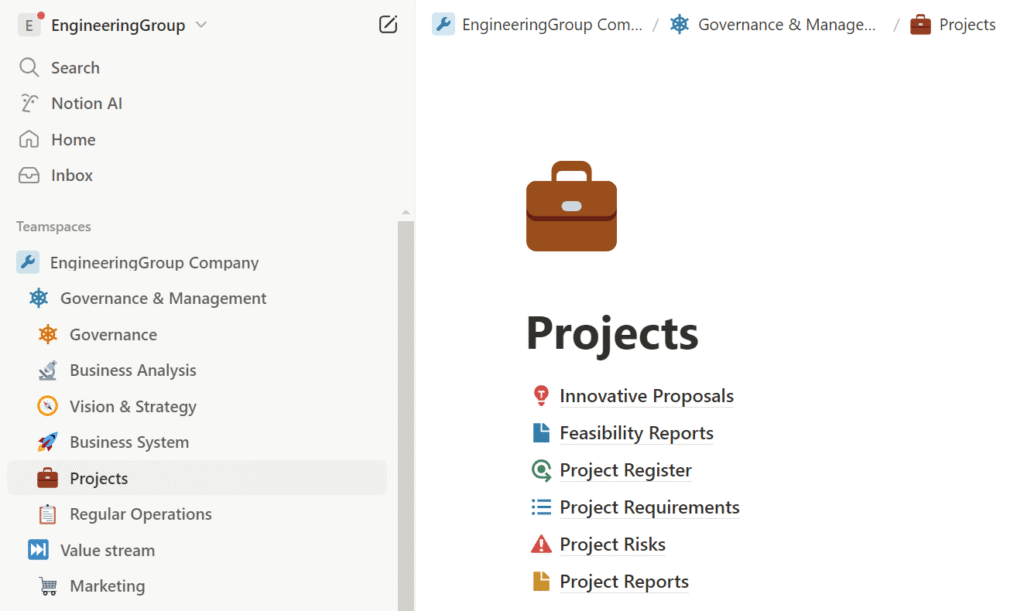
    Additionally, we have developed a set of project management tools designed to support not only systematization but the entire business. Unlike the business systematization tools placed in the ‘Business System’ section of the Notion workspace, project management tools are placed in the ‘Projects’ section according to the business process model.

    The Key Strategic Benefit

    The key strategic benefit of work done is that this systematization process model remains, on the one hand, simple and flexible, while on the other hand, it aligns with Level 5 (Optimizing) of the Capability Maturity Model Integration (CMMI). This provides the business with a number of advantages:

    1. Continuous Process Improvement
      • Organizations systematically identify weaknesses and strengthen processes.
      • Use of different business-analysis techniques ensures that problems are not just fixed, but prevented from recurring.
    2. Quantitative Decision-Making
      • Business and engineering decisions are based on data, not intuition.
      • Enables predictable outcomes in quality, cost, and schedule through statistical analysis.
    3. Innovation and Agility
      • Encourages the introduction of new tools, techniques, and technologies in a controlled and measured way.
      • High process maturity allows for faster adaptation to change while maintaining performance.
    4. High Customer Satisfaction
      • High reliability, predictable delivery, and consistent quality lead to stronger customer relationships and repeat business.
      • Organizations can offer clients customized improvements and better responsiveness.
    5. Operational Excellence
      • Reduced waste, rework, and defects through process optimization.
      • Higher productivity and lower costs over time.
    6. Competitive Advantage
      • Level 5 certification demonstrates world-class capability.
      • Often a requirement for large government or enterprise contracts, especially in defense, aerospace, and critical systems.
    7. Cultural Maturity
      • The entire organization is aligned around process excellence and learning culture.
      • Employees are empowered to propose improvements and are actively engaged in process performance.

    Summary and conclusions:

    In this article, we explored the development of the most optimal process model for building, developing, improving, and maintaining a business system. As a result, we arrived at a process mechanism that:

    1. Is universal, meaning it fits a wide range of businesses at any stage of development;
    2. Enables deeper engagement of the company’s personnel in business improvement activities, aligning with one of the key goals set by the business owner;
    3. Is fairly simple and flexible, allowing us to add certain operations and details to the described processes for more complex businesses—such as introducing audits to identify nonconformities—or, conversely, to simplify the process by replacing “Innovative Proposals” with simple “Ideas” and streamlining the development and approval of a Feasibility Report by replacing it with a “Project Candidate” for small businesses and startups;
    4. This process model for the life cycle of analysis, improvement, development, and support of the business system corresponds to the highest, fifth maturity level of the Capability Maturity Model Integration (CMMI) (Optimizing), meaning the business focuses on continuous process improvement.

    We have also completed the development of a full set of tools for business systematization and project management across the entire business. Now, we’re ready to move on to the fourth step: launching systematization and development projects to elevate the business to the next level.

  • How to systematize and automate business with Notion. Second Step: Design Business System Framework

    How to systematize and automate business with Notion. Second Step: Design Business System Framework

    Building on the foundational steps of systematizing business using Notion, this article delves into the second crucial step: designing a comprehensive business system framework. Learn how to structure interconnected components like goals, processes, indicators, and organizational roles. By understanding these relationships, you’ll gain a clearer path to building the required business system with reduced effort, risk, and cost. This article provides actionable insights and a practical guide to designing a scalable, robust and efficient business system framework using Notion.

    The previous article outlined the first step to systematize the business and implement Notion, including defining a high-level model of all business processes, creating a Notion workspace structure based this model, creating “Process Tags” database table and master “Tasks” database table to organize current tasks by high-level processes. We also looked at the benefits this solution provides, demonstrating its value and the potential of the work accomplished. For some businesses, this might be enough, but what about companies striving to achieve more significant goals, as in the business case under consideration?
    We have already established that achieving these goals is done through systematization—that is, by building and implementing an efficient business system. The next step, which we will unpack in this article, is designing the framework of this business system. This will help us gain a deeper understanding of how business processes should be structured and executed to achieve the set goals.
    The resulting framework will serve as:

    • A foundation for planning and executing the next steps in systematization and automation.
    • A basis for the business knowledge base, which will evolve as systematization and automation plans are implemented.

    This knowledge base will be used for training, minimizing errors among all individuals involved in business operations, and monitoring and resolving issues that arise in the course of business activities.

    Of course, to design like business system framework correctly, we must have the appropriate competencies, techniques, tools, and practical experience. I have done this multiple times using various tools, and that’s why I want to provide you with the best way to do this using Notion, as well as explain in detail how to use the resulting outcome as effectively as possible.

    Components of Business System

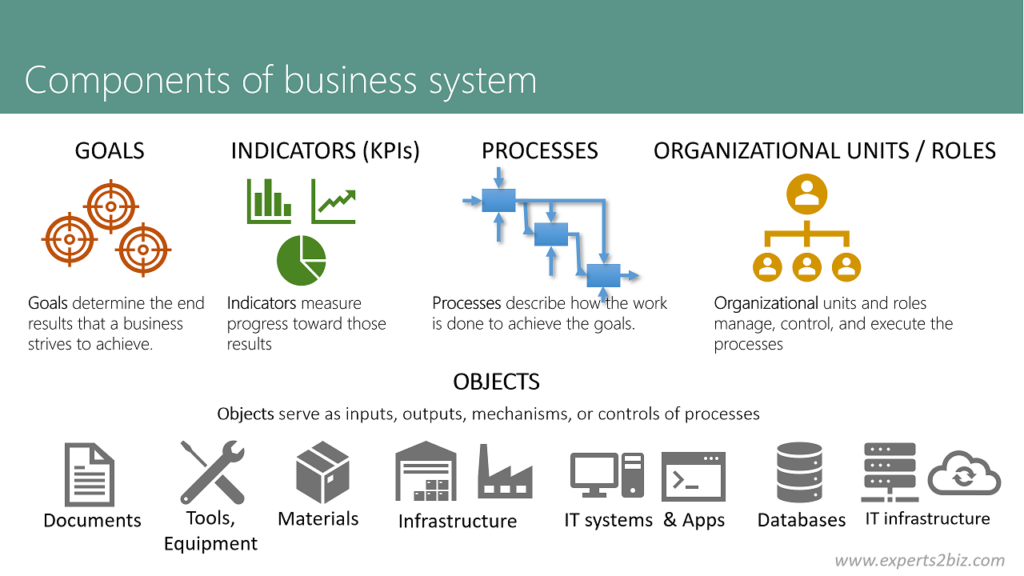
    A real complete business system that will really boost your business include the following interconnected component:

    • Goals – the goals list structured from high-level long-term strategic goals that shows what business want to achieve to operational level goals of processes.
    • Processes – structured list of business processes from high level business processes that defined as we describe in previous article to more low level processes. This list illustrate how all operations are structured and executed to achieve company’s objectives.
    • Indicators – a list of key performance indicators that show how we can measure results, ranging from individual processes to company-wide metrics, allowing tracking of whether the business is achieving its planned goals.
    • Organizational structure – a list of the company’s positions or team roles that defines the hierarchy and areas of responsibility.
    • Objects – a list of all material and non-material items, such as documents, assets, inventory, equipment, tools, materials, and other resources, with which the company operates through its processes.

    It is also necessary to highlight two categories of objects that play a crucial role in building a business system, making it convenient to include them separately as system components:

    • IT systems and apps – a structured list of IT systems and applications, along with their functions, that the business needs to use to improve efficiency and manage data properly.
    • Databases – list of databases, database tables, datasets, or database entities that IT systems can use to store business data. This list is optional because databases are also considered objects.

    ‘Interconnected’ mean that items of this components connected to each other to fully understand how all aspects of the business system work:

    • Connections between Goals and Indicators show how are goals achievement measured
    • Connections between Indicators and Processes show which processes yield which indicators
    • Connections between Processes and Objects shows which objects are associated with which processes and what operations are performed on these objects within the processes
    • Connections between Processes and Oganizational Structure or Team Roles show which position (role) owns the process and which position (role) performs specific operations in each process
    • Connections between Processes and IT systems or apps show which IT systems and applications are needed for business processes and what functions they should have to ensure maximum process efficiency
    • Connections between Processes and Databases indicate which databases are used in specific business processes, detailing how these databases support data storage, retrieval, and management to ensure accurate and efficient process execution. These connections also define what data is created, updated, or utilized during the execution of each process.

    So, comprehensive lists of business system components and the connections between their items provide an extremely detailed picture of the business, offering invaluable support for building, implementing, maintaining, and improving the business system in the most rational and cost-effective way. Notion provides the tools to do this work quite effectively:

    • We can use database tables to create a structured and hierarchical lists.
    • We can use relations between database tables to build connections between items of business system components, and set up very useful views.
    • We can setup templates for items of database tables to show information as documents with additional schemes and diagrams where it is needed and create any kind of regulations, instructions and requirement specifications.

    But Notion also has its limitations. For example, we cannot implement a fully comprehensive and convenient functionality for describing an exhaustive activity model for any business within the Notion environment. Additionally, Notion databases are of the NoSQL type, which also affects the final result. However, the advantages and accessibility of the Notion product outweigh these shortcomings, so we simply need to take these limitations into account during the work process.

    So, let’s do it to see real example and better understand benefits of work done.

    Planned Tasks in Designing a Business System Framework

    Having understood the components that make up a business system, we can begin creating a tool within the Notion environment to design these components and, ultimately, build the business system framework and its further development into an effective, resilient, and viable system. That is why we create the following list of tasks with “Business System” tag in our “Task” database table and start executing them:

    1. Create Goals database table.
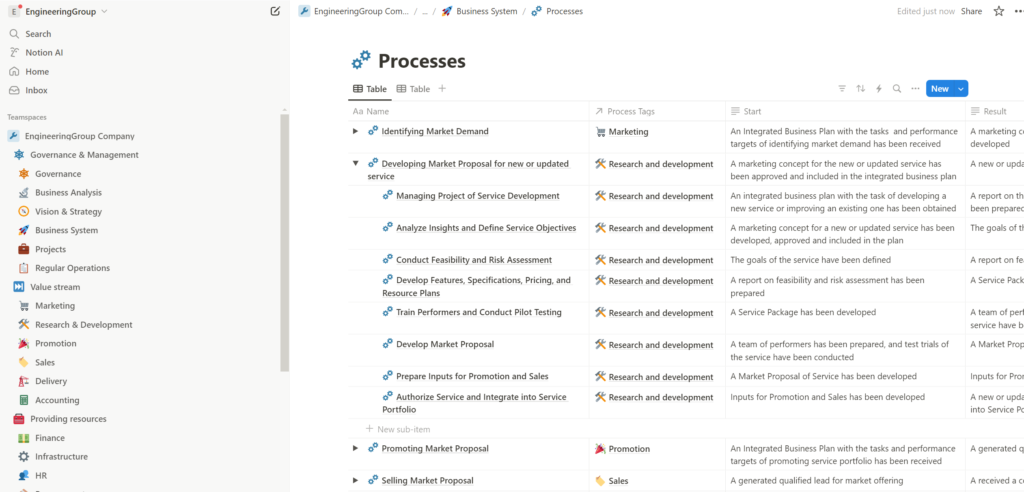
    2. Create Processes database table.
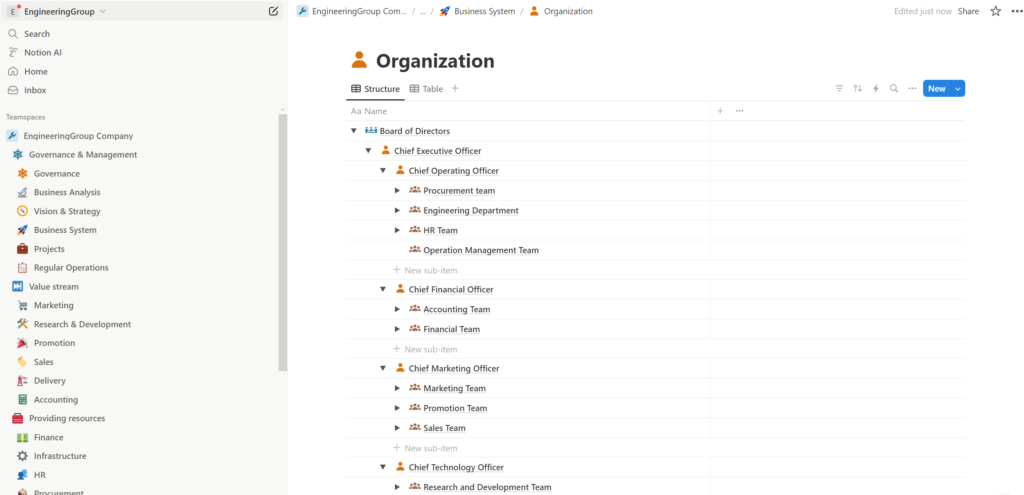
    3. Create Organization database table.
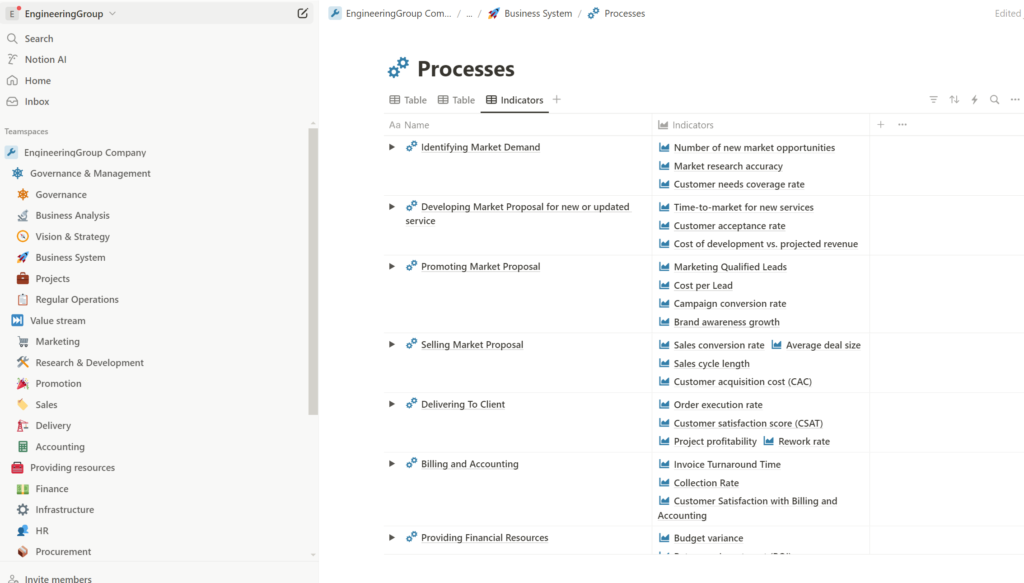
    4. Create Indicators database table.
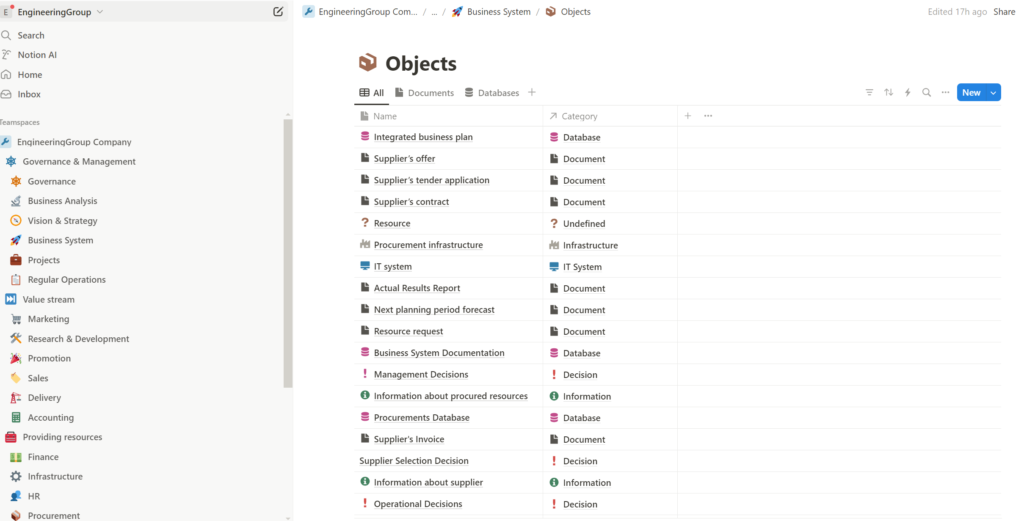
    5. Create Objects database table
    6. Create some additional databases for processes. As we now the definition of term ‘Process’ any process – a purposeful set of interrelated, regularly recurring activities (a sequence of tasks) that, following a specific technology, transforms inputs into outputs according to defined rules using certain mechanisms:
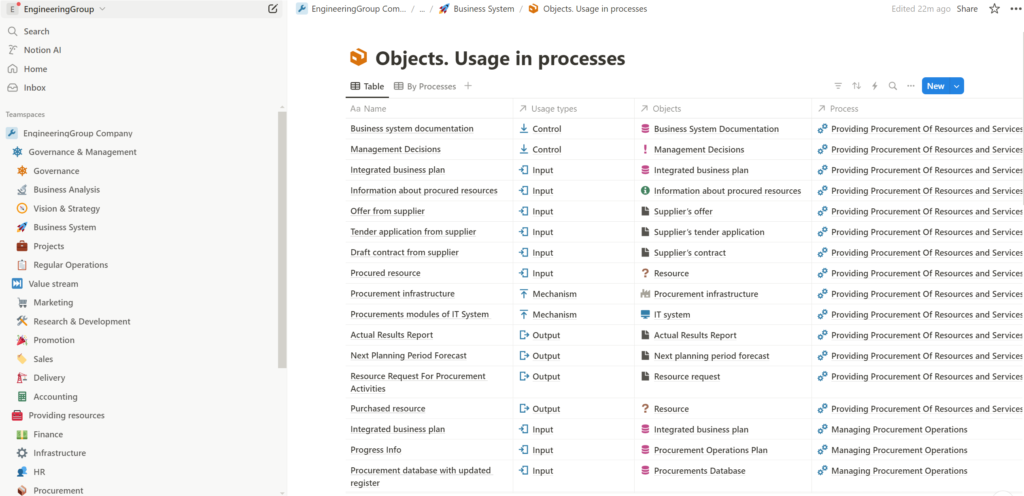
      • ‘Objects. Usage in process’ database table to connect Processes database with Objects database table that are used as Inputs, Controls, Outputs, Mechanisms of Processes (ICOM) and help us understand in which process which object is used;
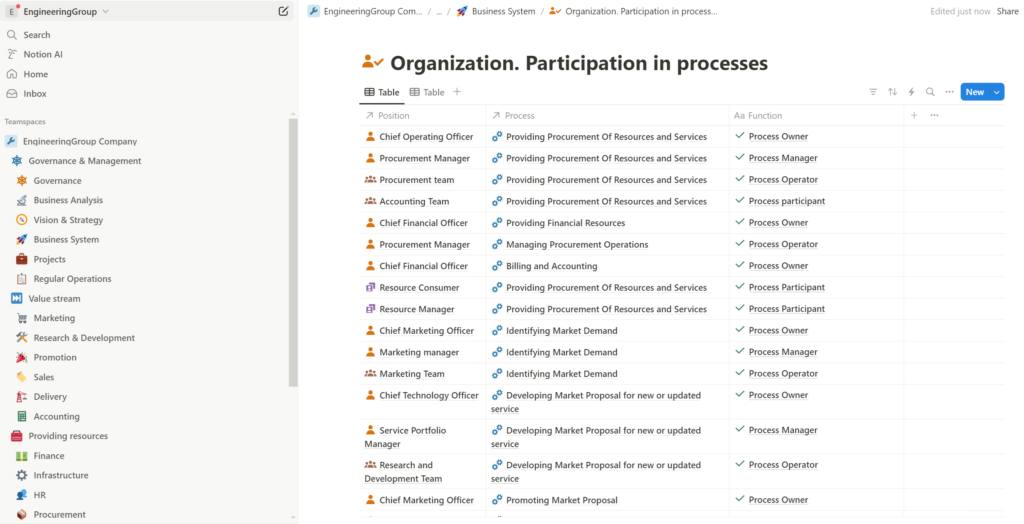
      • ‘Organization. Participation in processes’ database table to connect Processes with organization units and roles and helps us understand in which process which position or role performs which function;
      • ‘Object. Categories’ for easy object structuring;
      • ‘Object. Usage Types’ to mark object in ‘Objects. Usage in process’ database table as Input, Output, Control or Mechanism.
    7. Create, one more, important database to store definition of terms named Definitions.
    8. Create relations between databases:
      • Goals with Indicators;
      • Indicators with Processes;
      • Processes with Objects. Usage in process;
      • Processes with Organization. Participation in processes;
      • Organization with Organization. Participation in processes.
    9. Populate Processes Database with real business processes list.
    10. Populate others Databases with some example data and show results.

    Notice! We are already using our Notion workspace to build our system and accumulate historical information about our activities, which can be used for analysis and to draw valuable conclusions in the future.

    Benefits of the Work Done

    Goals database table

    Using the “Goals” database table, along with Notion’s capabilities and the proposed methodology, provides businesses with a strategic management tool that enables them to:

    • Create a structured list of strategic goals and break them down to the level of individual projects, processes, and positions. This ensures that the strategy is communicated to every employee, allowing all individuals involved in the business to understand their contribution to both current operations and the company’s future.
    • Simplify and optimize strategic management processes, making them accessible even to relatively small businesses.
    • Manage long-term vision, strategy, and strategic plans as they evolve and as new data becomes available, including actual company performance metrics.

    Indicators database table

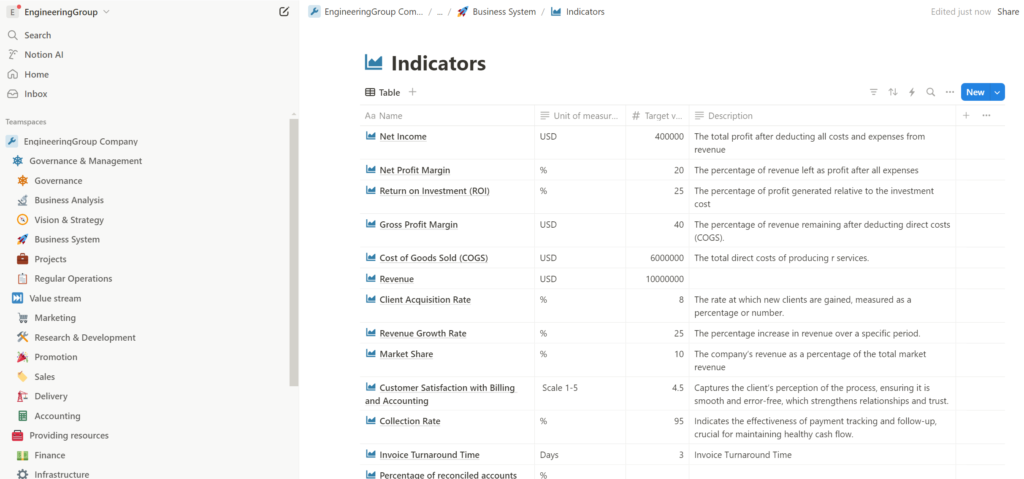
    Using the “Indicators” database table allows us to define and classify the indicators (KPI’s) needed to measure the business. We can also set target control values that the business must achieve to realize its vision and strategy. Later, we will use these indicators for project management and regular operations management within the corresponding processes to monitor and optimize them.

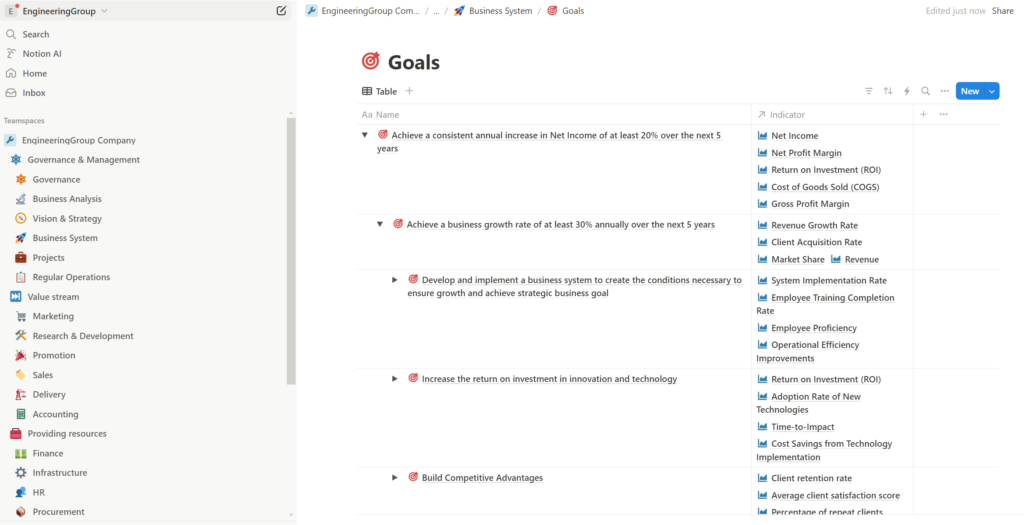
    Relation between Goals and Indicators shows us how goals are measured and how we can monitor their achievement

    Processes database table

    Using the “Processes” database table, along with Notion’s capabilities and the proposed methodology, provides a fundamental tool for process management. Built on the process model from the previous article, it allows us to:

    • Structure our processes by adding sub processes.
    • Define the initial event, outcome, and other key parameters for each process.
    • Include visual materials such as flowcharts and business process diagrams.
    • Prepare for process optimization and automation projects.

    This approach helps identify bottlenecks in current operations that can be improved or optimized to enhance business efficiency. Additionally, it provides a deeper understanding of the scope of business optimization and automation efforts, preparing us for the next steps, including process automation.

    The relationship between Processes and Indicators shows where the indicators originate from and how we can monitor and measure their effectiveness.

    Organization database table

    The ‘Organization’ database table helps us create our organizational or team structure by defining current positions along with their duties and responsibilities.

    “Organization: Participation in Processes” database

    The ‘Organization: Participation in Processes’ database table is used to establish relationships between processes and the organizational structure. This relationship helps define who owns, manages, and performs process operations, providing a clear understanding of required human resources and enabling their more effective use.

    Objects database table

    The “Objects” database table helps as to list all objects that using by business to understand for further optimization and automation too.

    Objects. Usage in processes database table

    The ‘Objects. Usage in Processes’ database table is used to establish relationships between processes and objects. Objects serve as inputs, outputs, controls, and mechanisms within processes. This information enhances our understanding of process structures and their automation potential. It also helps identify objects that can be eliminated to reduce costs, as well as objects that should be introduced because they currently lack associated processes, even though such processes are necessary for the business system.

    Finally, creating and populating the database of business system elements with accurate data provides us with a more precise and comprehensive view of the key components of the business system. This information can be effectively communicated to all stakeholders involved in the business. Proper use of the obtained tools will enable the business to avoid many mistakes and risks in the future, ultimately reducing costs for implementing business improvement projects.

    Summary and conclusions

    As a result of the work done, we have created a set of tools for structuring the key elements of the system. Filling them with accurate data ensures the outcome of systematization, while their further use enables solving a wide range of management tasks to achieve planned goals. Among these management tasks, for example, may be:

    1. Process optimization to reduce costs and increase productivity.
    2. Design and implementation of new processes that were previously missing, ensuring the business operates as a system rather than a collection of chaotic activities.
    3. Business process automation using existing market solutions or developing custom IT systems and applications to enhance competitiveness.
    4. Development and implementation of training and professional development programs for team members, enabled by a clearer understanding of goals, processes, and employee roles.
    5. Minimization of errors, poor decisions, and risks through a deeper and more visual understanding of how all processes should work, allowing for faster achievement of necessary results with lower costs.

    In the future, it will only be necessary to update and supplement the database tables as internal and external conditions change and the business system evolves. This way, the business will always have an up-to-date and comprehensive knowledge base at hand, covering: where we are heading (goals), how we will achieve it (strategy), how everything operates (processes), who is responsible for what (organizational structure/team roles), what we measure to track results (indicators), and which objects are used or transformed in which processes, and so on.

    However, it is also important to understand that not every business, at the start of its systematization and improvement efforts, has sufficient competencies and personnel to correctly formalize goals, indicators, processes, organizational structures, and objects—and to complete all this work properly within a single project. That is why, in the next article, I will explain how systematization processes should be structured so that this issue is fully addressed, allowing us to move forward.

  • How to systematize and automate business with Notion. First Step: Define high-level holistic and integrated process model

    How to systematize and automate business with Notion. First Step: Define high-level holistic and integrated process model

    In previous article I briefly described business case, goals, approach and methodology to universal method of systematization and automation business based on Notion and Make. In this article, I will cover the First Step: Defining a high-level, holistic and integrated process model for the entire business. But before diving in, it is necessary to understand a number of key concepts and definitions.

    Key Concepts and Definitions

    The goal of first step is defining a high-level holistic and integrated model of processes for the entire business but before doing so, it is necessary to clarify some definitions and key concepts.

    Key principles:

    • Call things by their name and use clear and precise terminology. This mean avoid overly complex terminology terms, fashionable or confusing abbreviations that confuse all persons involved in the processes and management of the business and complicate the understanding of the system. The simpler, the better.
    • Abstract approach. The application of an abstract approach enables the development of universal process models that can be adapted to various types of activities and business cases, which also simplifies and facilitates the understanding of business as a cohesive system.

    Why Start with Defining High-Level Processes?

    A common practice is to design Low-Code/No-Code solutions (as well as solutions based on hardcore coding 🙂) using a functional-based approach. A typical example is creating a TeamSpace’s aligned with the organizational or teams structure. While this is a standard solution, it inherits all the drawbacks of the functional management approach and fails to deliver the same level of business efficiency as a system architecture built on a process-based approach.

    This is because, in the functional approach, the system is constructed around the existing or anticipated human resource structure rather than the natural flow of value-creating processes tailored to the chosen business activities and goals. As a result, the outcome is a bureaucratic system that operates less efficiently than one designed with a process-driven methodology. It’s also essential to remember that the ultimate goal of business automation is to automate processes, so it’s best to start with processes from the outset. The rest of this article will help you gain a deeper understanding of the application of the process-based approach.

    Now let’s break down what the terms ‘high-level,’ ‘holistic,’ and ‘integrated’ mean.

    High-level – at the initial stage, in order to build and use the system, we need the top level of the process model to see how the company creates value, provides resources, and manages the business without delving into details (details will be addressed in the following steps).

    Holistic – processes are presented as a unified and complete business mechanism without omissions or disconnected parts, providing a full representation of the business processes required to achieve the company’s strategic and operational goals.

    Integrated – all processes are interconnected; there are no isolated or ‘out-of-context’ processes.

    Now, understanding the essence of these meanings, let’s explore how to define such a top-level model at a conceptual level, that is, briefly and without going into deep details.

    Defining High-Level Value Stream Process

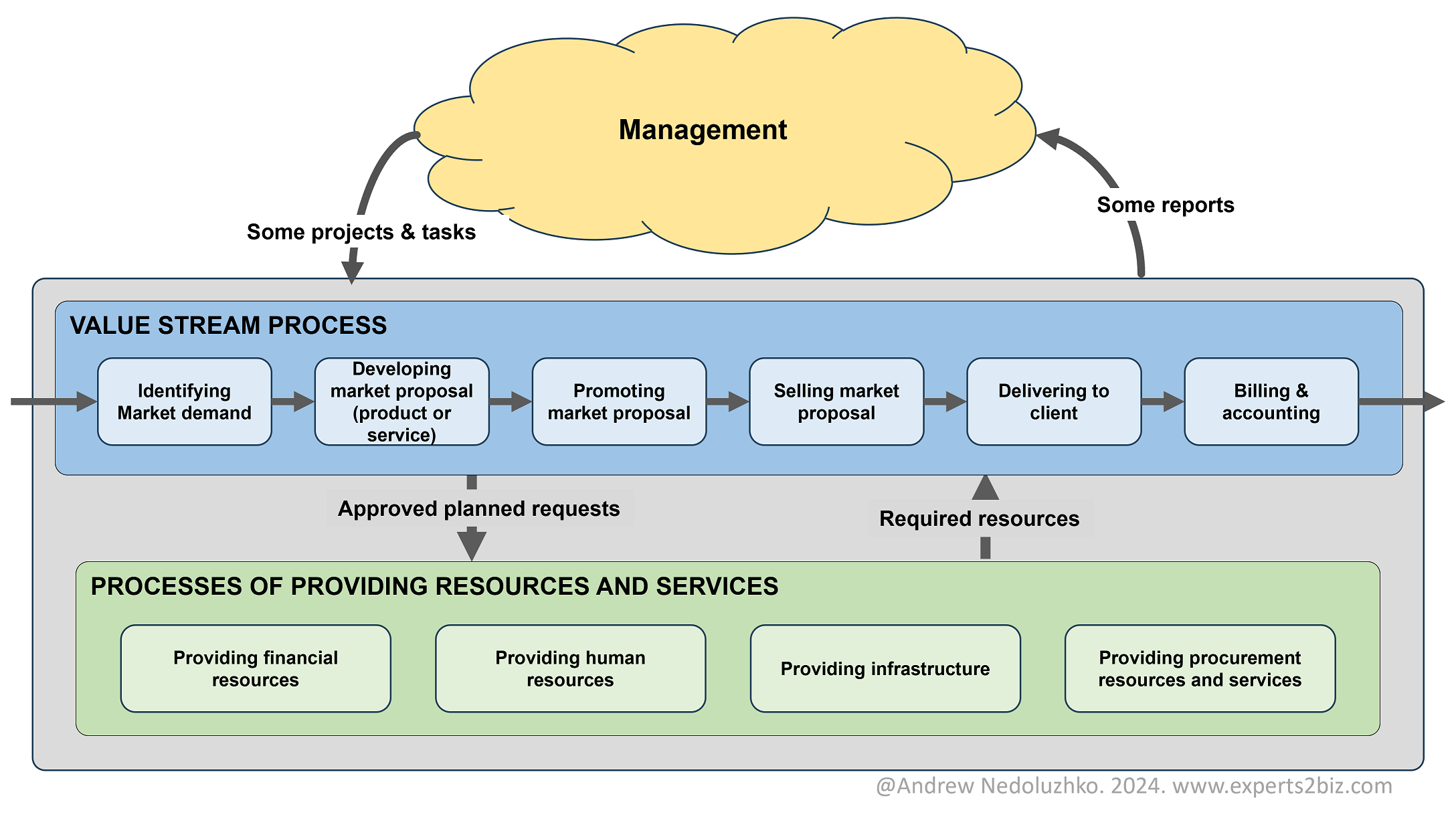
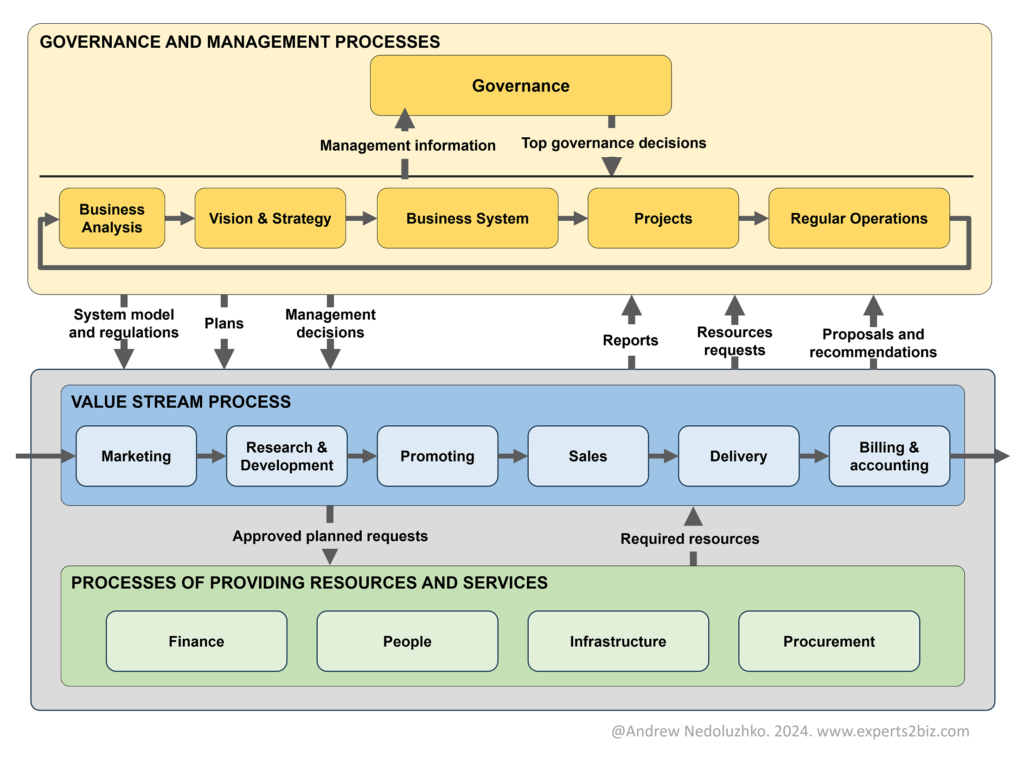
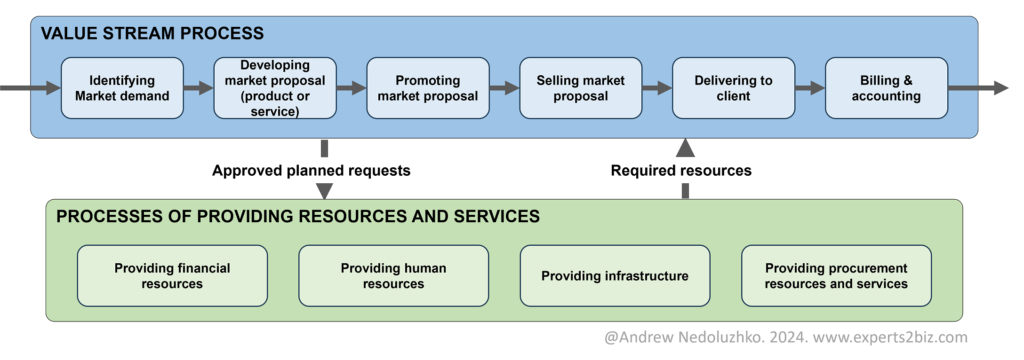
    First, we define the core business process as the value creation flow. A basic example of a value creation flow can be represented by the abstract model shown in the diagram below:

    In a sense, this is a classic value creation process (value chain) that has been utilized by manufacturing corporations for decades:

    Depending on the type of activity, market niche, and specific characteristics, this approach can be adjusted and adapted to suit any business type:

    For example, in some cases, it is convenient to combine the processes of promotion and sales:

    Here is an example of how this might look for a service-oriented business:

    There are also businesses where different value creation process models can be used. For example, in real estate development, I have encountered two different models:

    First model for property development: The company first conducts marketing to determine market demand and develop a basic concept for the real estate project, and then, based on the concept, proceeds with the search and acquisition of the land:

    Second model for property development: The company first finds and acquires the land, and then carries out the marketing processes and develops the marketing concept.

    That is, any variations of the basic value creation flow process model are acceptable, as long as they suit your business case.

    Defining the high-level processes that provide the value creation process with the necessary resources

    A common problem in many companies is the presence of excessive providing processes or those that are overly complex and redundant. However, in most cases, these processes can be distilled into the following:

    • the process of providing financial resources,
    • the process of providing people (it can be called human resource provision, talent acquisition, or champion sourcing, but the essence remains the same),
    • the process of providing infrastructure,
    • procurement of resources.

    Conceptually, the resource providing processes are illustrated in the diagram below.

    For clarity, let me highlight three important details:

    First, it is essential to accurately understand the process of providing infrastructure. For instance, according to ISO 9001 standards :
    The organization shall determine, provide and maintain the infrastructure necessary for the operation of its processes and to achieve conformity of products and services. NOTE Infrastructure can include:

    • a) buildings and associated utilities;
    • b) equipment, including hardware and software;
    • c) transportation resources;
    • d) information and communication technology.

    That is, infrastructure is not limited to buildings, structures, or equipment; it also includes IT infrastructure, software, and cloud resources. In future articles, I will demonstrate how this process should be optimally organized to be efficient and account for all these details.

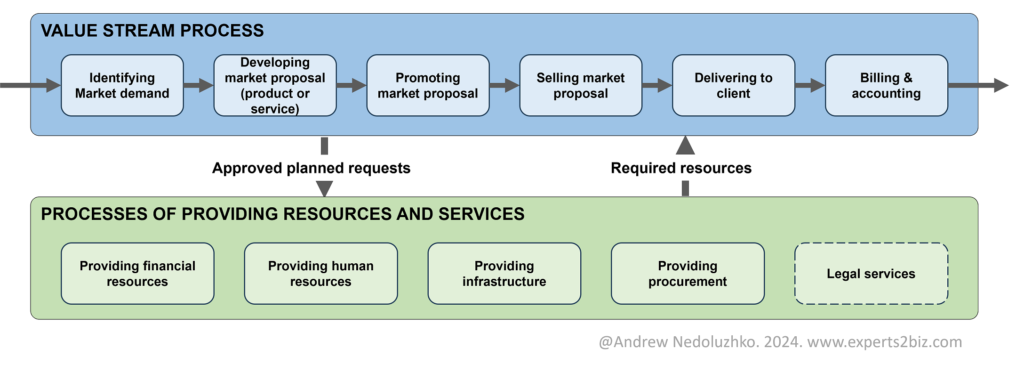
    Second, readers of this article might argue that most businesses typically have far more support processes. However, if you aim to build the most efficient business model, almost all of these processes can be outsourced, consolidating them into a well-structured procurement process (which will also be examined in detail in future articles). At the same time, I fully acknowledge that in some business cases, additional processes may be required, such as legal support, PR, reputation management, and so on.

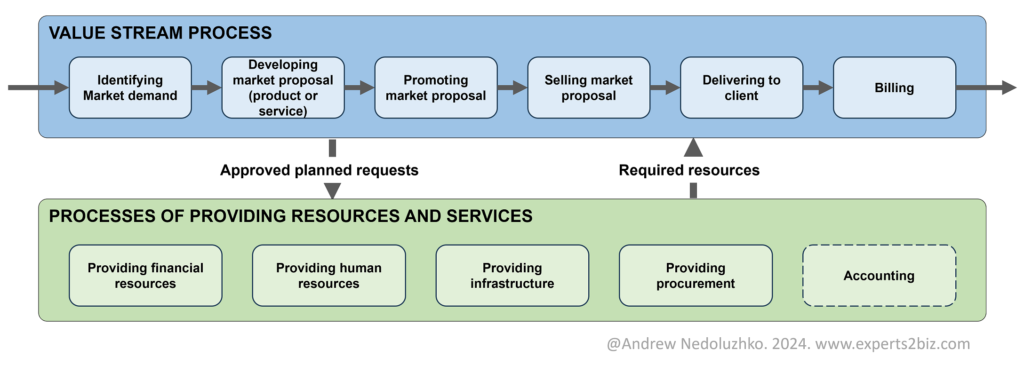
    And sometimes, even parts of the value stream process can be moved to the provisioning process or outsourced through procurement. For example, the figure below shows that accounting is moved to a separate supporting process.

    Defining the High Level Management Processes

    On the one hand, these processes neither create value nor provide resources for the business. On the other hand, they are critically important for ensuring growth, scalability, and, at the same time, providing stability, reliability, and assurances to investors. However, practice shows that in most companies, this is the least systematized and optimized category of processes and often looks as shown in the next diagram. Over time, this leads to deep-seated business problems that are difficult to resolve because the company’s management does not understand the root causes of their origin.

    Figure 10 – How business management works in many companies

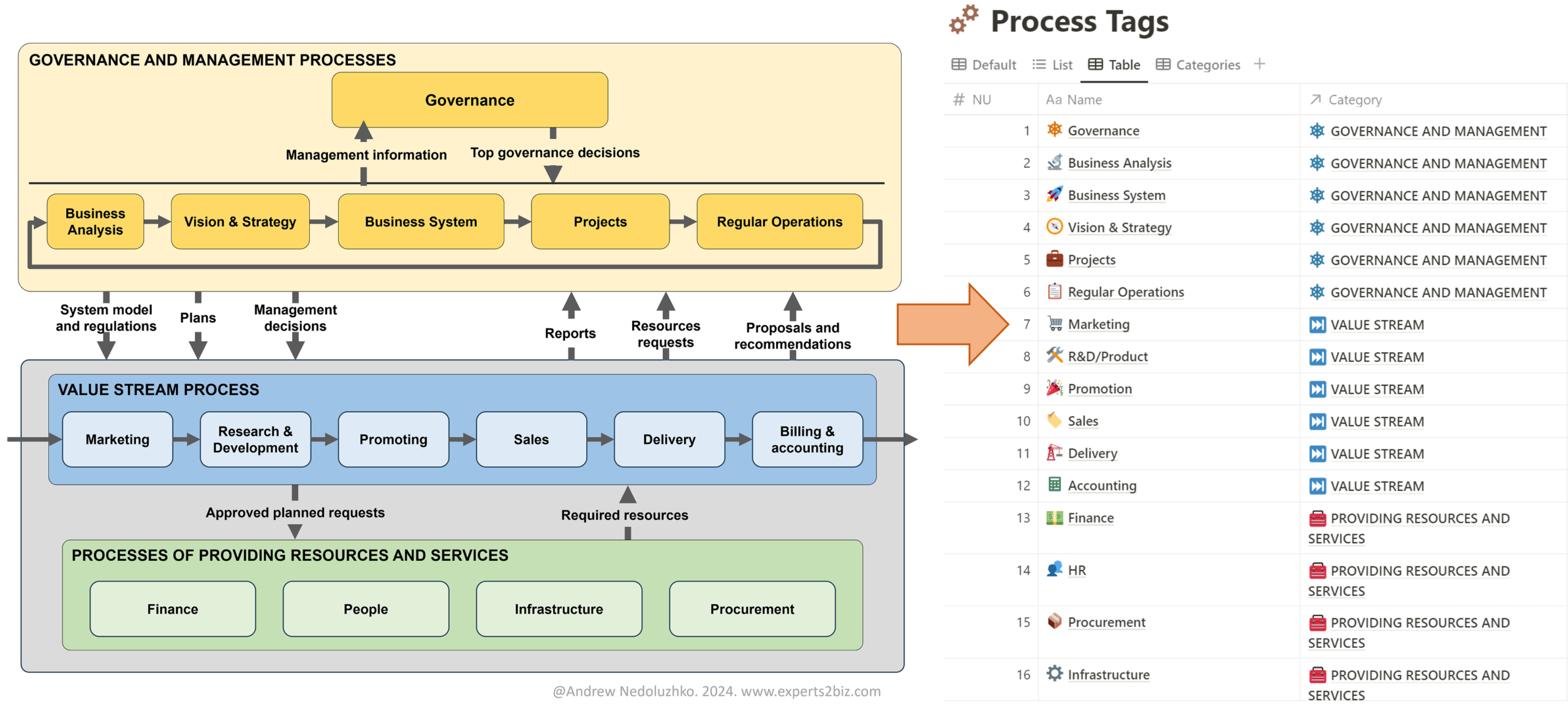
    So, to build an effective management system, we must define, design, and implement the following high-level processes:

    1. Defining the current state of the business – A process for identifying, evaluating, and managing information about the company’s current state to figuratively understand where we are now.
    2. Defining the future state of the business and developing strategy to achieve it– A process for defining, formalizing, and managing the company’s vision for the future, as well as developing strategies and strategic plans to achieve that vision. Figuratively speaking, it is the formalization of where we want to go.
    3. Developing the tool(system) for implementing strategy and achieving the future state – The process of creating, developing and supporting a business system, that is, a tool that will ensure the achievement of strategic goals.
    4. Managing projects for strategy realization and achieving the future state – A process for managing internal development projects, i.e., projects (or portfolios of projects and programs for larger businesses) that enable the development of the company’s products/services, the building and improvement of business systems, and the execution of various unique tasks aimed at achieving strategic goals. In other words, it is about creating the conditions necessary to achieve the planned outcomes.
    5. Managing regular operations for strategy realization and achieving the future state – A process for managing operational activities aimed at delivering planned outcomes, such as productivity, sales volume, customer satisfaction, revenue, profitability, net income, and so on. In other words, all the process metrics used to evaluate results and determine whether the company is progressing toward its goals.
    6. Governance Decision Management – the pinnacle of the business system: a process of senior business leadership where the highest management decisions are prepared, made, and their execution is monitored.

    It is crucial to understand that most companies attempt to implement strategic management by developing a vision, mission, and strategy without defining or understanding their current state. In other words, they design a roadmap for where the company wants to go without having a clear picture of where it is now. This is a critical mistake! The outcome is entirely predictable 🙂

    As a result, we have arrived at a simple, fairly understandable, yet holistic and integrated model of high-level processes. The next step involves detailing these processes and formalizing them through the development of guidelines and automation. However, at this stage, it is essential to focus on other, more important and valuable actions, which will be carried out in the Notion environment so that users can see the system’s framework and utilize its basic elements.

    Defining a list of high-level tags reflecting the process model in our workspace

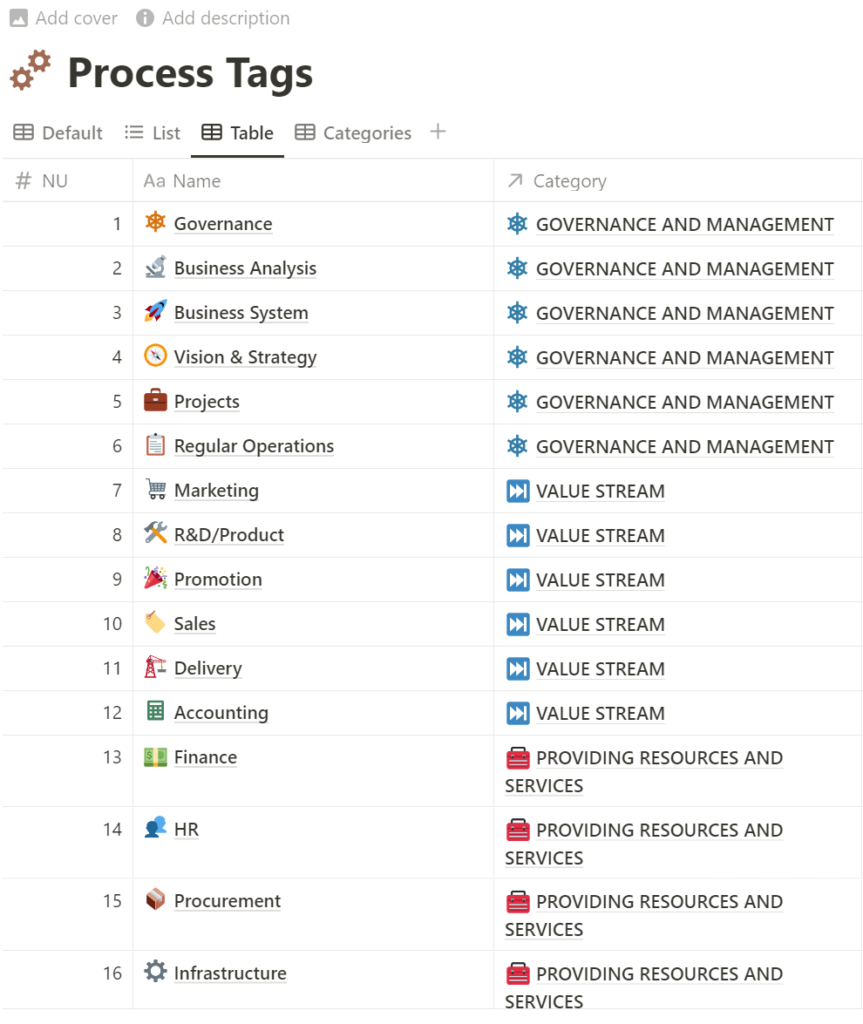
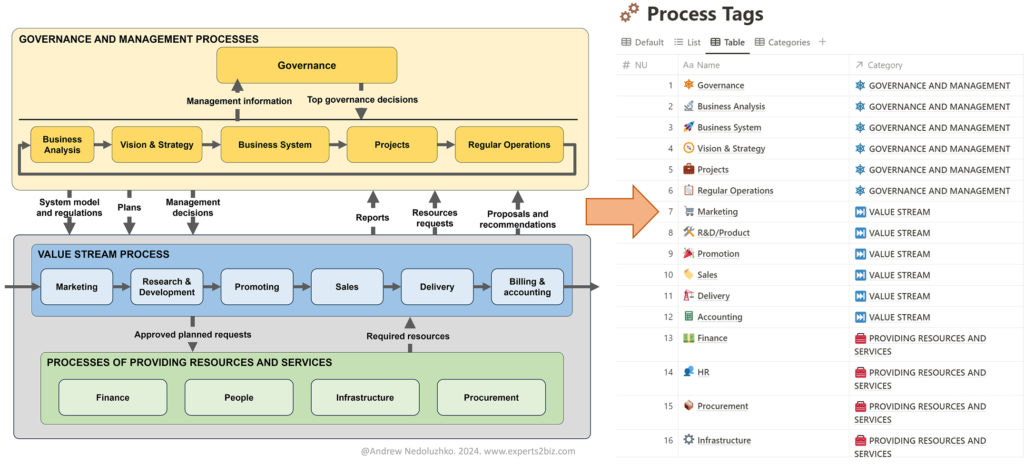
    Based on the resulting model of high-level processes, we will define a list of tags that will play a central role in our system. The process names can be chosen arbitrarily, but it’s preferable to keep them concise and ensure they reflect the essence of the process. For this case, I arrived at the following tag structure

    Let’s start using Notion

    Create a Notion Workspace for Our Business Case

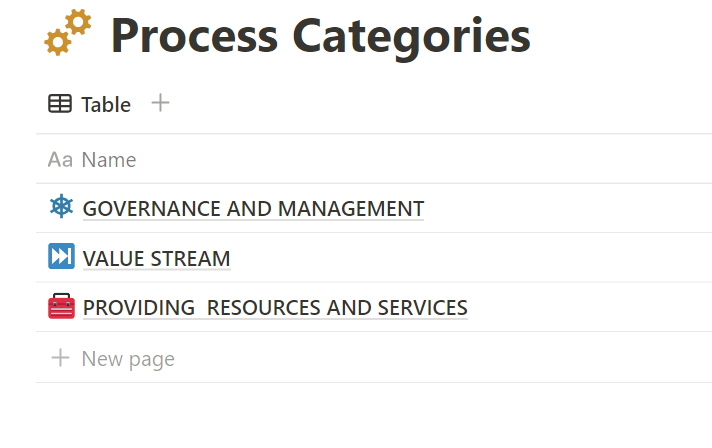
    Then, we create a database table for process categories and a database table for process tags .

    This list of tags will be used as a relational field (Relations) in various system elements, such as tasks, projects, issues, goals, and other system components.

    Creating the workspace structure or team spaces reflecting the process model.

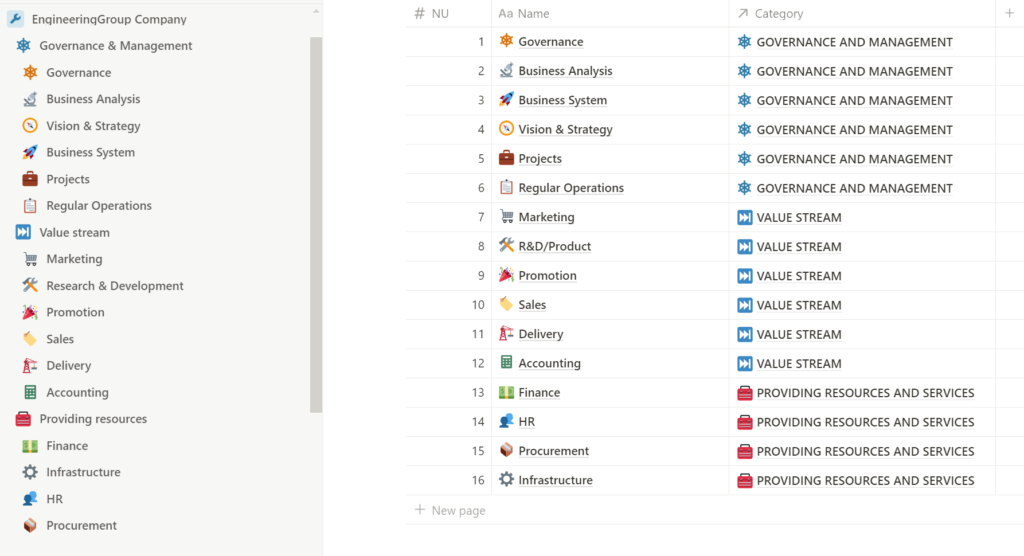
    Now, we create the workspace structure or team spaces that correspond to the structure of process tags.

    Move Process Categories and Process Tags to the Business System section

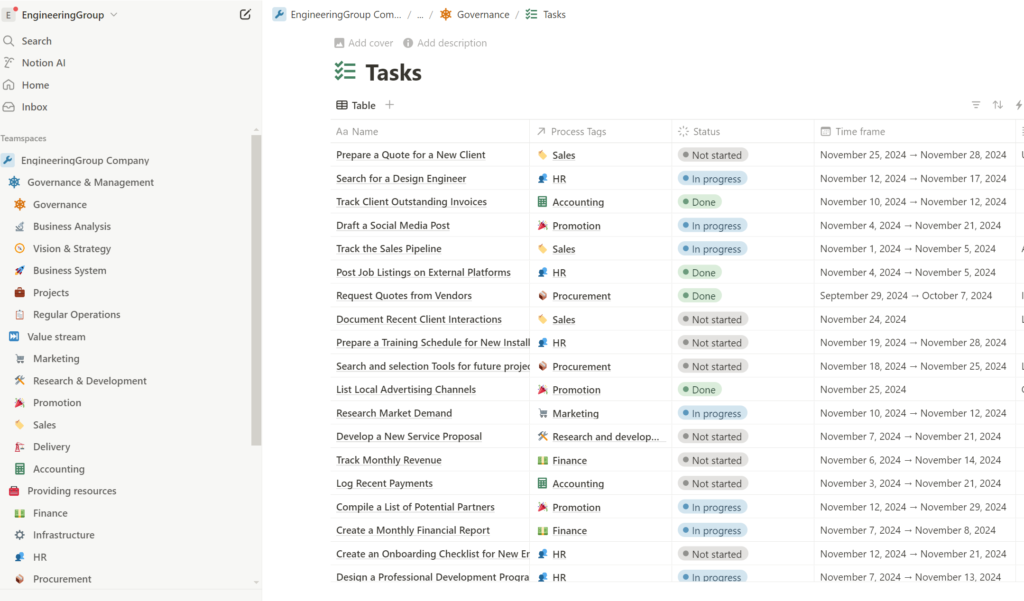
    In the Governance section create a central Tasks database table and add a Process Tag column

    That’s it! The first stage is complete! We defined high level process model of entire business and set up Notion workspace according of this model. This is simple!

    Benefits of the Work Done and Next Step

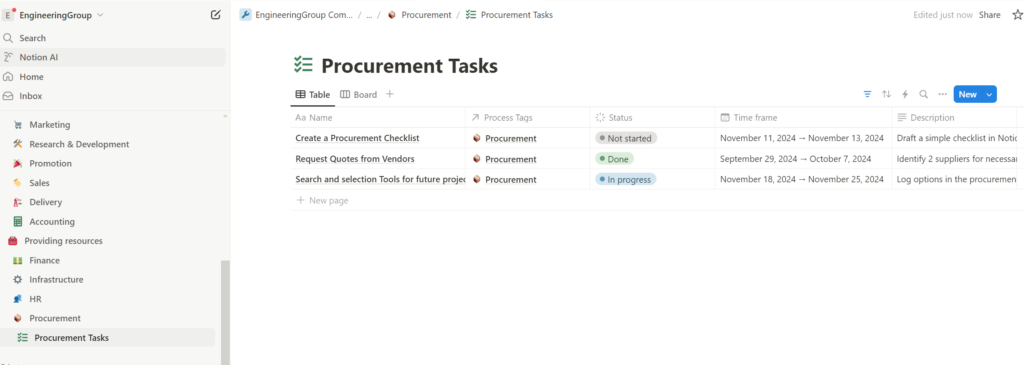
    We did a simple and quick job but in line with a long-term systematization and automation strategy of business to build efficient business system. Without yet having a complete and detailed understanding of the algorithms behind specific processes, company employees can add tasks linked to specific process tags. This enables the collection of objective data for accurate and realistic process design. Additionally, employees using the system begin to develop habits of structuring and systematizing tasks while becoming engaged in the design and development of the business system. For example, they can identify recurring tasks related to specific processes and contribute to finding automation solutions. For each process, task views can already be configured to display tasks related to that process and integrated into the corresponding sections or TeamSpace’s of the system

    Create database tables for Process Registry, System Objects, Goals, and Metrics to further design the elements of the business system. This topic will be covered in detail in the next article.

    Depending on their roles and responsibilities, users can already create the necessary business content within the system’s sections. This ensures that valuable content is centralized in one place while simultaneously being organized and linked to specific processes.

    Summary and conclusions:

    1. The optimal way to start systematize business is define conceptual model of high-level business processes. Start designing the system by defining value stream processes, followed by resource-providing processes, and then business management processes.
    2. If the goal of the systematization is to create conditions for sustainable, growing, and scalable business, it is critically important to establish and implement management processes as outlined above. These processes are suitable for any business and require only minor adaptations in certain details, depending on the specifics of the particular business.
      Figure 19 – Management processes are the key to creating conditions for a sustainable, growing, and scalable business
    3. Once the high-level process model is established, you can immediately take the first steps in developing and using a business system based on LowCode/NoCode platforms such as Notion. This approach allows you to see the full picture of systematization and create a proper structure. This structure enables gradual system functionality growth, user engagement, risk minimization, and avoids chaos and information clutter in the future.
    4. As mentioned at the beginning, this approach can be used not only by different types of companies but also by solopreneurs, portfolio managers, and investment companies:
      • For individual entrepreneurs, systematizing their activities into processes proves to be highly beneficial. It helps with better planning and prioritization, reducing the risk of overload, missed deadlines, or emergency tasks, while providing a clear framework for analyzing their activities. This structured, process-based approach not only aids in identifying routine tasks that can be automated but also facilitates delegating such tasks through outsourcing.
      • Portfolio Management and Investment Companies can leverage this approach to build an efficient business system, where the core process flows from selecting a startup or investment object, through its development, to its sale and exit. And, of course, they can use this approach to improve the performance of their portfolio companies or startups.
  • How to systematize and automate business with Notion. Introduction to Step-By-Step tutorial

    How to systematize and automate business with Notion. Introduction to Step-By-Step tutorial

    This article serves as an introduction to a step-by-step guide for systematizing and automating business using Notion. It focuses on creating a holistic approach to define, design, build, and manage an entire business system. This method addresses common challenges in business systematization, such as adapting to market changes and managing collaboration. It blends global standards with practical experience to help businesses systematize and automate effectively while maintaining flexibility. Whether for small startups or large companies, this guide offers actionable insights for building efficient, sustainable, scalable business systems.

    Understanding the Challenge

    The market currently offers a wide range of affordable No-Code/Low-Code platforms used to systematize and automate business. Among the most popular are Notion, Airtable, Coda, and ClickUp, and their number is growing, as is the number of businesses adopting them.

    I believe that founders and business owners who seek to systematize and automate their business are experts in their field, aiming to make their operations more profitable, sustainable, and capitalized. However, they often lack deep experience with modern tools, which makes it natural for them to see potential risks and challenges in such projects.

    In my opinion, the key issue with such projects is the lack of a proper approach from the start, including the chosen methodology, development strategy, and system architecture. These initial mistakes lead to ongoing problems, forced reworks, and disappointments throughout the entire development process and the system’s functionality. This, in turn, will reduce the potential benefits of using the system and increase costs, ultimately resulting in missed opportunities and lost profits. On the other hand, high expectations of No-Code/Low-Code products can also be problematic, as these tools cannot solve all automation challenges, such as creating rich and fully user-friendly interfaces, ensuring high performance and security, or providing sufficient data storage as the system scales, among others.

    Years of designing such solutions have allowed me to develop a universal approach that enables project stakeholders to achieve quick results while building and evolving systems without stress or unnecessary complexity. This approach allows stakeholders to start using and benefiting from the system from the very first days of the project, all while continuing to develop it in parallel with their core business activities – the very reason the system is being created. Moreover, this approach helps avoid a wide range of risks that companies often face in such projects, including:

    • Inability to quickly adapt the system to rapidly changing business conditions. These include market shifts, new competitors, regulatory changes, or growth opportunities such as expanding product lines, entering new markets, or geographical expansion. Quick and stress-free updates to existing processes and their supporting systems become essential, necessitating a built-in change management system from the start.
    • Delays and extended project timelines. Critical questions take too long to discuss, and consensus on how to systematize is often reached only after several failures and reworks.
    • Lack of employee experience in organizing collaborative work. For instance, an employee might think: “I’m a professional in my own work and have already systematized it (individually), but how can we organize the workflows of the entire company, considering different departments, roles, and a long-term growth strategy?” Additionally, does such a strategy even exist in a formal document, or is it just in the head of the company leader?
    • Transferring offline chaos to online tools. Instead of creating a structured system, companies risk ending up with a jumble of IT services and scattered information, leading to low efficiency and poor usability and further aggravation of this chaos will only increasing costs.

    That’s why I propose a simple, step-by-step, and effective method for systematization and automation. This approach enables to gain the correct perspective on business as a system, to gradually enhance and improve it without disrupting the company or incurring high costs. This method is based on the synthesis of global standards, such as ISO 9000 (Quality Management Systems), ISO 12500 (Project Management), PMI standards (Project Management Institute), IIBA standards (International Institute of Business Analysis), CMM/CMMI (Software Engineering Institute), and so on. At the same time, this method is as lightweight as possible, avoiding extensive, tedious analytical and diagnostic projects.

    It’s also crucial to highlight that this method is suitable not only for building systems with No-Code/Low-Code platforms but also for traditional custom development or implementing other software solutions. Additionally, it works well for combining No-Code/Low-Code platforms with custom-built systems, particularly in cases where these platforms alone cannot fully solve your challenges but can still be valuable for tasks like preparation, requirements management, project oversight, or prototyping. In other words, the main idea is to leverage the maximum potential of No-Code/Low-Code platforms and then follow aligned with the business’s vision and long-term development strategy. If your strategic management processes are well-configured, it goes without saying that the strategy should also include a sub-strategy for building and evolving the business system.

    I am confident that this approach can be applied to various types of activities and businesses of different sizes – from solopreneurs to portfolio companies managing multiple businesses, from startups aiming to properly organize their processes to increase their chances of success, to established companies seeking greater simplicity, sustainability, growth drivers, and cost reduction.

    Business Case Example

    Let’s assume we are dealing with a small company that provides design and installation services for engineering systems in various construction projects. Historically, the company was created and comfortably developed in a growing market with low competition, but recently it has faced increased competition in its location, forcing the company to improve its processes and expand its service portfolio. At the same time, the company’s founder sees potential and opportunities to expand the business geographically and would like to take advantage of this. Given the period of comfortable existence, the company lacks a holistic system of processes, and employees use various isolated software products for their needs. The founder understands that business activities need to be systematized and processes automated, as well as ensuring data integration from various systems or migrating data into one system where possible. According to the company’s founder, this will give the business competitive advantages, scalability, and provide sustainable long-term growth. But the founder doesn’t know where to start, has no idea who to work with, and lacks confidence that the solutions being proposed will deliver the desired results.

    Goals

    Therefore, the founder faces the following objectives:

    1. Unified System of Processes: To systematize the company’s business processes to create a comprehensive and holistic view of these processes, one that all employees can understand and accept.
    2. Collaborative Work: Enable users to operate within a unified collaborative system that lays the foundation for future automation.
    3. Engagement: Ensure employees are both engaged and motivated to improve processes and contribute to the development of the business system.
    4. Automation and Control: Automate collaborative processes to minimize routine tasks while maintaining control and access to process analytics.
    5. Systematization Strategy: Develop a clear understanding and vision for how to build and evolve the system in alignment with the business’s long-term goals and objectives.

    Methodology

    To reach this goals we have to start from four steps:

    • Step 1: Define a high-level holistic and integrated model of processes for the entire business. This first step will include the initial systematization and task management automation based on a business process model using Notion. This is a very convenient approach that provides a significant boost right from the start, especially for those just beginning to systematize: now we view the business from the perspective of a lean and efficient process model, and we immediately start using elements of this model in our practical activities.
    • Step 2: Design business system framework. Using Notion, develop a business system framework consisting of a goal structure, a list of indicators, a business process structure, a list of functions of IT systems and apps, and databases, all of which are logically connected. Creating this business system framework allows you to:
      1. Gain a comprehensive view of the business as a system and communicate it to stakeholders.
      2. Identify business bottlenecks and develop solutions to address them.
      3. Determine the metrics to measure processes and track the achievement of strategic goals.
      4. Assign responsibility for processes to specific roles or team members.
      5. Create a roadmap for strategy implementation and individual project roadmaps using the goal structure.
      6. Obtain baseline data for planning activities aimed at developing the business system: organizational changes, process optimization, and automation.
      7. Use the resulting framework as a foundation for building the business knowledge base.
    • Step 3: Launch regular processes of ongoing business system development, maintenance, and improvement. At this step, we will focus on explaining the processes of developing and improving the business system. This is crucial because we cannot create a perfect system instantly. Initially, it might seem that achieving results requires implementing at least one or a series of projects. But the reality is much more complex…
      1. First, when you implement Step 2, you will be more likely to understand the scope of activities for building the business system because you will observe the current state of business systematization in relation to the desired outcome.
      2. Secondly, the external environment in which your business operates is constantly changing, which will continuously necessitate adjustments to the system to address external challenges. Therefore, you cannot simply stop and freeze the result once you think you’ve achieved the desired goals of building the business system.
      3. Thirdly, as your business system evolves, you and your team will discover new opportunities for business growth and generate fresh ideas for development, which will also trigger changes to the existing system
      This is why managing the development and improvement of a business system as a set of regular activities, structured as ongoing processes, is far more effective than attempting to achieve results through a single endless project. By establishing and launching these processes once, you will achieve much greater success, making this activity systematic, transparent, and manageable.
    • Step 4: Continuous development, maintenance and improvement business system according to plans. In this step, I will demonstrate how to shift the focus from understanding the conditions necessary to launch regular activities for creating, developing, and improving a business system to actual practical activities, with examples of process systematization and automation.

    Tools

    The Notion platform will be used as the basic tool, while Make.com (formerly Integromat) will be used for advanced automation.

    Why Notion?

    Notion is a universal platform for organizing data, collaboration, managing tasks, calendars, projects, documents, and notes. It isn’t an ideal tool for the tasks described above. However, it is popular, affordable due to its low cost of ownership, and offers several useful features that we will utilize:

    1. The ability to structure Notion’s workspace to systematize information. In our case, we will create an information structure for the workspace based on the business process model.
    2. The ability to create database tables quickly, flexibly, and conveniently.
    3. The ability to create hierarchical data structures in database tables is a very powerful tool that we will actively use.
    4. The ability to link items between database tables using relationships.
    5. The ability to store data in database tables as documents with additional text and graphical information, such as diagrams and charts.
    6. The ability to create task lists to track the progress of projects, process operations, and individual assignments.
    7. The ability to use built-in automation functions to solve simple automation tasks.
    8. The ability to automate complex processes and integrate Notion’s workspace with other apps, systems, and databases using tools like Make (formerly Integromat), Zapier, and others.

    It is also worth mentioning the disadvantages of Notion:

    1. As a No-Code platform, Notion provides a set of standard functions for working with content, which limits us in our quest to achieve the perfect solution for our case. For example, we cannot create process diagrams, complex business logic, advanced user interface, or sophisticated forms, which are often desired by demanding users.
    2. As a SaaS solution, Notion may conflict with the security policies of certain businesses.
    3. Notion databases fall under the NoSQL type, which imposes certain limitations in terms of functionality. Additionally, they have constraints on the number of records in database tables compared to databases built on industrial-grade DBMS platforms.

    However, businesses with higher requirements can use the Notion platform:

    1. For systematization – to describe the system the company wants to build and implement.
    2. For prototyping – that is, creating prototypes of databases and applications to refine and thoroughly prepare requirements, which will later be implemented on more advanced and powerful platforms or through traditional software development methods.

    That is why, in the following articles, we will try to get the most out of the Notion platform for our business case.