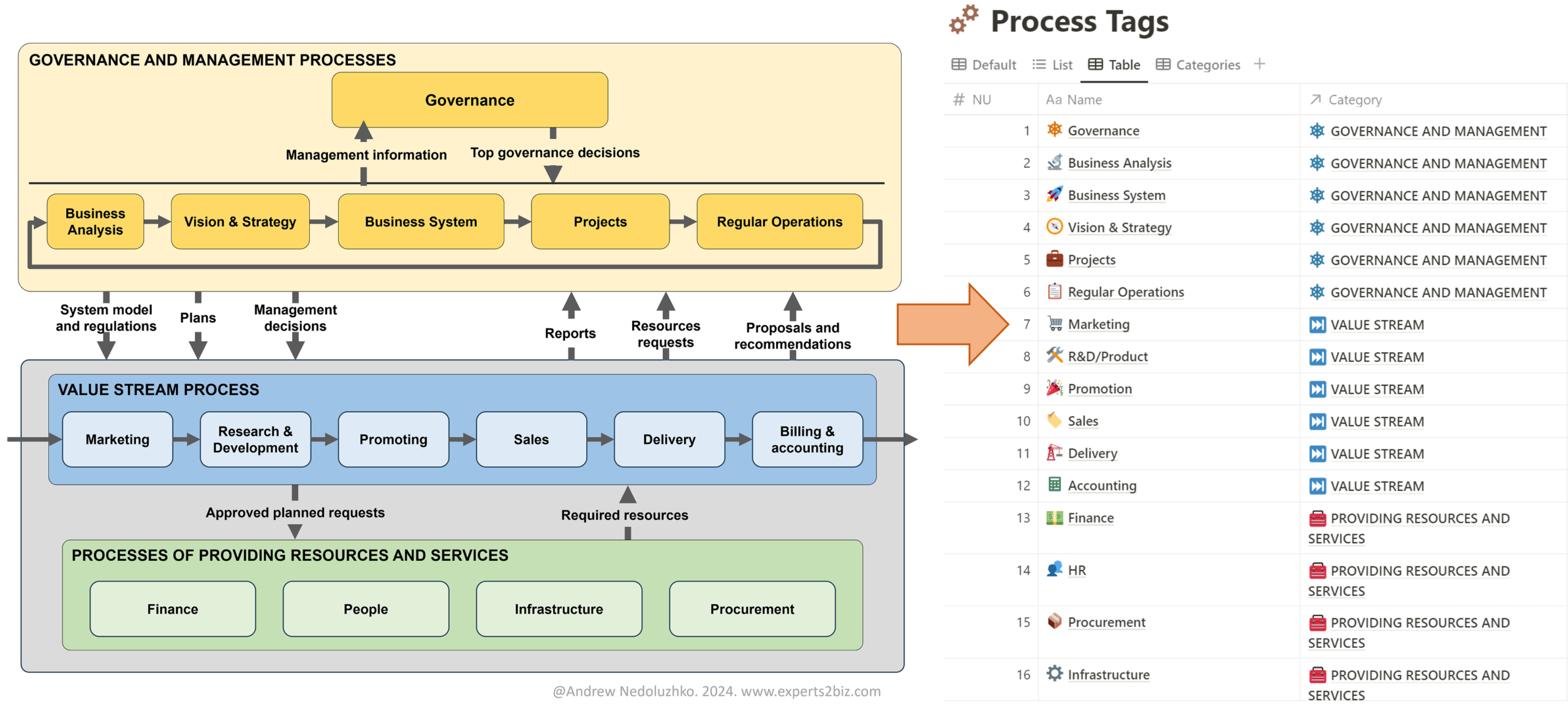
In previous article I briefly described business case, goals, approach and methodology to universal method of systematization and automation business based on Notion and Make. In this article, I will cover the First Step: Defining a high-level, holistic and integrated process model for the entire business. But before diving in, it is necessary to understand a number of key concepts and definitions.
Key Concepts and Definitions
The goal of first step is defining a high-level holistic and integrated model of processes for the entire business but before doing so, it is necessary to clarify some definitions and key concepts.
Key principles:
- Call things by their name and use clear and precise terminology. This mean avoid overly complex terminology terms, fashionable or confusing abbreviations that confuse all persons involved in the processes and management of the business and complicate the understanding of the system. The simpler, the better.
- Abstract approach. The application of an abstract approach enables the development of universal process models that can be adapted to various types of activities and business cases, which also simplifies and facilitates the understanding of business as a cohesive system.
Why Start with Defining High-Level Processes?
A common practice is to design Low-Code/No-Code solutions (as well as solutions based on hardcore coding 🙂) using a functional-based approach. A typical example is creating a TeamSpace’s aligned with the organizational or teams structure. While this is a standard solution, it inherits all the drawbacks of the functional management approach and fails to deliver the same level of business efficiency as a system architecture built on a process-based approach.
This is because, in the functional approach, the system is constructed around the existing or anticipated human resource structure rather than the natural flow of value-creating processes tailored to the chosen business activities and goals. As a result, the outcome is a bureaucratic system that operates less efficiently than one designed with a process-driven methodology. It’s also essential to remember that the ultimate goal of business automation is to automate processes, so it’s best to start with processes from the outset. The rest of this article will help you gain a deeper understanding of the application of the process-based approach.
Now let’s break down what the terms ‘high-level,’ ‘holistic,’ and ‘integrated’ mean.
High-level – at the initial stage, in order to build and use the system, we need the top level of the process model to see how the company creates value, provides resources, and manages the business without delving into details (details will be addressed in the following steps).
Holistic – processes are presented as a unified and complete business mechanism without omissions or disconnected parts, providing a full representation of the business processes required to achieve the company’s strategic and operational goals.
Integrated – all processes are interconnected; there are no isolated or ‘out-of-context’ processes.
Now, understanding the essence of these meanings, let’s explore how to define such a top-level model at a conceptual level, that is, briefly and without going into deep details.
Defining High-Level Value Stream Process
First, we define the core business process as the value creation flow. A basic example of a value creation flow can be represented by the abstract model shown in the diagram below:

In a sense, this is a classic value creation process (value chain) that has been utilized by manufacturing corporations for decades:

Depending on the type of activity, market niche, and specific characteristics, this approach can be adjusted and adapted to suit any business type:
For example, in some cases, it is convenient to combine the processes of promotion and sales:

Here is an example of how this might look for a service-oriented business:

There are also businesses where different value creation process models can be used. For example, in real estate development, I have encountered two different models:
First model for property development: The company first conducts marketing to determine market demand and develop a basic concept for the real estate project, and then, based on the concept, proceeds with the search and acquisition of the land:

Second model for property development: The company first finds and acquires the land, and then carries out the marketing processes and develops the marketing concept.

That is, any variations of the basic value creation flow process model are acceptable, as long as they suit your business case.
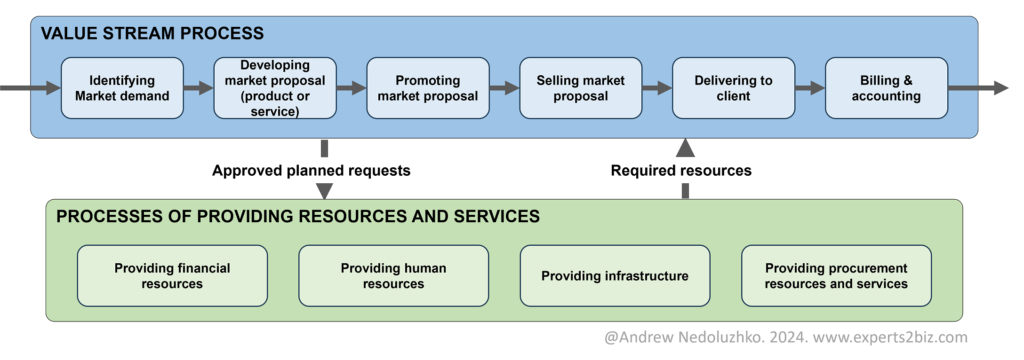
Defining the high-level processes that provide the value creation process with the necessary resources
A common problem in many companies is the presence of excessive providing processes or those that are overly complex and redundant. However, in most cases, these processes can be distilled into the following:
- the process of providing financial resources,
- the process of providing people (it can be called human resource provision, talent acquisition, or champion sourcing, but the essence remains the same),
- the process of providing infrastructure,
- procurement of resources.
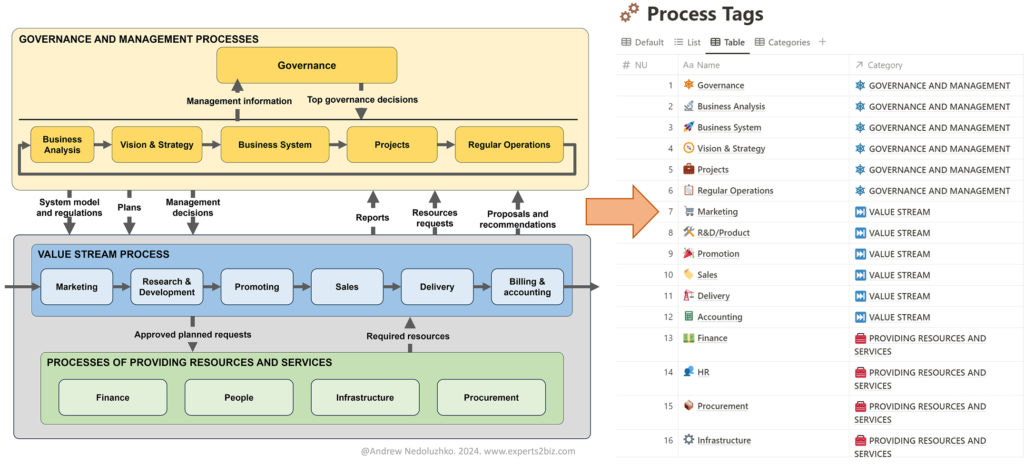
Conceptually, the resource providing processes are illustrated in the diagram below.
For clarity, let me highlight three important details:
First, it is essential to accurately understand the process of providing infrastructure. For instance, according to ISO 9001 standards :
The organization shall determine, provide and maintain the infrastructure necessary for the operation of its processes and to achieve conformity of products and services. NOTE Infrastructure can include:
- a) buildings and associated utilities;
- b) equipment, including hardware and software;
- c) transportation resources;
- d) information and communication technology.
That is, infrastructure is not limited to buildings, structures, or equipment; it also includes IT infrastructure, software, and cloud resources. In future articles, I will demonstrate how this process should be optimally organized to be efficient and account for all these details.
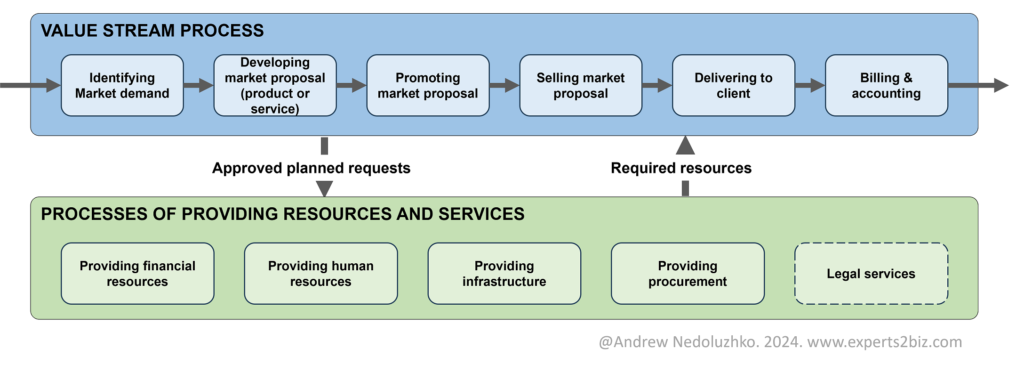
Second, readers of this article might argue that most businesses typically have far more support processes. However, if you aim to build the most efficient business model, almost all of these processes can be outsourced, consolidating them into a well-structured procurement process (which will also be examined in detail in future articles). At the same time, I fully acknowledge that in some business cases, additional processes may be required, such as legal support, PR, reputation management, and so on.
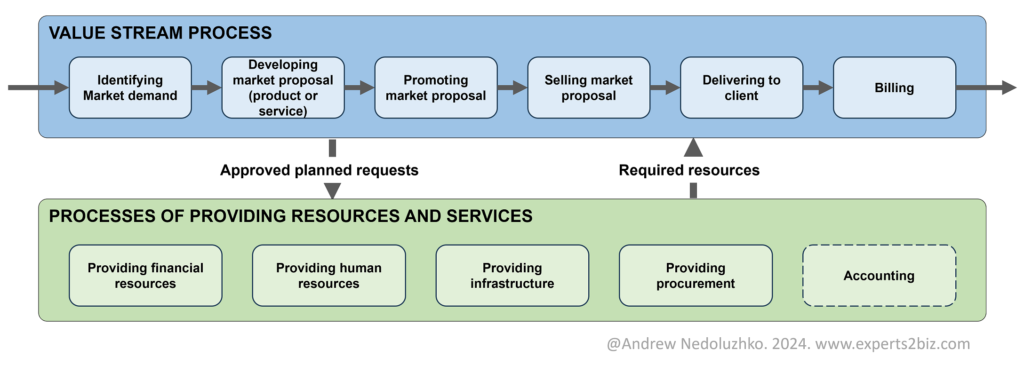
And sometimes, even parts of the value stream process can be moved to the provisioning process or outsourced through procurement. For example, the figure below shows that accounting is moved to a separate supporting process.
Defining the High Level Management Processes
On the one hand, these processes neither create value nor provide resources for the business. On the other hand, they are critically important for ensuring growth, scalability, and, at the same time, providing stability, reliability, and assurances to investors. However, practice shows that in most companies, this is the least systematized and optimized category of processes and often looks as shown in the next diagram. Over time, this leads to deep-seated business problems that are difficult to resolve because the company’s management does not understand the root causes of their origin.
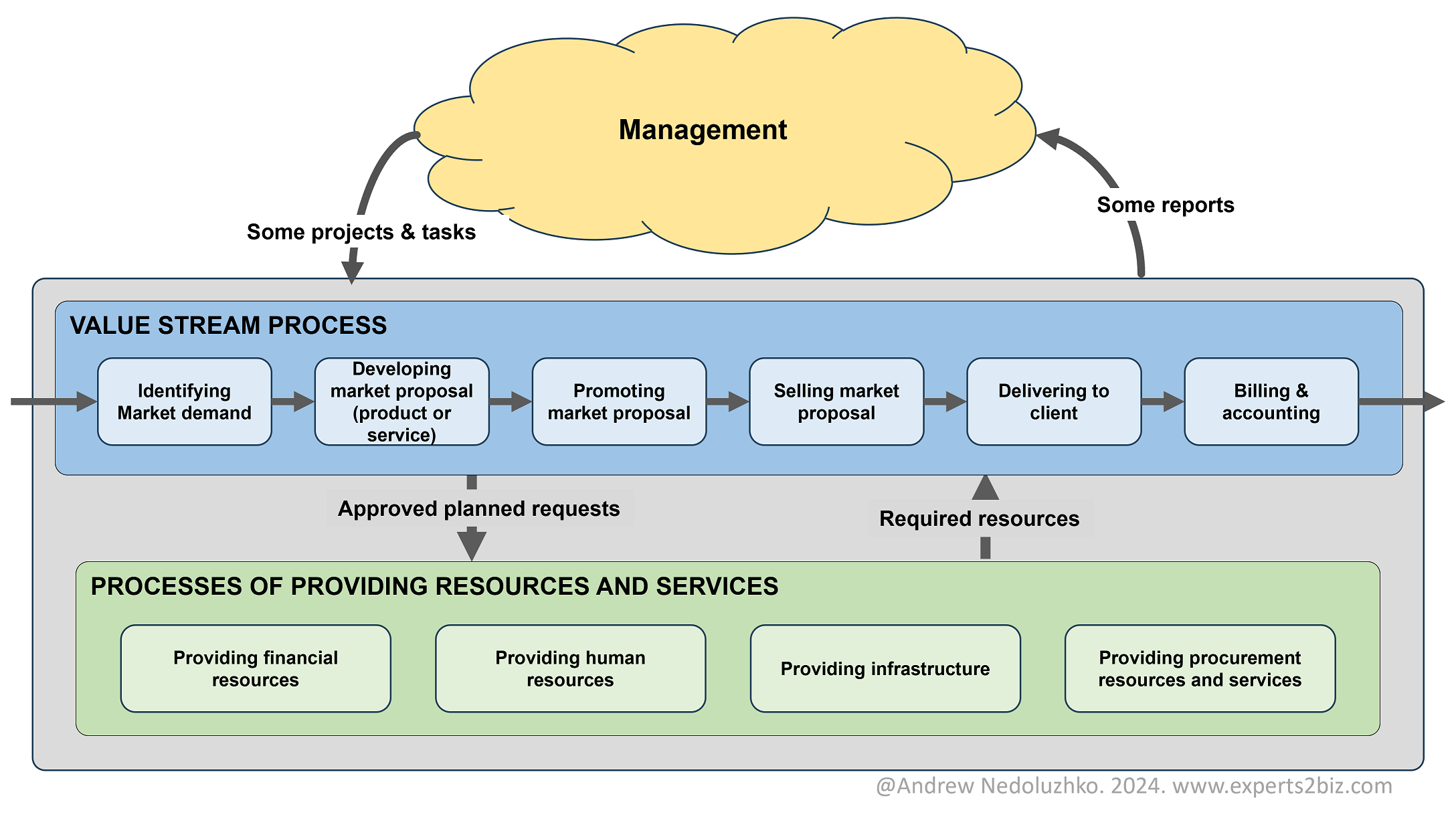
So, to build an effective management system, we must define, design, and implement the following high-level processes:
- Defining the current state of the business – A process for identifying, evaluating, and managing information about the company’s current state to figuratively understand where we are now.
- Defining the future state of the business and developing strategy to achieve it– A process for defining, formalizing, and managing the company’s vision for the future, as well as developing strategies and strategic plans to achieve that vision. Figuratively speaking, it is the formalization of where we want to go.
- Developing the tool(system) for implementing strategy and achieving the future state – The process of creating, developing and supporting a business system, that is, a tool that will ensure the achievement of strategic goals.
- Managing projects for strategy realization and achieving the future state – A process for managing internal development projects, i.e., projects (or portfolios of projects and programs for larger businesses) that enable the development of the company’s products/services, the building and improvement of business systems, and the execution of various unique tasks aimed at achieving strategic goals. In other words, it is about creating the conditions necessary to achieve the planned outcomes.
- Managing regular operations for strategy realization and achieving the future state – A process for managing operational activities aimed at delivering planned outcomes, such as productivity, sales volume, customer satisfaction, revenue, profitability, net income, and so on. In other words, all the process metrics used to evaluate results and determine whether the company is progressing toward its goals.
- Governance Decision Management – the pinnacle of the business system: a process of senior business leadership where the highest management decisions are prepared, made, and their execution is monitored.
It is crucial to understand that most companies attempt to implement strategic management by developing a vision, mission, and strategy without defining or understanding their current state. In other words, they design a roadmap for where the company wants to go without having a clear picture of where it is now. This is a critical mistake! The outcome is entirely predictable 🙂
As a result, we have arrived at a simple, fairly understandable, yet holistic and integrated model of high-level processes. The next step involves detailing these processes and formalizing them through the development of guidelines and automation. However, at this stage, it is essential to focus on other, more important and valuable actions, which will be carried out in the Notion environment so that users can see the system’s framework and utilize its basic elements.
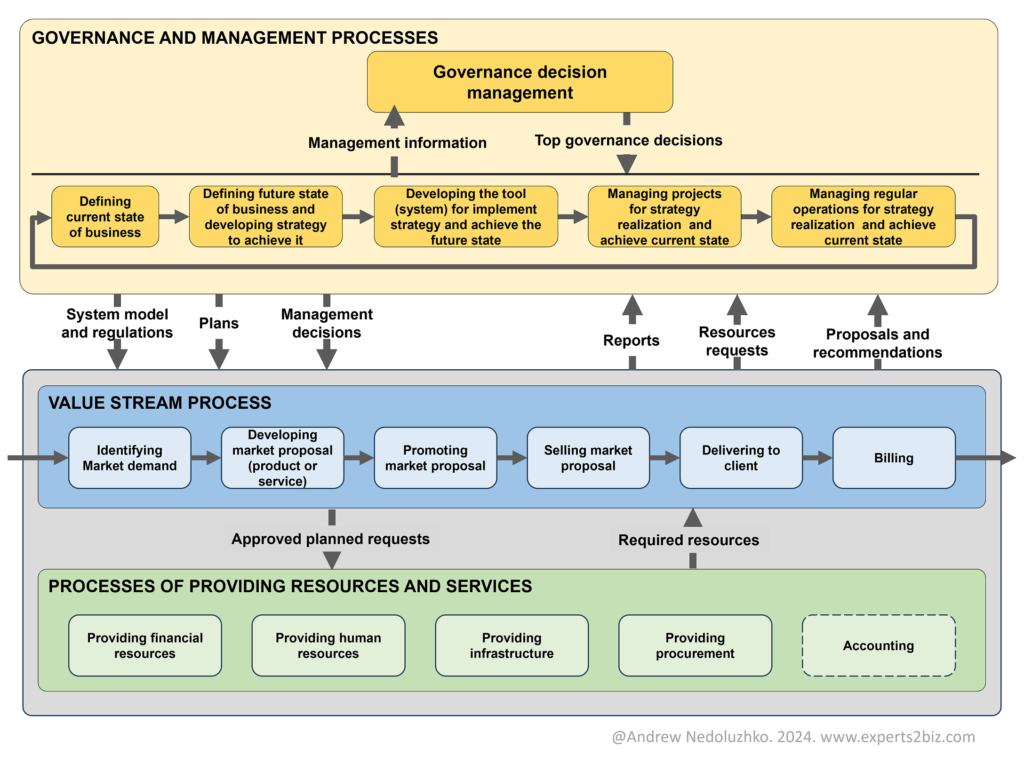
Defining a list of high-level tags reflecting the process model in our workspace
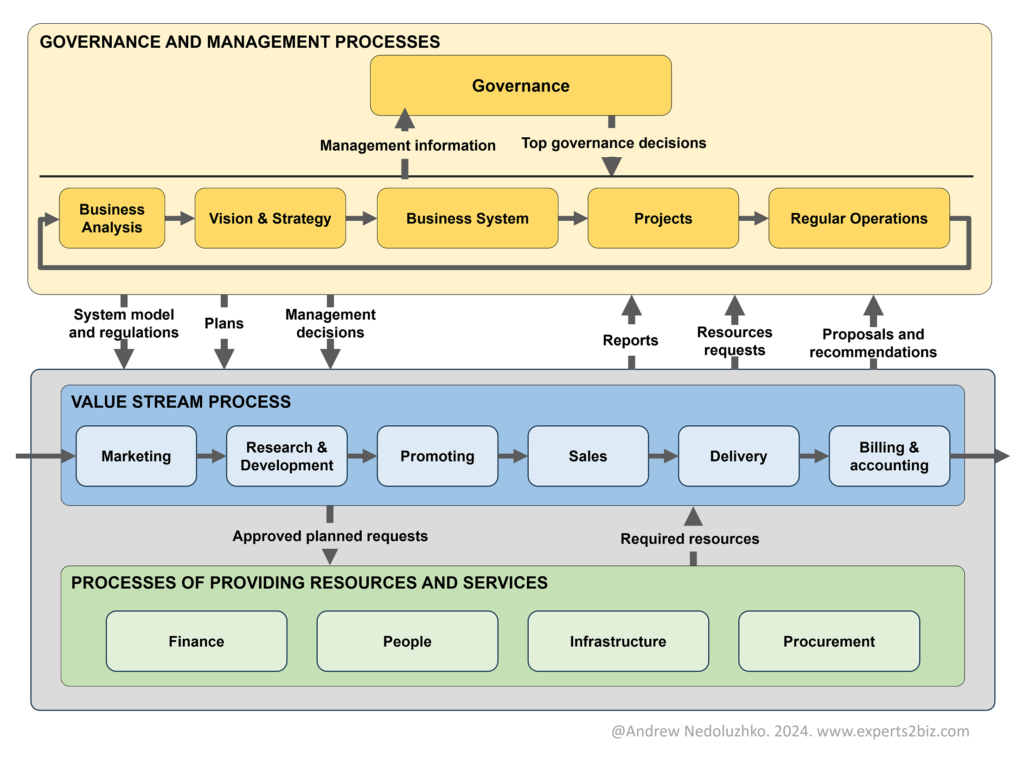
Based on the resulting model of high-level processes, we will define a list of tags that will play a central role in our system. The process names can be chosen arbitrarily, but it’s preferable to keep them concise and ensure they reflect the essence of the process. For this case, I arrived at the following tag structure
Let’s start using Notion
Create a Notion Workspace for Our Business Case
Then, we create a database table for process categories and a database table for process tags .
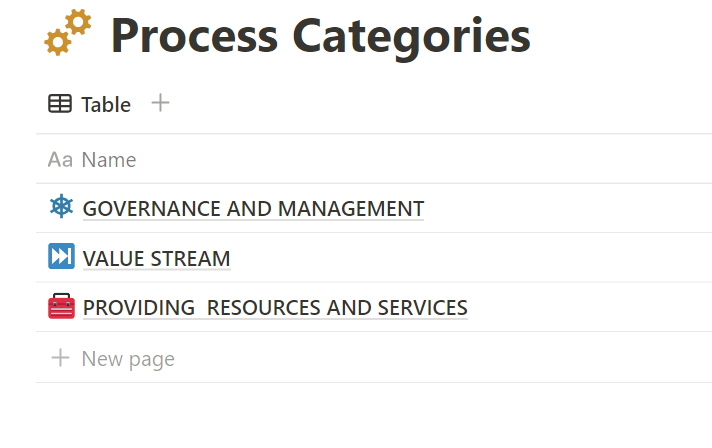
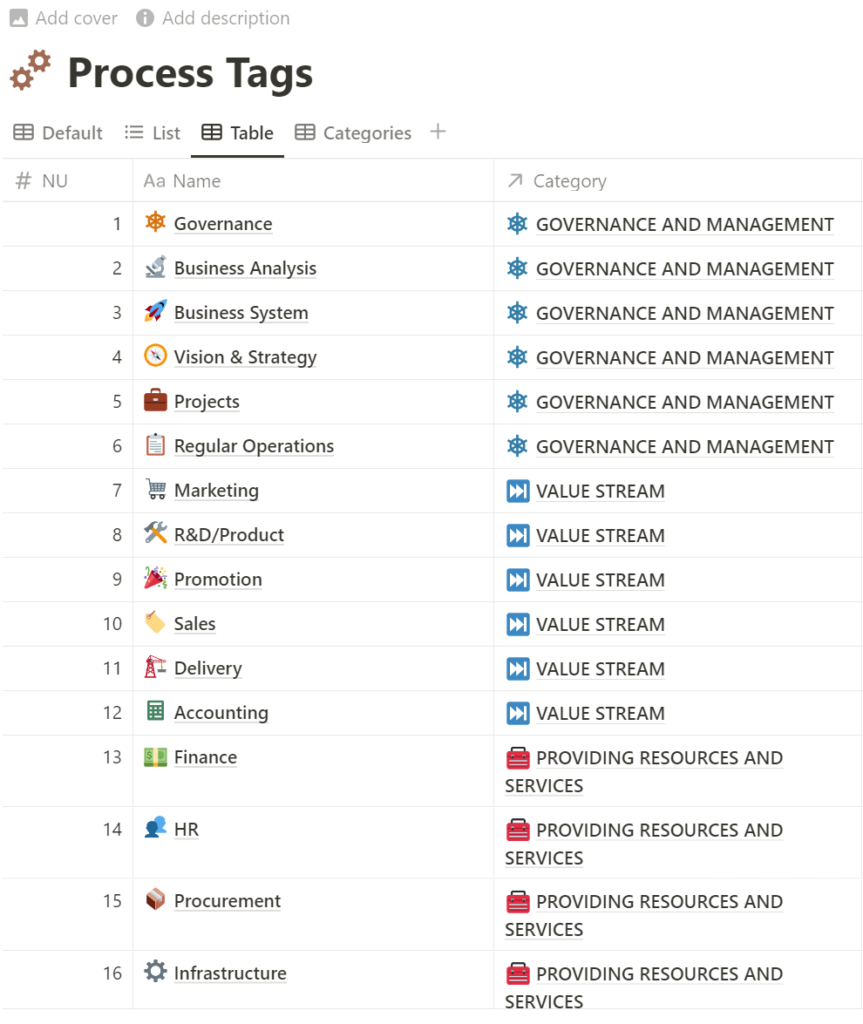
This list of tags will be used as a relational field (Relations) in various system elements, such as tasks, projects, issues, goals, and other system components.
Creating the workspace structure or team spaces reflecting the process model.
Now, we create the workspace structure or team spaces that correspond to the structure of process tags.
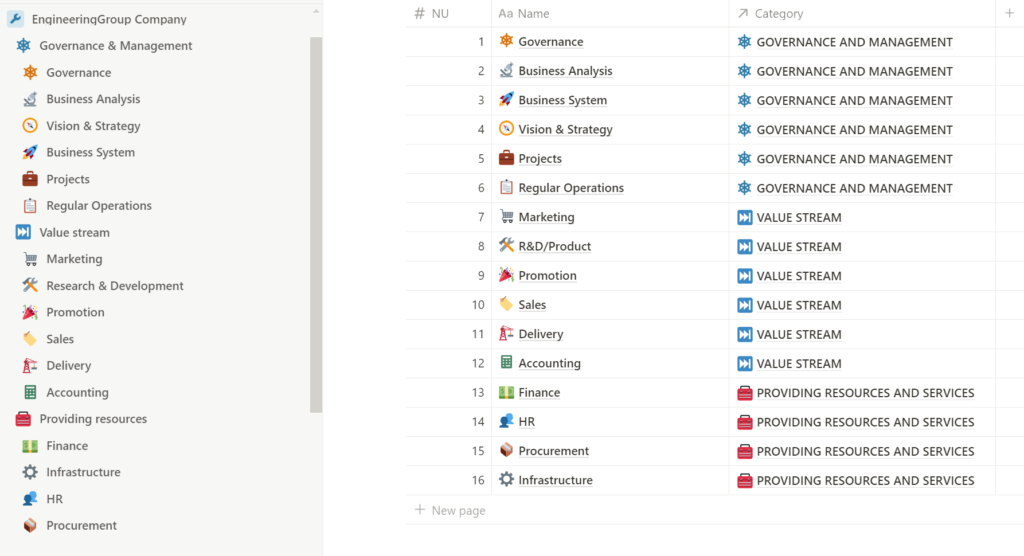
Move Process Categories and Process Tags to the Business System section
In the Governance section create a central Tasks database table and add a Process Tag column
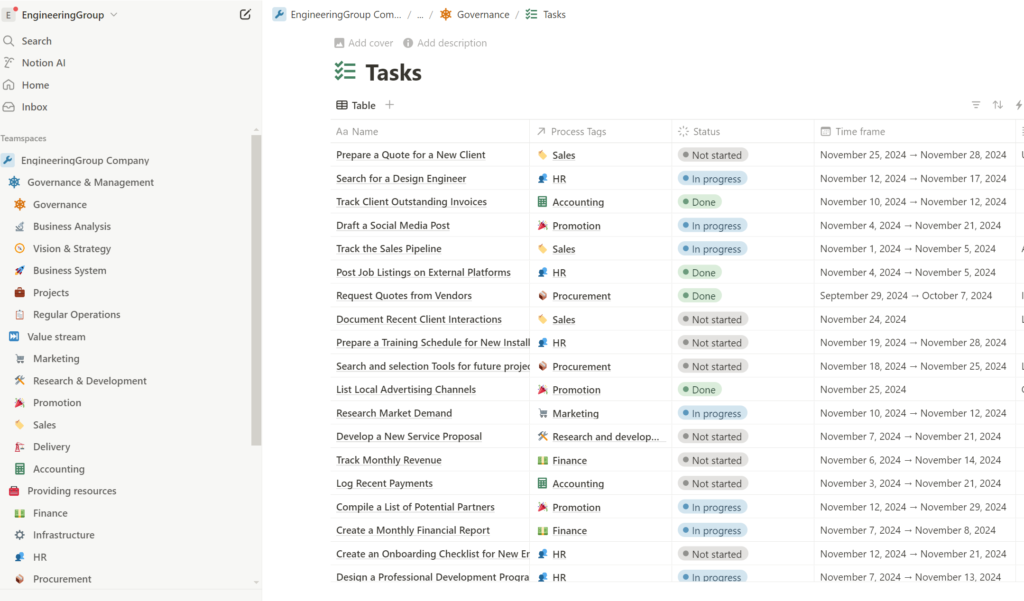
That’s it! The first stage is complete! We defined high level process model of entire business and set up Notion workspace according of this model. This is simple!
Benefits of the Work Done and Next Step
We did a simple and quick job but in line with a long-term systematization and automation strategy of business to build efficient business system. Without yet having a complete and detailed understanding of the algorithms behind specific processes, company employees can add tasks linked to specific process tags. This enables the collection of objective data for accurate and realistic process design. Additionally, employees using the system begin to develop habits of structuring and systematizing tasks while becoming engaged in the design and development of the business system. For example, they can identify recurring tasks related to specific processes and contribute to finding automation solutions. For each process, task views can already be configured to display tasks related to that process and integrated into the corresponding sections or TeamSpace’s of the system
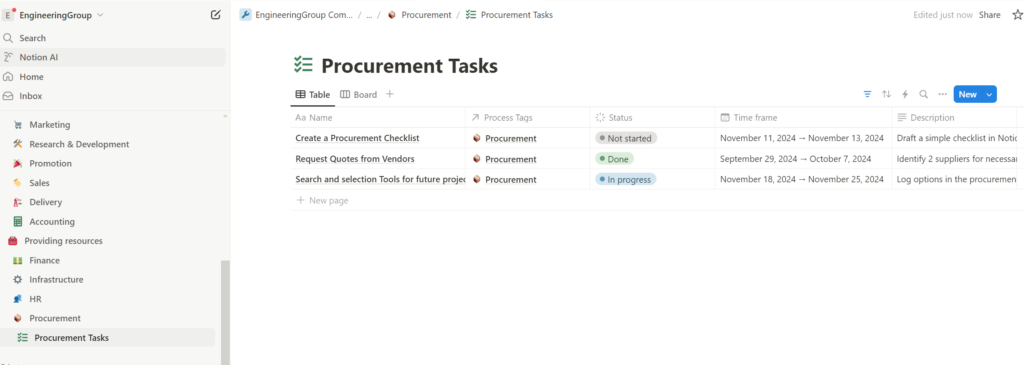
Create database tables for Process Registry, System Objects, Goals, and Metrics to further design the elements of the business system. This topic will be covered in detail in the next article.
Depending on their roles and responsibilities, users can already create the necessary business content within the system’s sections. This ensures that valuable content is centralized in one place while simultaneously being organized and linked to specific processes.
Summary and conclusions:
- The optimal way to start systematize business is define conceptual model of high-level business processes. Start designing the system by defining value stream processes, followed by resource-providing processes, and then business management processes.
- If the goal of the systematization is to create conditions for sustainable, growing, and scalable business, it is critically important to establish and implement management processes as outlined above. These processes are suitable for any business and require only minor adaptations in certain details, depending on the specifics of the particular business.
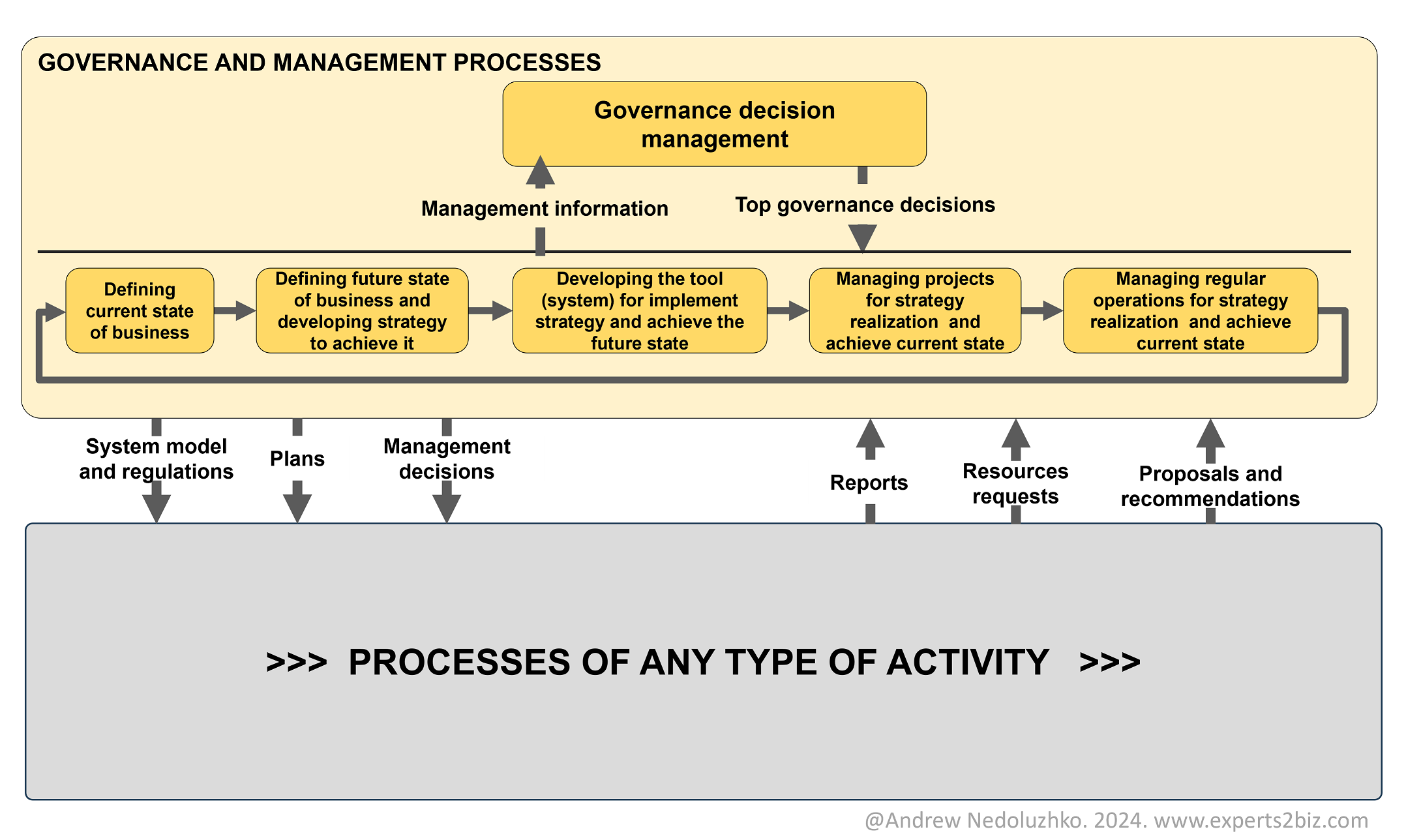
Figure 19 – Management processes are the key to creating conditions for a sustainable, growing, and scalable business - Once the high-level process model is established, you can immediately take the first steps in developing and using a business system based on LowCode/NoCode platforms such as Notion. This approach allows you to see the full picture of systematization and create a proper structure. This structure enables gradual system functionality growth, user engagement, risk minimization, and avoids chaos and information clutter in the future.
- As mentioned at the beginning, this approach can be used not only by different types of companies but also by solopreneurs, portfolio managers, and investment companies:
- For individual entrepreneurs, systematizing their activities into processes proves to be highly beneficial. It helps with better planning and prioritization, reducing the risk of overload, missed deadlines, or emergency tasks, while providing a clear framework for analyzing their activities. This structured, process-based approach not only aids in identifying routine tasks that can be automated but also facilitates delegating such tasks through outsourcing.
- Portfolio Management and Investment Companies can leverage this approach to build an efficient business system, where the core process flows from selecting a startup or investment object, through its development, to its sale and exit. And, of course, they can use this approach to improve the performance of their portfolio companies or startups.