Tag: Project Management

the application of knowledge, skills, tools, and techniques to project activities to meet the project objectives. It involves planning, organizing, executing, monitoring, and closing work to achieve specific goals within defined constraints such as time, cost, scope, and quality.

  • How to systemize and automate business with Notion. Step 4: Continuous development, maintenance and improvement business system according to plans

    How to systemize and automate business with Notion. Step 4: Continuous development, maintenance and improvement business system according to plans

    We have already completed the three main steps of systematization and achieved the following results:

    1. Built the process model of the entire business, which served as the foundation for structuring the Notion workspace. Based on this model, we organized the workspace accordingly and actively use process tags to systematize information in databases. In essence, the system architecture is based on the process model.
    2. Developed a set of services for creating the business system framework, which allows for a deeper understanding of the business as a holistic system and enables more accurate formulation of requirements for further systematization and automation.
    3. Examined in detail the life cycle process of systematization — including the processes of analyzing the current state of the business system and justifying the need for its development, developing the business system through projects, and supporting the current version of the business system.

    We now have a complete understanding and an initial set of tools, implemented directly in the Notion environment, that are necessary to plan and perform activities related to the development, support, and improvement of the business system. Planning should start at the strategic level, which must be represented by long-term business goals, and the systematization and automation goals should align with them.

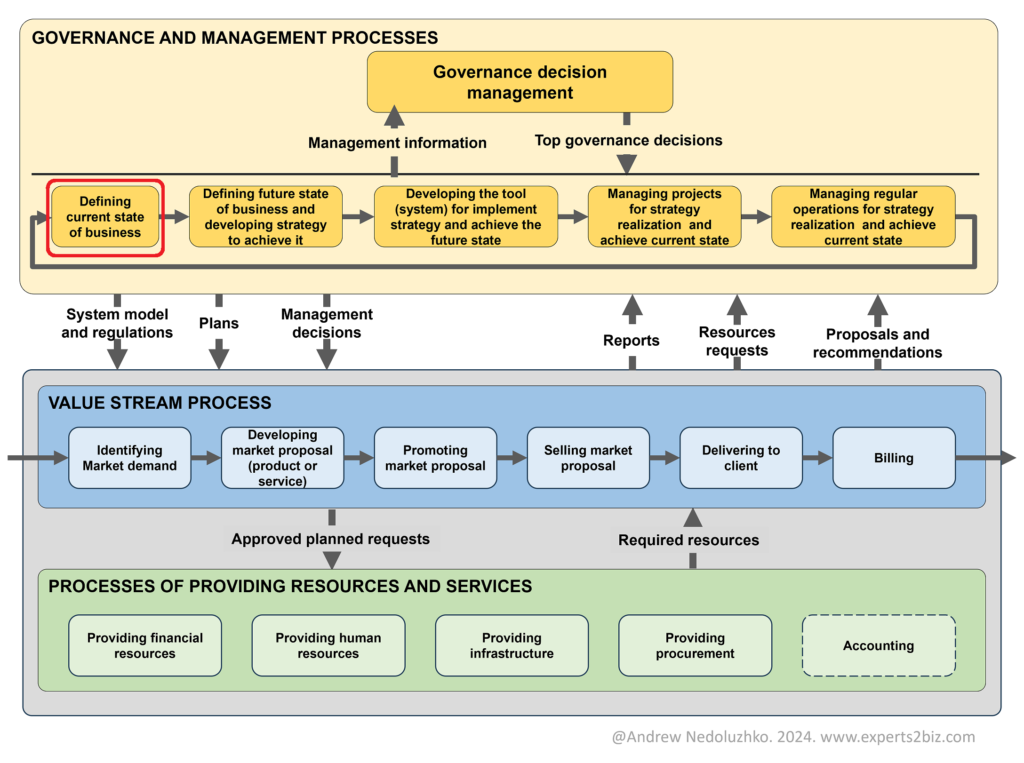
    But before moving on to defining goals, it is essential to clearly understand — and regularly monitor in the future — where the business currently stands. This is accomplished through the practice of business analysis, which is carried out in the process “Defining the Current State of the Business” in our holistic model (Figure 1)
    It’s reasonable to ask why I didn’t start explaining the business systematization methodology with this process. The answer is simple: at the beginning of such projects, the business usually has only a vague understanding of the goals, tasks, value, and impact of business analysis. However, after completing the earlier stages, achieving practical results, and gaining a comprehensive view of the business, the importance of this process becomes clear. At this point, developing business analysis expertise within the company also becomes justified.

    The result of the business analysis process — which serves as an input for defining the future state of the business — is the “Current Business State Assessment” document. In general, it includes the following components:

    1. Internal and external environment analysis
    2. SWOT analysis
    3. Stakeholder analysis
    4. Gap analysis
    5. Business requirements definition

    The “Current Business State Assessment” document is the key input for initiating the definition of the Vision, Strategy, and Long-Term Strategic Goals in the process “Defining the future state of the business and developing the strategy to achieve it.”

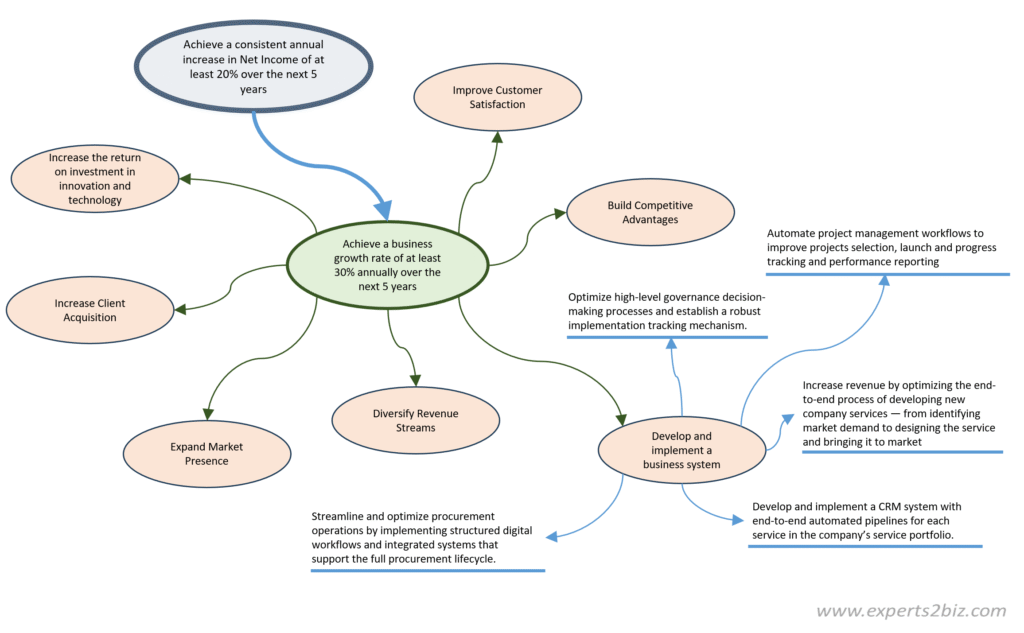
    Typically, strategic business goals include objectives such as increasing market share, improving financial performance, and enhancing the company’s market value. Goals related to the development of the business system are an essential part of long-term business goals, as they create the necessary conditions for achieving them (Figure 2).
    During the previous work, an initial draft structure of strategic goals was defined in the Goals database table (Figure 3), along with the initial goal for the development of the business system: “Develop and implement a business system to create the conditions necessary to ensure growth and achieve strategic business goals”.
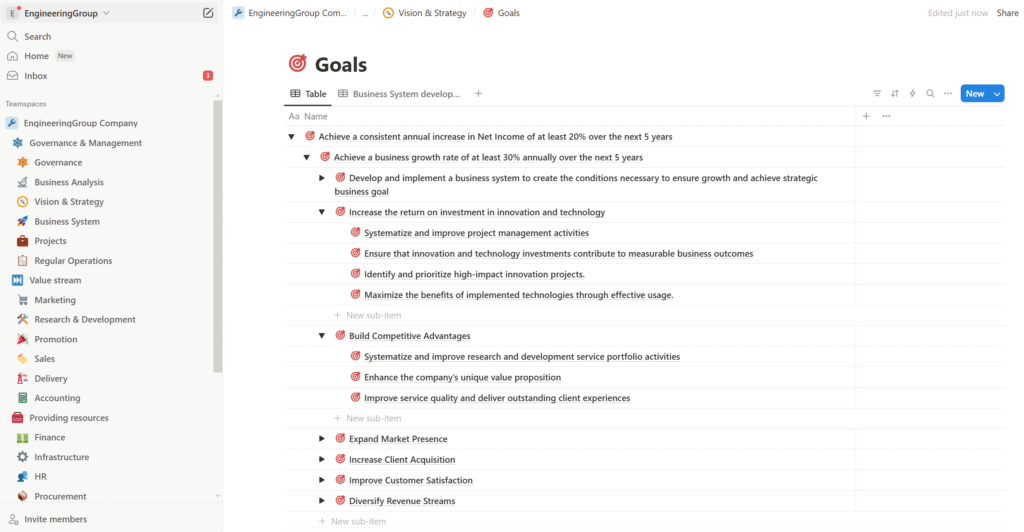
    This goal will be broken down into sub-goals, which we will present in the form of a strategic goal map. The elements of this strategic map will then be transformed into initial Innovative Proposals for developing the business system, triggering the business system life cycle processes described in the previous article. In this way, we move from understanding systematization processes to launching actual systematization and automation activities. Thanks to No-Code tools, systematization seamlessly and naturally flows into automation, and both can be carried out by the same team.
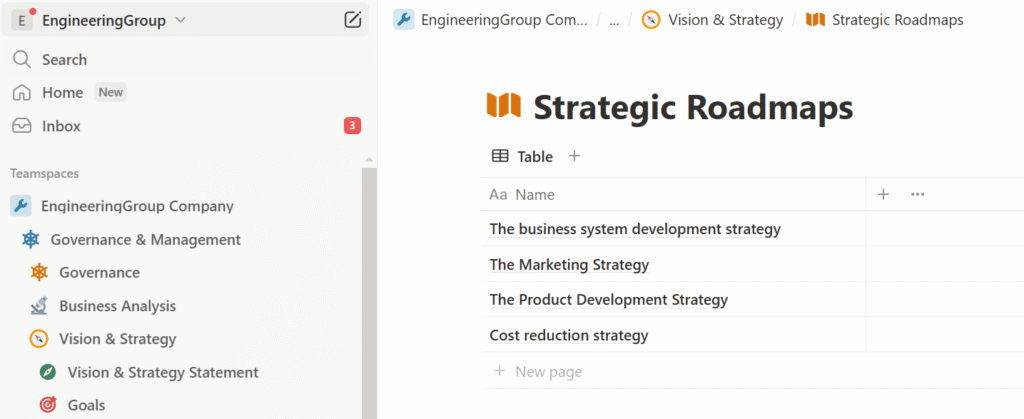
    To represent goals as strategic maps, create a “Roadmaps” database table in the Vision & Strategy section, where we have already set up linked views of the Goals and Indicators tables, as well as a section for drafting the overall vision, mission, and strategy statements. Then we can create a Relation property in the Goals table to link it with the “Roadmaps” table and create different views of roadmaps, as shown in the Figure 5
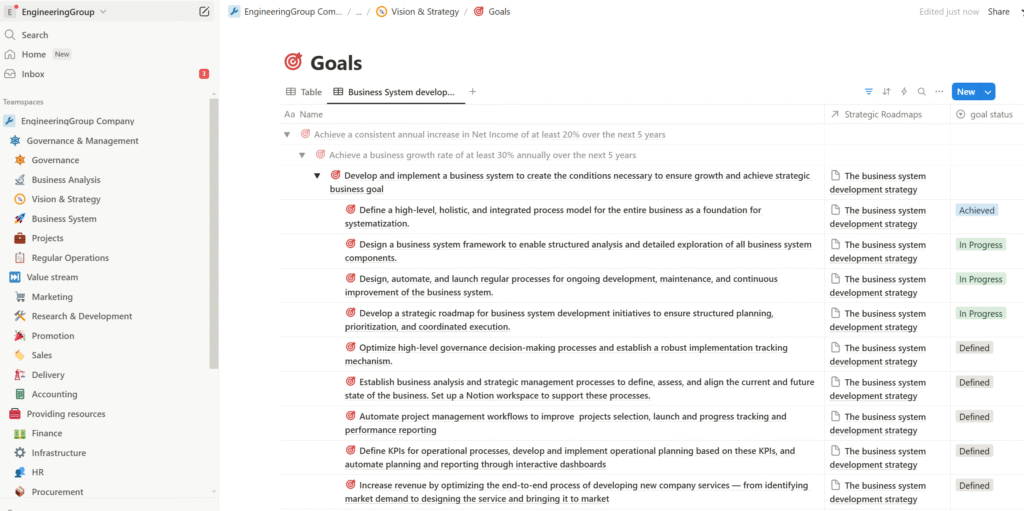
    Formalizing Business System Development Goals

    A great aid in setting the initial business system development goals is the use of the same business process model. We go through the top-level processes sequentially, identifying and formulating the most obvious and urgent goals for business system development — that is, for systematization and automation. Less obvious goals will become visible during further iterations of business system development. I usually recommend starting from the top of this diagram and moving downward — beginning with the ‘Governance and Management Processes’, followed by the ‘Value Stream Processes’, and finally the ‘Processes of Providing Resources and Services’. I will selectively provide examples of business system development goals and some of their characteristics:

    GOVERNANCE AND MANAGEMENT PROCESS CATEGORY

    Process: Governance Decision Management:

    • Goal: Optimize high-level governance decision-making processes and establish a robust implementation tracking mechanism.
      • Expected Result: Clear decision pipeline with tracking for implementation.
      • Time Frame: 3–5 weeks.
      • Metrics & Milestones:
        • Weekly decision review cycle in place.
        • Implementation status dashboard live.
      • Owner: CEO / Executive Assistant.

    Processes: Defining the current state of the business; Defining the future state of the business and developing the strategy to achieve it

    • Goal: Establish business analysis and strategic management processes to define, assess, and align the current and future state of the business. Set up a Notion workspace to support these processes and build supporting workflow automation.
      • Expected Result: Regular BA cycles (quarterly reviews), strategy updates, and Notion workspace setup.
      • Time Frame: 4–6 weeks.
      • Metrics & Milestones:
        • Strategic review page live in Notion.
        • SWOT and Current/Future state documented.
      • Owner: CEO / Strategic Planning Lead.

    VALUE STREAM PROCESS CATEGORY

    Processes: Identifying Market Demand, Developing Market Proposal for new or updated service, Promoting Market Proposal

    • Goal: Increase revenue by optimizing the end-to-end process of developing new company services — from identifying market demand to designing the service and bringing it to market
      • Expected Result: Clear innovation pipeline, tracked in Notion from idea to market.
      • Time Frame: 6–8 weeks.
      • Metrics & Milestones:
        • Time to market reduced by 25%.
        • Service development cycle documented.
      • Owner: CMO / CTO

    Processes: Selling Market Proposal

    • Goal: Develop and implement a CRM system with end-to-end automated pipelines for each service in the company’s service portfolio.
      • Expected Result: Notion-based CRM with workflows per service type.
      • Time Frame: 4–6 weeks.
      • Metrics & Milestones:
        • Pipelines running for 100% of services.
        • Conversion tracking enabled.
      • Owner: CMO

    Process: Delivering To Client

    • Goal: Optimize and automate the order fulfillment process to improve customer satisfaction, accelerate delivery cycles, and enhance cash flow.
      • Expected Results:
        • Faster, more accurate order processing and delivery.
        • Fewer fulfillment-related errors or delays.
        • Improved customer satisfaction (e.g., feedback, repeat purchases).
        • Accelerated conversion of orders into revenue (faster cash inflow).
      • Time Frame:
        • 4–6 weeks for workflow analysis, design, and first automation cycle.
      • Metrics & Milestones:
        • Average order fulfillment time reduced by 30%.
        • Error rate in order processing reduced to <2%.
        • Customer satisfaction scores increased by 15%.
        • Automated fulfillment tracking dashboard implemented.
      • Owner:
        • COO / Engineering Delivery Manager

    Process: Billing and Accounting

    • Goal: Integrate the accounting system with the Notion workspace to ensure automatic data exchange, timely financial settlements, and improved financial oversight.
    • Expected Results:
      • Seamless synchronization of key financial data (e.g., invoices, payments, expenses)
      • Reduced manual data entry and reconciliation errors
      • Faster and more accurate financial reporting
      • Timely client invoicing and payment tracking directly from Notion workflows
    • Time Frame:
      • 4–6 weeks for integration setup, testing, and rollout
    • Metrics & Milestones:
      • 100% of invoices automatically synced between Notion and accounting system
      • Manual input workload reduced by at least 70%
      • Financial settlements completed within standard terms >95% of the time
      • First automated monthly financial report generated from integrated data
    • Owner:
      • CFO / Accounting Manager

    PROVIDING RESOURCES AND SERVICES PROCESS CATEGORY

    Process: Providing Financial Resources

    • Goal: Implement financial supporting system (e.g., dashboards and automation tools) to enable seamless financial planning, monitoring, and reporting.
      • Expected Result: Budgeting, funding tracking, and financial dashboards in place.
      • Time Frame: 5–7 weeks.
      • Metrics & Milestones:
        • 100% projects tracked by budget vs. actual.
        • Monthly reporting cycle automated.
      • Owner: CFO / Financial Manager

    Process: Providing Human Resources

    • Goal: Optimize and automate the human resource management process to support hiring pipelines, onboarding programs, performance reviews, and full employee lifecycle management.
      • Expected Result: Automated hiring, onboarding, review, and offboarding flows in Notion.
      • Time Frame: 6–8 weeks.
      • Metrics & Milestones:
        • Time to hire reduced by 30%.
        • 100% employees tracked with review status.
      • Owner: COO / HR Manager

    Process: Providing Infrastructure

    • Goal: Reduce costs and increase utilization efficiency through the implementation of structured and streamlined workflows, along with supporting systems to manage infrastructure assessments, timely development cycles, incident handling, and usage monitoring.
      • Expected Result: Monitoring system for infrastructure with incident logs and optimization reports.
      • Time Frame: 4–6 weeks.
      • Metrics & Milestones:
        • Downtime < 1%.
        • Issue response time reduced by 50%.
      • Owner: CTO / Infrastructure Manager

    Process: Providing Procurement Resources and Services.

    • Goal: Streamline and optimize procurement operations by implementing structured digital workflows and integrated systems that support the full procurement lifecycle.
      • Expected Result: Procurement process database with workflows and automation.
      • Time Frame: 3–5 weeks.
      • Metrics & Milestones:
        • Requisition-to-approval cycle reduced.
        • Vendor data maintained with 100% accuracy.
      • Owner: COO / Procurement Manager

    Next, based on the goals, innovative proposals are formed and the processes described in the previous article are launched. As a result, we get the following end-to-end management workflow: Current Business State Assessment—> Vision and Strategy Statement —> Business Strategic Goals (Strategic Plans)—> Business System Development Roadmap —> Business System Development Innovative Proposals —>Business System Development Feasibility Reports —> Business System Development Projects (Project plans and Tasks) —>Current Version of the Business System Under Maintenance (Operational Plans based on KPI’s and Tasks)
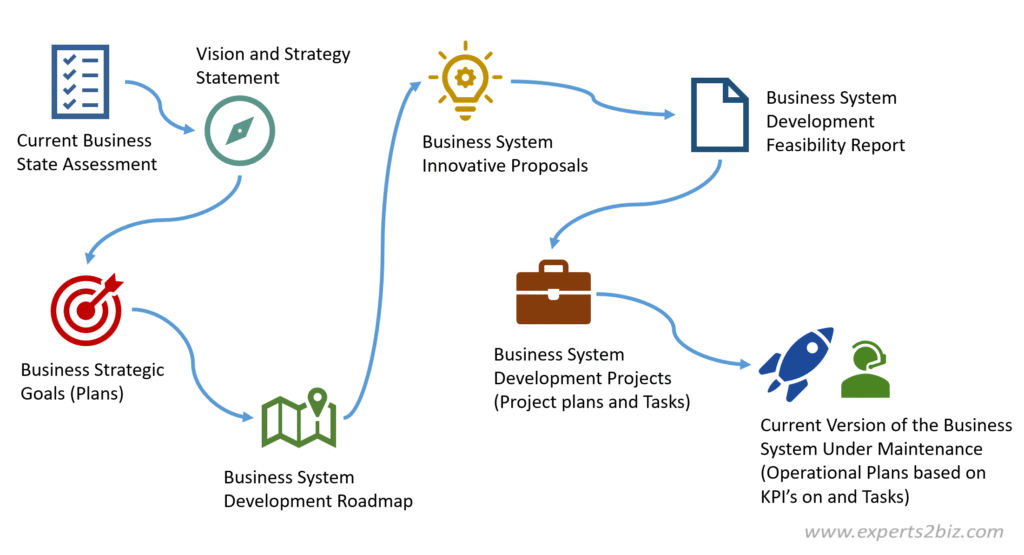
    The gradual launch and regular execution of this workflow ensures that the business reaches a new level and achieves sustainable development in line with the approved goals.

    Benefits of Work Done

    Strategic Alignment and Shared Vision

    A comprehensive view of management processes and their role in the development of the business system ensures maximum management efficiency, transparency, and traceability in decision-making and business system development. This approach to organizing management processes provides full control over the implementation of projects aimed at achieving strategic goals and maintaining long-term focus. As a result, we achieve significant time savings for the key people in the business — and their time is expensive!

    Standardization and Template-Based Implementation

    We can apply a similar approach and its implementation to marketing, product and service development, and resource provision processes — that is, an end-to-end process from current state analysis and goal setting, through projects, to regular operations. As a result, we achieve significant cost savings through standardization and template-based implementation.

    Automation

    Now we can gradually automate the processes — first as standalone procedures, and then, where possible, integrate them into end-to-end workflows. This leads to increased productivity, faster execution, and, consequently, improved business profitability

    Using AI

    The step-by-step creation of database tables in Notion that we carried out at each stage of systematization, along with the use of Relation columns to link the tables together, ensures proper structuring of information and data. This, in turn, enables the most efficient and accurate use of AI for automating even complex analytical tasks.

    Improving High-Level Planning and Prioritization

    Agility – we can proactively make changes to the roadmap by adjusting the sequence of goal achievement in case circumstances change or new opportunities arise.

    Having a roadmap allows for calm and unhurried planning of business transformation projects, enabling timely reservation of necessary resources, adjustment of timelines, and thus optimizing and making the most rational use of available resources.

    Stronger Management Control and Focus

    • Gives managers a structured reference point to track progress and maintain focus over time;
    • Prevents loss of direction during daily operations or when priorities shift;
    • Enables regular strategic reviews and informed adjustments.

    Overall Summary and Conclusions

    The comprehensive view

    We have completed all four steps to systematize business to gain fully understanding the approach of systematizing business, prepare and provide readiness for further automation. Having a comprehensive understanding of the methodology implemented as a set of management processes allows for confident, stress-free, and timely progress toward the development and implementation of the business system.

    Establishing Control

    My systematization approach starts by uncovering and structuring the core management processes—their sequence, logic, and interdependencies. These foundational processes must come first in building a business system. If they are not properly designed and functioning, the rest of the processes cannot be effectively launched or operated. Inefficient management processes inevitably lead to inefficiencies across the entire organization. By focusing initially on these key processes and activating their operational mechanisms, we establish real control and oversight over all other business functions. This creates a truly effective, integrated, and sustainable business system.

    Services that support management processes

    While studying the proposed approach, we created a set of Notion database tables to support effective work on defining the current state of the business, envisioning its future state, formulating long-term strategy, working with goals and roadmaps, analyzing, developing, and maintaining the business system, and managing projects and operations. Many of these services will be used not only for the business system lifecycle but also across all business processes, including marketing, R&D, promotion, sales and service delivery, accounting, and providing resources. These database tables will also support further automation and the application of AI to elevate business productivity to the next level.

    Readiness for Launch

    The results obtained make it possible to develop a roadmap for business system development, define and sequentially launch the necessary projects, and maintain full control over their execution, scope, and allocated resources — while flexibly making adjustments and changes in response to shifts in both the external and internal environment. And we are now ready to consider implementing some workflow automation.

    Progress Review: Achieving the Business Systematization Goals

    Let’s review which of the goals, outlined in the business case from the first article, have already been achieved:

    1. Unified System of Processes: To systematize the company’s business processes to create a comprehensive and holistic view of these processes, one that all employees can understand and accept.
      Status – ✅ Achieved: We developed a holistic and integrated process model of the entire business and created the Notion database table ‘Processes’, filling it with the actual process structure
    2. Collaborative Work: Enable users to operate within a unified collaborative system that lays the foundation for future automation.
      Status – ✅ Achieved: We chose and started using the Notion platform for collaborative work and as a foundation for future automation.
    3. Engagement: Ensure employees are both engaged and motivated to improve processes and contribute to the development of the business system.
      Status – ✅ Achieved: We have already started engaging people in systematization on three levels:
      • First level: The company workspace structure reflects the process model of the entire business, helping to organize information properly and avoid chaos.
      • Second level: Process tags are used across various database tables to structure goals, projects, tasks, feasibility studies, resource procurement, and more.
      • Third level: The ‘Innovative Proposals’ database table provides an opportunity for employees to propose ideas for improving the business system and other aspects of the company.
    4. Automation and Control: Automate collaborative processes to minimize routine tasks while maintaining control and access to process analytics.
      Status – ⏳ In Progress: We have completed the preparatory work for process automation and are ready to begin the sequential automation of the most important and critical workflows. The most interesting automation cases will be explored in the upcoming articles
    5. Systematization Strategy: Develop a clear understanding and vision for how to build and evolve the system in alignment with the business’s long-term goals and objectives.
      Status – ✅ Achieved. We created the Goals and Roadmaps databases and defined key automation and systematization goals aligned with our long-term strategy to drive the business forward.

    We have successfully completed 4 out of the 5 goals defined in our business case. The remaining goal—automation and control—is actively in progress. Key steps and practical examples for achieving it will be explored in the next articles.

  • How to systematize and automate business with Notion. Step 3: Launch regular processes of ongoing business system development, maintenance and improvement

    How to systematize and automate business with Notion. Step 3: Launch regular processes of ongoing business system development, maintenance and improvement

    At this step, we will focus on explaining the mechanisms of the processes for building, developing, improving, and maintaining the business system.

    Implementing such a process mechanism addresses the core challenge of business systematization: before systematizing the business itself, it is necessary to first build and launch the systematization processes to reduce potential risks and achieve greater impact. It’s also impossible to create a perfect business system instantly. We can’t create it within a single project or even a series of projects. Because there are three main factors affected there:

    • The first factor is accepting reality — a realistic understanding of the current state of business systematization in relation to the desired outcome. That is, if you’ve attempted to complete Step 2, which is to develop a business system framework, you’ve probably already realized that even properly formalizing the structure of goals and processes is quite challenging. You’ll likely need to revisit, review, and adjust what has already been done from time to time. And sometimes, you may even need to pause the work to gather more information — for example, actual performance data to refine the goals, or feedback from process participants regarding how those processes are carried out.
    • The second factor is the external environment — everything happening around your business. Market changes, innovations, new methods, products and technologies, emerging markets, regulatory changes, and the appearance of new competitors will all require you to review and adjust your products, services, processes, goals, and strategies for achieving them. Accordingly, from time to time, it is necessary to make changes to the existing business system to ensure that the entire business aligns with market realities and remains profitable and competitive.
    • The third factor is the human factor. First, people within the business need to mature in order to embrace a systematic approach — and not everyone can do this quickly. It often takes several cycles or iterations before they begin to view the business as a system, think systematically, make decisions systematically, and act accordingly. Even more importantly, as new elements and functions of the business system are implemented, those involved in the business will begin to discover new opportunities for growth and generate fresh ideas for development. This will also lead to changes in the existing system, prompting further improvement and evolving of the business system.

    In other words, a recurring, cyclical (iterative) approach will be more effective than scattered, impulsive projects. Of course, there are businesses with extremely simple business models and technologies, or those operating in stable markets — and even there, such a cyclical approach can still be effective; the cycles of change and development in the business system will simply occur less frequently and at a smaller scale. However, for dynamic, growing businesses or those operating in highly competitive markets, one must be prepared for a large number of repeated business system development projects before reaching any level of stabilization.

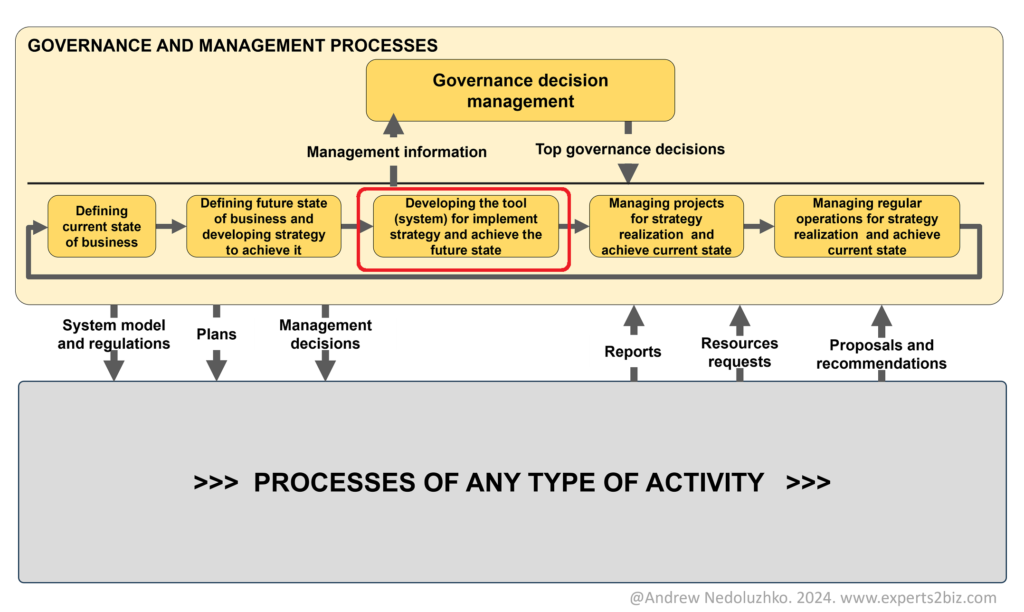
    Before we move on to designing this process and developing services in Notion to support and automate it, we need to pause and consider the context of the process — that is, to understand its inputs and outputs. In the article where I discussed the development of a high-level process model of the entire business, I presented the following conceptual diagram:

    In this diagram, the process “Developing the tool (business system) for implementing strategy and achieving the future state” represents the business system lifecycle process — or, for short, the Systematization Process.

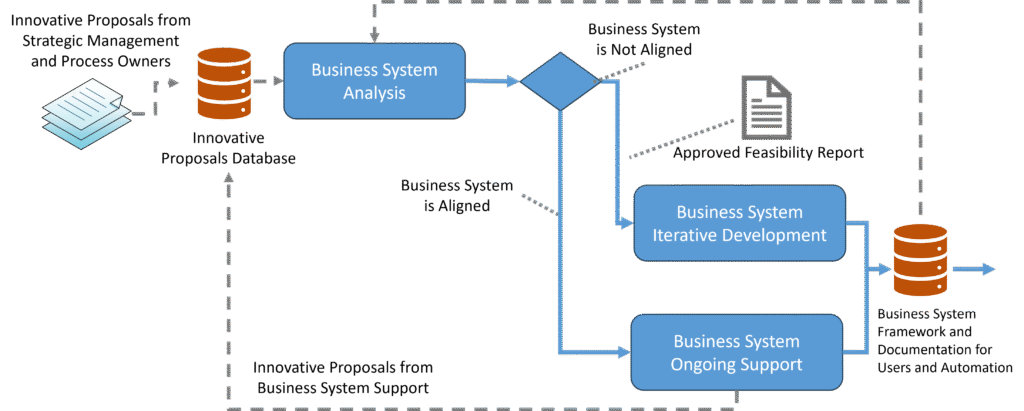
    This diagram implies that the main input for the business systematization process is the outcome of the strategic management process: “Defining the current state of the business and developing the future state of the business.” These outcomes can be presented as innovative proposals for the development of the business system. In addition, such proposals can be created by managers or owners of various processes. Innovative proposals may also be formed within the systematization process itself, during the execution of operations supporting the current version of the business system. An innovative proposal is essentially an idea aimed at improving existing business processes. Small companies and solopreneurs may use the term ‘ideas’ for simplicity and convenience, while still understanding the purpose of these ideas.

    The output of the process is the business system framework in the form of Notion databases containing elements of the business system, the development of which was presented in the previous article, along with supporting documentation in the form of various regulations, procedures, or instructions. This documentation elaborates on the framework and can be stored directly in the corresponding database records. For example, we can store instructions in the description of a particular process, or a brief draft of a roadmap in the record of a specific goal, and so on. The structure and documentation of the business system are also used to ensure the correct execution and automation of all business and control processes—so we can make sure that all our processes are properly configured and functioning, and that any nonconformities identified are either resolved immediately or formalized as innovative proposals to be implemented in future iterations of business system development.

    The Business Systematization Life Cycle Process

    Now let’s examine the internal structure of the process “Developing the tool (business system) for implementing strategy and achieving the future state.” When we look at this process as the life cycle of a business system, we can distinguish four categories of activities or tasks that must be performed to achieve optimal results. This approach allows for a more structured and effective design of the business process. These categories include:

    • Analytical tasks. These are discrete tasks that need to be performed periodically to assess whether the current state of the business system meets present needs. If it does not, we must prepare and approve a rationale for initiating changes, which serves as the basis for launching a change project and reserving and allocating the necessary resources for its implementation.
    • Project tasks. Once a project is initiated, we must clarify the requirements, carry out the design of the changes, implement those changes, and finally integrate them into the business operations.
    • Regular operations. This involves maintaining the current state of the system, which includes identifying and resolving nonconformities and deviations, making minor updates to the framework and documentation of the business system, or preparing innovative proposals for further development.
    • Management tasks. We must manage each type of activity (analytical, project-based, operational), meaning we need to plan, monitor execution, measure, and analyze the outcomes.

    Accordingly, we arrive at the following model of the business systematization lifecycle process.

    This process includes three sub processes: Analysis, Development, and Support of the Business System. The words ‘Iterative’ and ‘Ongoing’ are not necessary – I added them to emphasize this aspect. Now, let’s take a closer look at each of them.

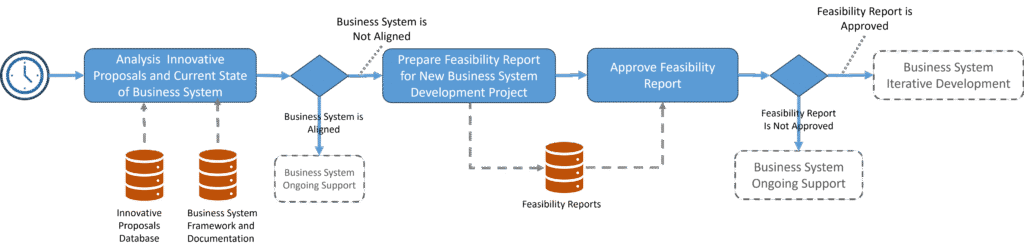
    The Business System Analysis Subprocess

    This process have the next logic:

    1. Innovative proposals are collected in a database table and, at a set interval—monthly, quarterly, or semi-annually—these proposals are reviewed. It is possible that there are no proposals at all, or too few and too minor to justify a system-development project. In that case, we simply continue supporting the current version of the business system.
    2. If, however, there are enough innovative proposals, the next step is to prepare a Feasibility Report to justify launching a new business-system development project. Once the report is drafted, it goes through an approval process:
      • If the Feasibility Report is approved, the business-system development project is initiated.
      • If the Feasibility Report is not approved, we continue to support the existing system until the next scheduled review of innovative proposals against the current state of the business system.

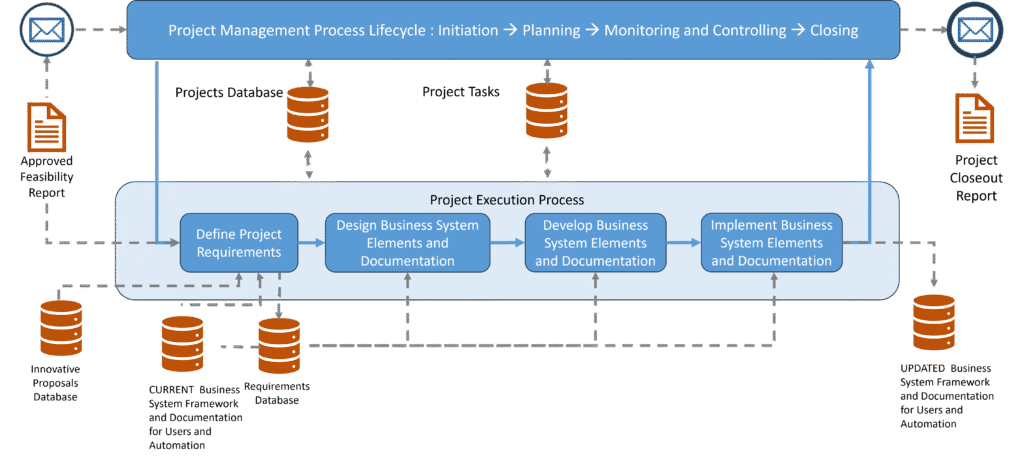
    The Business System Development Subprocess

    The logic of this process is as follows. It consists of two subprocesses:

    1. Project Management Process, which includes the classic project management processes: Initiation, Planning, Monitoring and Control, and Project Closure.
    2. Project Execution Process: which involves the sequential steps of Defining Requirements, Designing Business System Elements and the structure of necessary documents, Developing Business System Elements and documents, and Implementation.

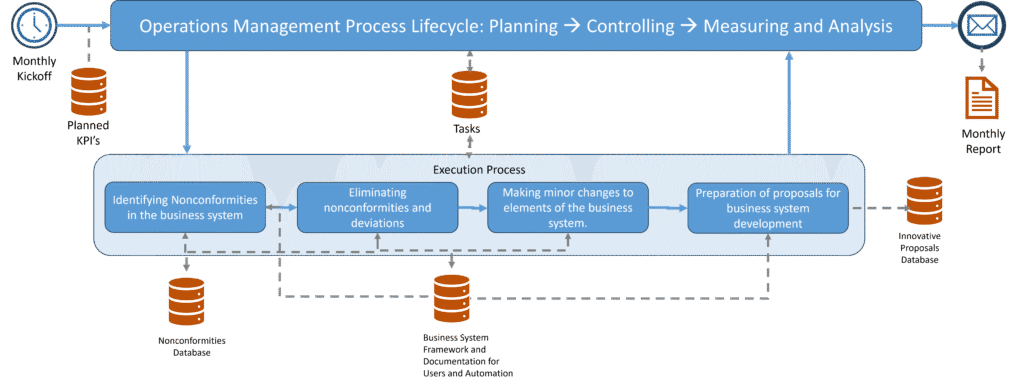
    The Business System Support Subprocess

    As in the previous case, the word ‘Ongoing’ is not necessary. I added it to emphasize this aspect as well.

    The Business System Support process also consists of two sub processes:

    1. Support Operations Management Process, which includes Planning, Control, Measurement, and Analysis.
    2. Support Operations Execution Process, which includes the following execution steps:
      1. Identifying Nonconformities and Deviations in the Business System,
      2. Eliminating Nonconformities and Deviations in the Business System,
      3. Making Minor Changes to Business System Elements and Documentation,
      4. Preparing Proposals for the Development of the Business System.

    It is important to understand that at the start of the systematization activities, innovative proposals will mainly be formed based on strategic goals, which will indicate which projects we need to implement in order to achieve the desired business system. The frequency of such projects will be high at first; then, a stabilization period will follow, during which the frequency of such projects will decrease, and innovative proposals will mainly be generated by process owners or managers, as well as by the business system support process.

    Realization in Notion.

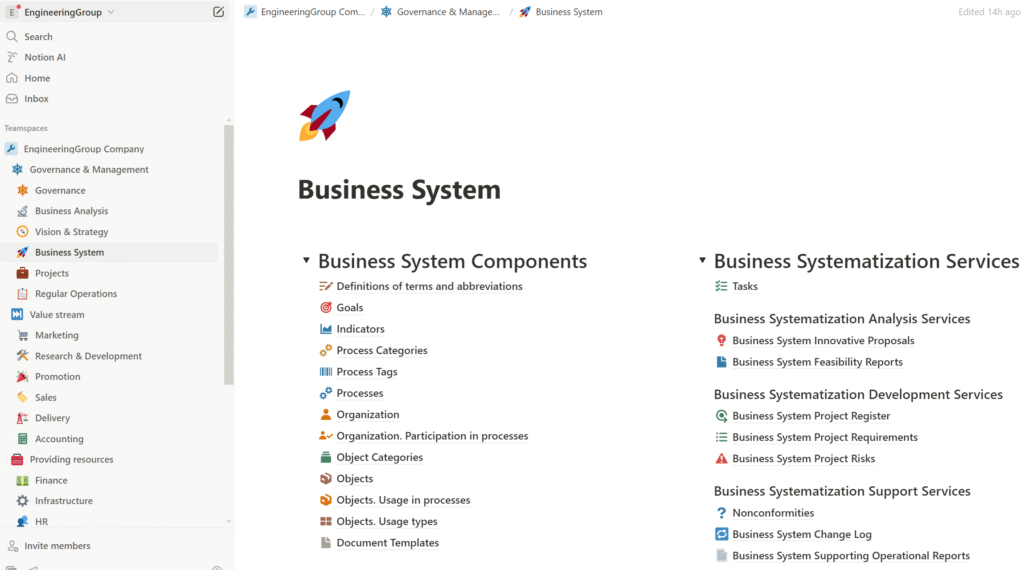
    The systematization life cycle diagrams clearly show which Notion database tables must be created next to launch the building, improvement, and support of the business system.

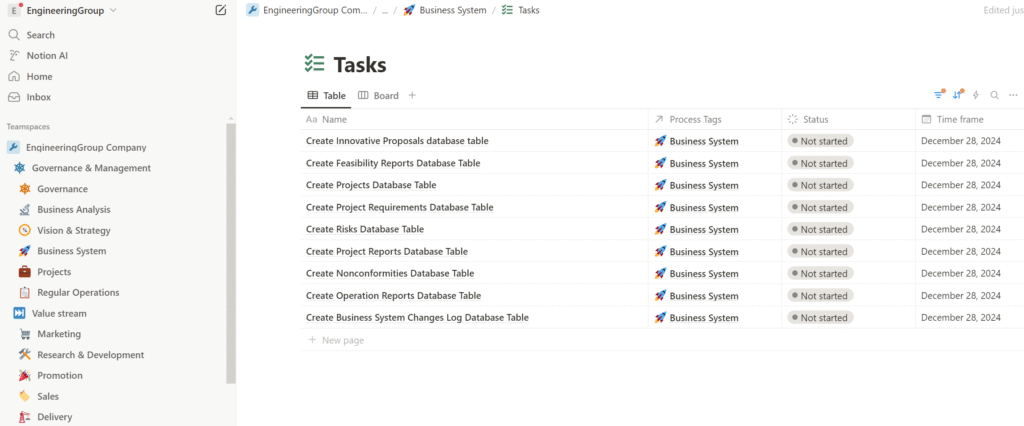
    So, we should add next portion of tasks in the Tasks database table with “Business System” tag and start executing them:

    1. Create Innovative Proposals database table;
    2. Create Feasibility Reports database table;
    3. Create Projects database table;
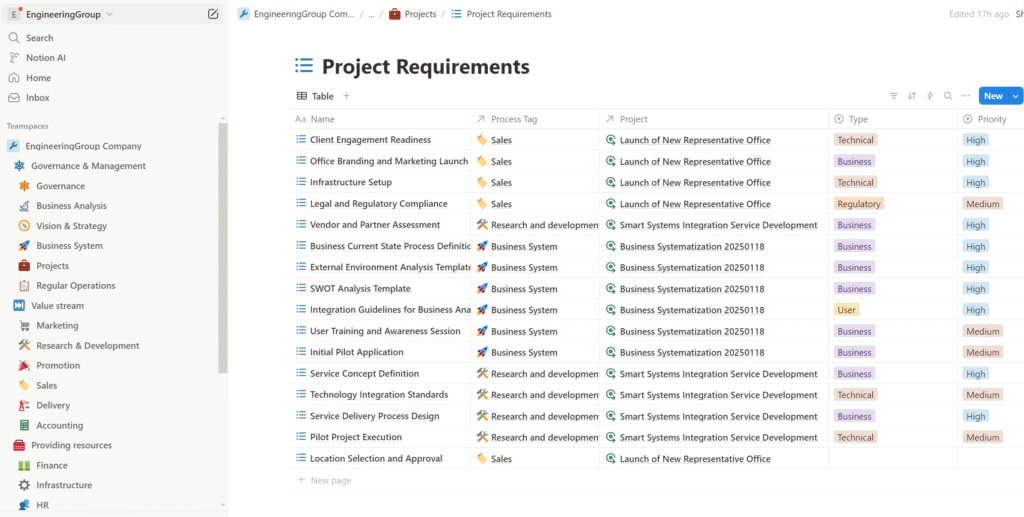
    4. Create Project Requirements database table
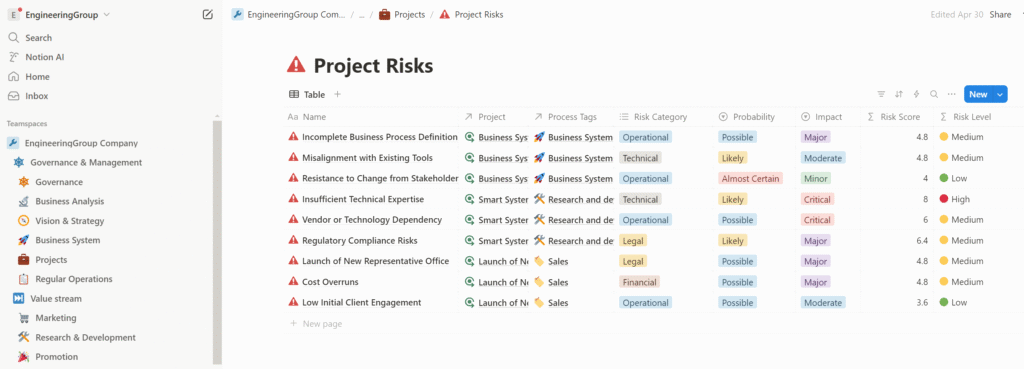
    5. Create Project Risks database table
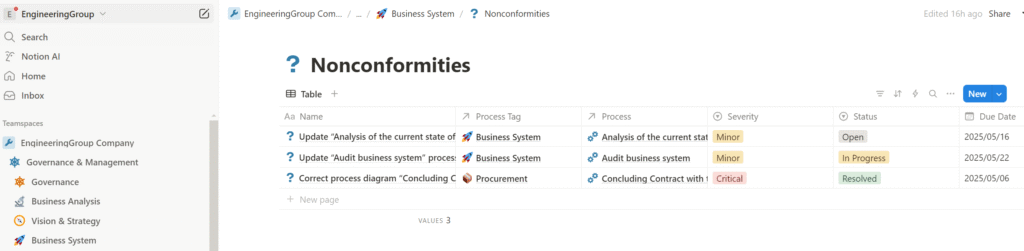
    6. Create Nonconformities database table
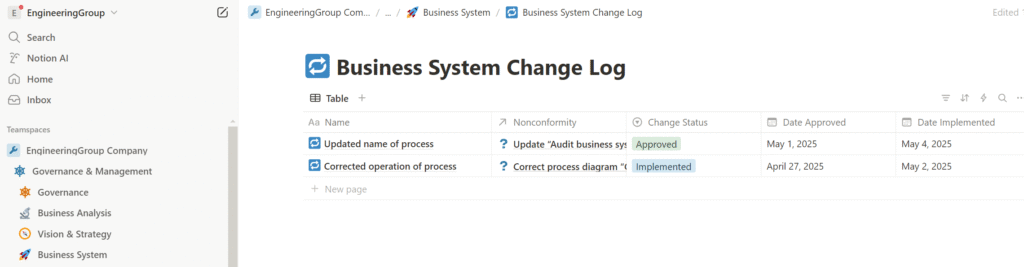
    7. Create Business System Changes Log database table
    8. Create Project Reports database table – optional table of project information to track project’s progress.
    9. Create Operation Reports database table – optional table to prepare and tracking operational reports.

    Benefits of Work Done

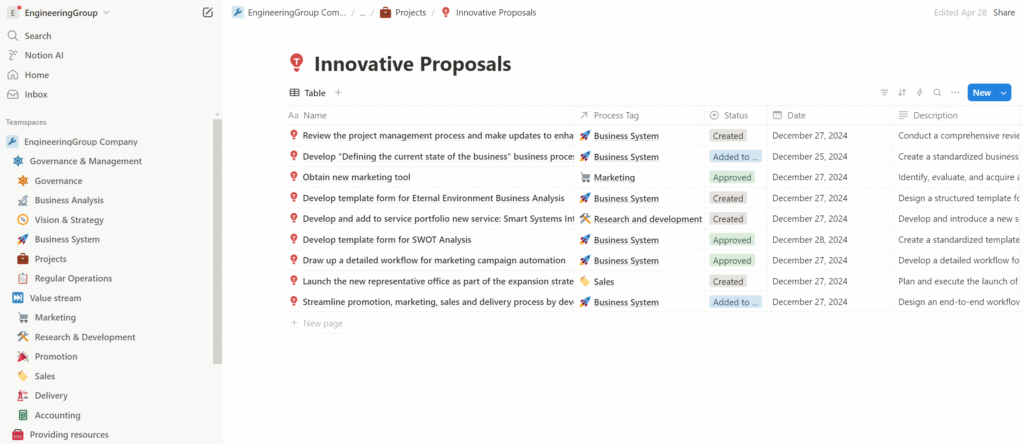
    Innovative Proposals Notion Database Table

    The ‘Innovative Proposals’ table is used to collect proposals on how to improve the existing business. Thanks to Process Tags, the ‘Innovative Proposals’ database becomes a universal tool that can be applied not only to systematization but to any aspect of the business — including new products, marketing tools, promotional campaigns, sales activities, and more.

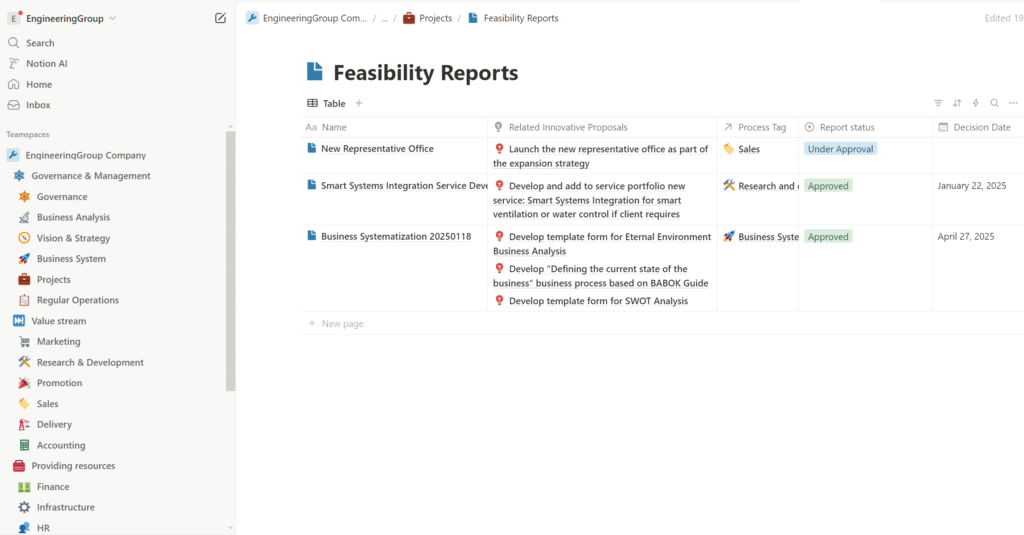
    Feasibility Report Notion Database Table

    The ‘Feasibility Reports’ table is used to group proposals and justify the feasibility of their implementation through development projects. It is linked to the ‘Process Tags’ table to identify the area of the future project, and to the ‘Goals’ table to clarify which previously established goals the project’s implementation is intended to support. Like the Innovative Proposals table, the Feasibility Reports table applies not only to the systematization of activities but also to the business as a whole.

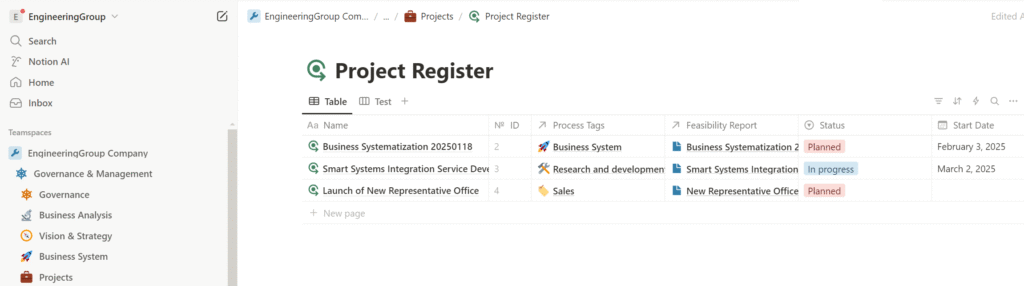
    Project Register Database Table

    The ‘Project Register’ table is used to manage all projects across the entire business and the data related to them. It links with Process Tags, Feasibility Reports, Goals, Project Requirements, Project Risks, and Project Reports to provide a comprehensive view of each project’s context, rationale, objectives, constraints, and outcomes.

    Project Requirements Database Table

    The ‘Project Requirements’ table is used to define, collect, refine, prioritize, and manage project requirements throughout the project lifecycle, ensuring alignment with stakeholder expectations and project objectives.

    Project Risks Database Table

    The ‘Project Risks’ table is used to manage all identified and documented risks by tracking their likelihood, impact, mitigation strategies, and status throughout the project lifecycle

    Nonconformities Database Table

    The Nonconformities Database Table is used to register, handle, and resolve identified nonconformities of the business system by documenting their nature, root causes, corrective actions, and resolution status to ensure compliance.

    Change Log Database Table

    The Change Log Database Table is used to register and analyze Business System changes, ensuring that all modifications are documented, evaluated for impact, and properly implemented to maintain system integrity and traceability.

    The Complete Set of Tools for Business Systematization

    Finally, a complete, ready-to-use set of tools supporting the business systematization process has been developed, ensuring continuous analysis, improvement, and development of the business system. It functions as a unified, cyclical mechanism that enables the business to evolve consistently, systematically, and cost-effectively, taking into account:

    • strategic vision and long-term goals,
    • initiatives from process participants,
    • changes in the external business environment.

    Project Management Tools

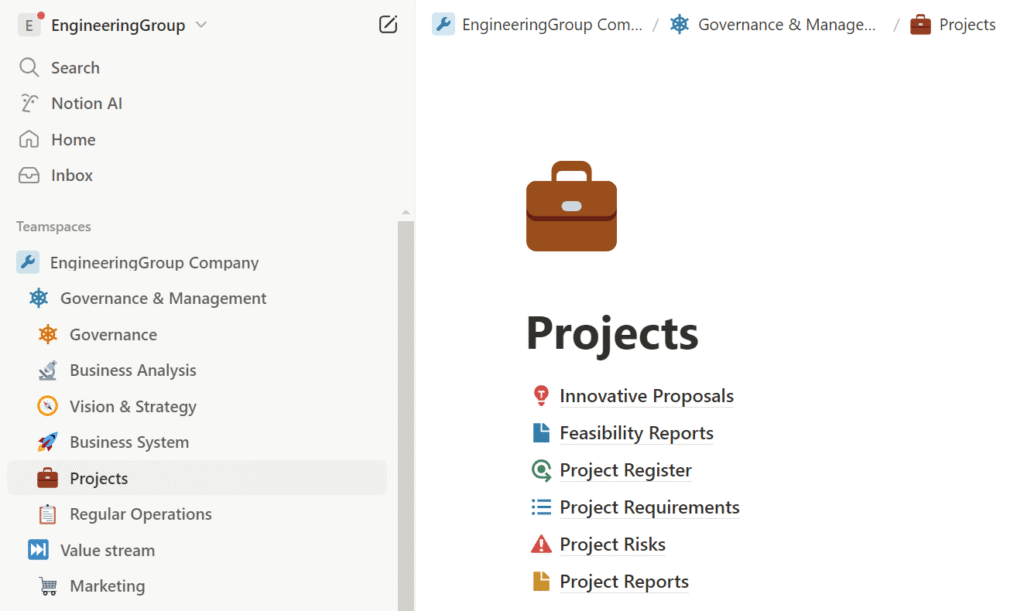
    Additionally, we have developed a set of project management tools designed to support not only systematization but the entire business. Unlike the business systematization tools placed in the ‘Business System’ section of the Notion workspace, project management tools are placed in the ‘Projects’ section according to the business process model.

    The Key Strategic Benefit

    The key strategic benefit of work done is that this systematization process model remains, on the one hand, simple and flexible, while on the other hand, it aligns with Level 5 (Optimizing) of the Capability Maturity Model Integration (CMMI). This provides the business with a number of advantages:

    1. Continuous Process Improvement
      • Organizations systematically identify weaknesses and strengthen processes.
      • Use of different business-analysis techniques ensures that problems are not just fixed, but prevented from recurring.
    2. Quantitative Decision-Making
      • Business and engineering decisions are based on data, not intuition.
      • Enables predictable outcomes in quality, cost, and schedule through statistical analysis.
    3. Innovation and Agility
      • Encourages the introduction of new tools, techniques, and technologies in a controlled and measured way.
      • High process maturity allows for faster adaptation to change while maintaining performance.
    4. High Customer Satisfaction
      • High reliability, predictable delivery, and consistent quality lead to stronger customer relationships and repeat business.
      • Organizations can offer clients customized improvements and better responsiveness.
    5. Operational Excellence
      • Reduced waste, rework, and defects through process optimization.
      • Higher productivity and lower costs over time.
    6. Competitive Advantage
      • Level 5 certification demonstrates world-class capability.
      • Often a requirement for large government or enterprise contracts, especially in defense, aerospace, and critical systems.
    7. Cultural Maturity
      • The entire organization is aligned around process excellence and learning culture.
      • Employees are empowered to propose improvements and are actively engaged in process performance.

    Summary and conclusions:

    In this article, we explored the development of the most optimal process model for building, developing, improving, and maintaining a business system. As a result, we arrived at a process mechanism that:

    1. Is universal, meaning it fits a wide range of businesses at any stage of development;
    2. Enables deeper engagement of the company’s personnel in business improvement activities, aligning with one of the key goals set by the business owner;
    3. Is fairly simple and flexible, allowing us to add certain operations and details to the described processes for more complex businesses—such as introducing audits to identify nonconformities—or, conversely, to simplify the process by replacing “Innovative Proposals” with simple “Ideas” and streamlining the development and approval of a Feasibility Report by replacing it with a “Project Candidate” for small businesses and startups;
    4. This process model for the life cycle of analysis, improvement, development, and support of the business system corresponds to the highest, fifth maturity level of the Capability Maturity Model Integration (CMMI) (Optimizing), meaning the business focuses on continuous process improvement.

    We have also completed the development of a full set of tools for business systematization and project management across the entire business. Now, we’re ready to move on to the fourth step: launching systematization and development projects to elevate the business to the next level.